Welcome to WordPress! This is your first post. Edit or delete it to take the first step in your blogging journey.
-
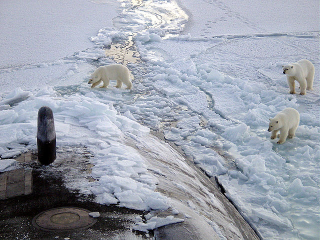 Near the North Pole, examining a submarine.
When we were getting ready to go to Antarctica, people warned us about polar bears. Polar bears, they pointed out, are fast, big, smart, dangerous. They are more inclined than other bears to view humans as fabulous taste explosions.
No, we said. We're going to the Antarctic, not the Arctic. There are no polar bears in Antarctica.
Oh yeah. Well, polar bears eat people!
During our stay, groups from our station occasionally visited passing cruise ships. The station manager and lab manager gave talks about the U.S. Antarctic Program. Then, Q & A for all of us from the station.
 They told you that was a bear costume?
The ship passengers knew they would not be seeing polar bears. But some asked why. Ice and snow everywhere – perfect polar bear country. Why no big white bears?
Here are my responses – after looking it up – to the Big Questions.
Are there polar bears in Antarctica?
You already know: no.Here's a way you might guess this from personal experience. Have you ever seen a photograph of a polar bear eating a penguin? Probably not. But if polar bears and penguins lived in the same place, there'd be photos. So far, no one's told me they've seen such a photo. Although there are zoos in this world, so who knows.
Why aren't there polar bears in Antarctica?
History! Really ancient history. There's a nice video by Sally Gillies that tells just how ancient. Basically, the bear family evolved in the northern hemisphere. As bears developed exciting new spin-offs (panda! sun bear! sloth bear!), some bears moved south. To this day, there are more bear species in the northern hemisphere than the south. The closest bear to Antarctica is the spectacled bear, which rambled south along the Andes. It gets no further down than northwest Argentina.
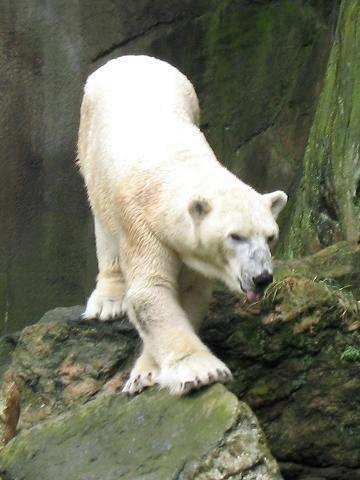
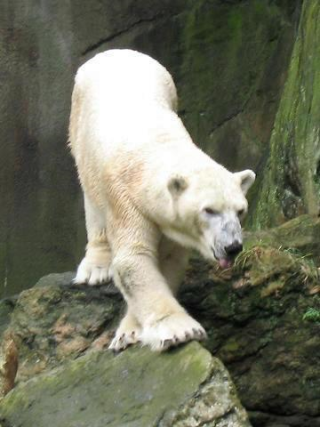 (In the Bronx Zoo.) Look at the size of those feet.
What with continents drifting apart and all, Antarctica is too far for a bear to swim. Up north, polar bears, who recently spun off from grizzly bears, had a smooth transition across land from warmer climates to icy ones. From there they could stroll onto sea ice. Or swim feasible distances.
So even if people weren't making life very difficult for bears (ask the extinct Atlas bear of northern Africa), and they were free to explore new niches, it'd be a long time, if ever, before a bear got far enough south to be selected for Antarctic living. And when we talk about people making life difficult for polar bears, the biggest factor is climate change.
Should there be polar bears in Antarctica?
No. You've heard that things are getting bad for polar bears. Because of Arctic warming, they're losing sea ice to hunt from. Habitat is melting out from under those huge furry feet.
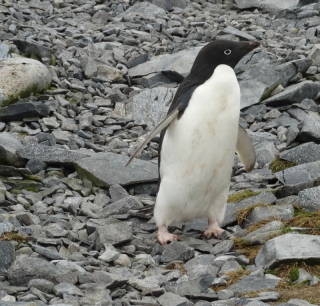 Plate tectonics? What does that have to do with me?
You know somebody somewhere is thinking maybe polar bears could be transplanted to Antarctica. Sure, climate chaos is happening there, too, but for now there's still sea ice. Assisted migration! What could be bad?
Ask any penguin what could be bad. They will say “Awwwk! I see no problem! Awwwk!” That is because penguins are stupid about land predators. When early explorers brought sled dogs to Antarctica, penguins would walk up to the tethered dogs. “Awwwk! What's your story, furball?” The dogs would tear them to pieces. More penguins would walk up. “Awwwk! Are you new kids?” The dogs would tear them to pieces. More penguins would walk up. “Awwwk! Can I touch your fur?” And so on.
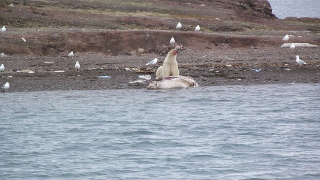 In the Svalbard Archipelago, eating a walrus. Gulls stand by ready to help.
Polar bears could devastate penguin colonies. In fact, polar bears are already turning to northern bird colonies. They're trying to survive by eating prey so small they previously didn't bother with them. Lots and lots of eggs.
So yeah no. Polar bears are an unpredictable bunch. Antarctic wildlife is also subject to the grievous insults of climate change. They don't need rapacious northerners on top of that.
Carpetbaggers, stay away!
 Bears? Sure, bring 'em on. There's plenty of room. What ARE bears, anyway?
 -
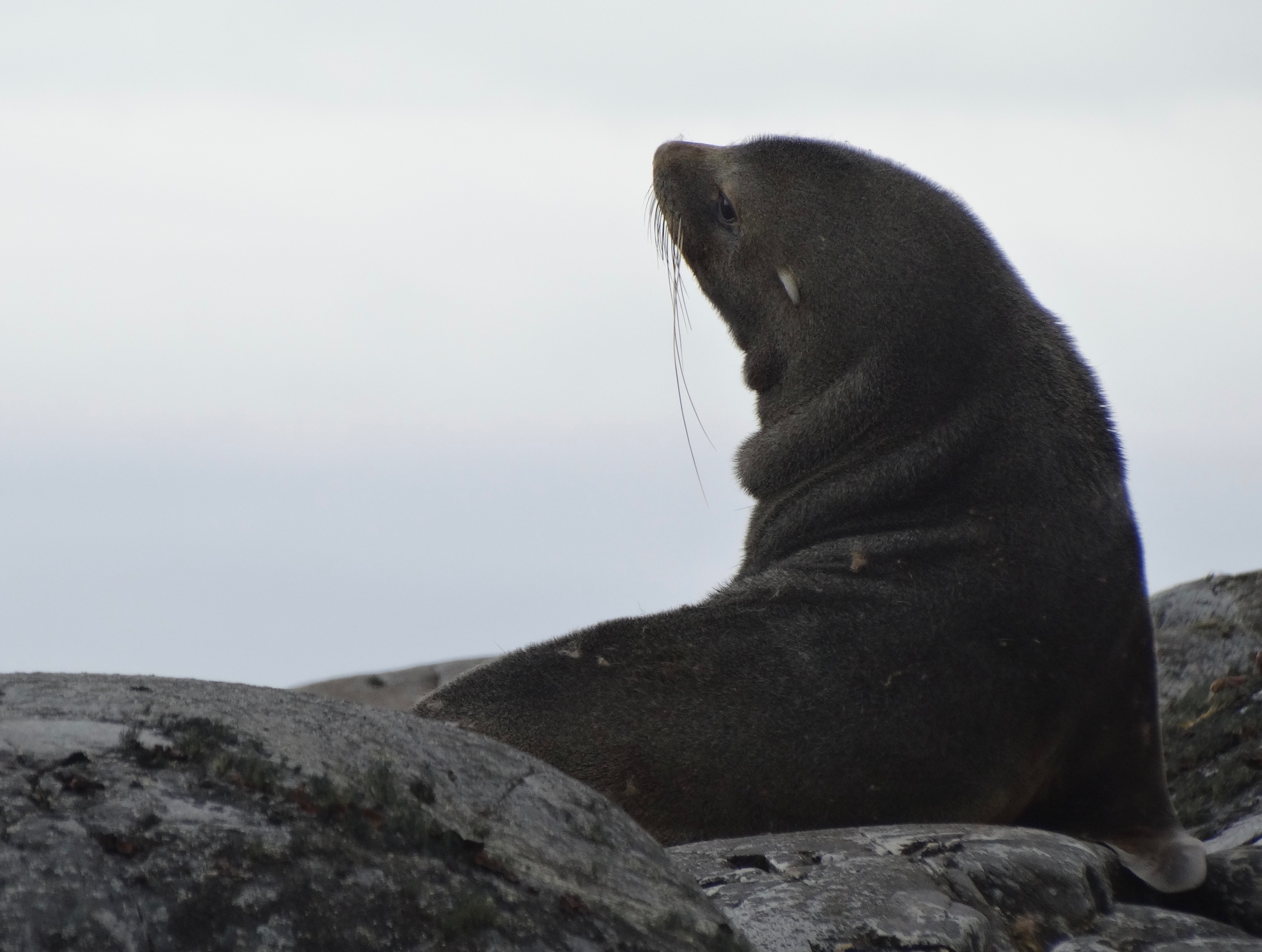
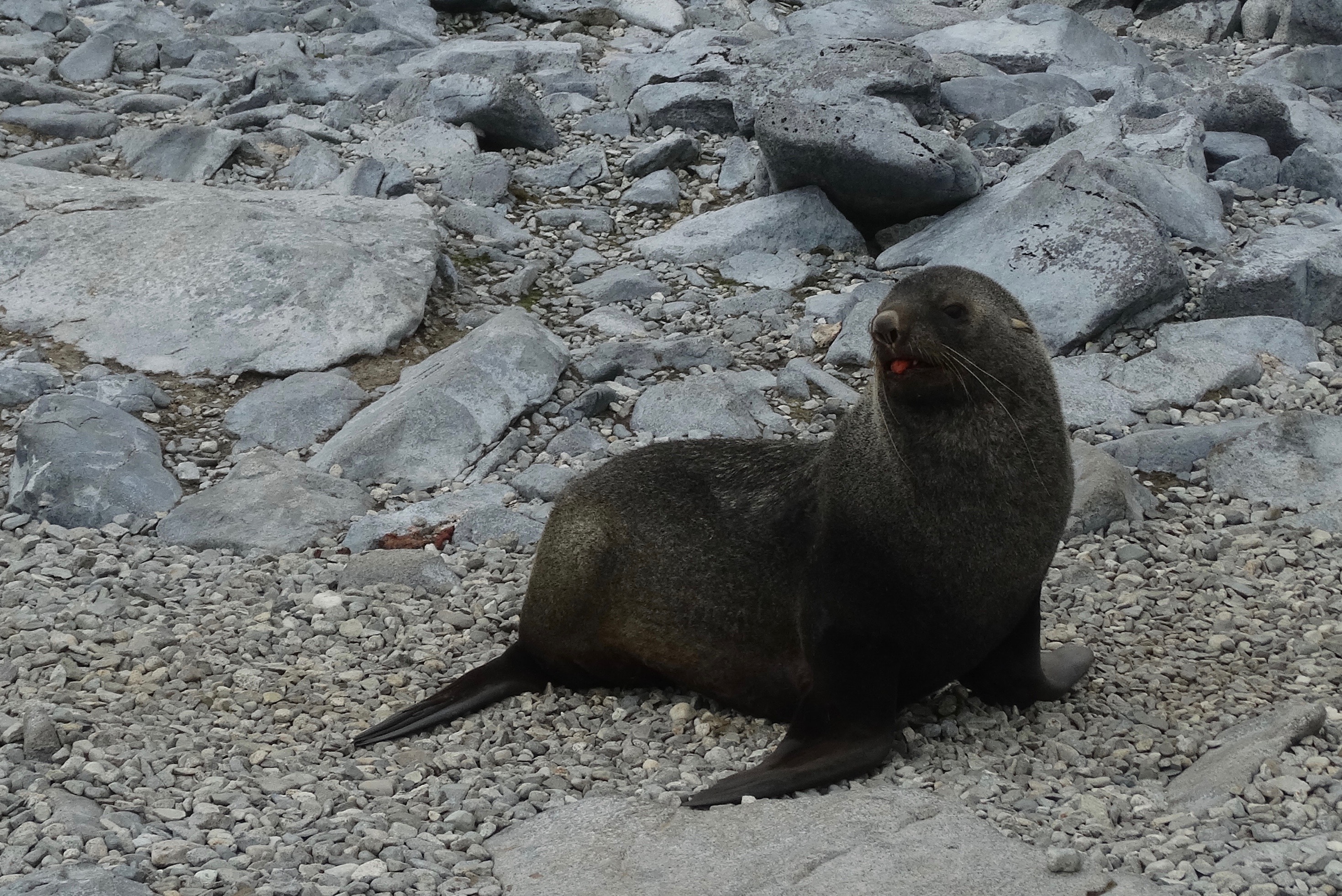
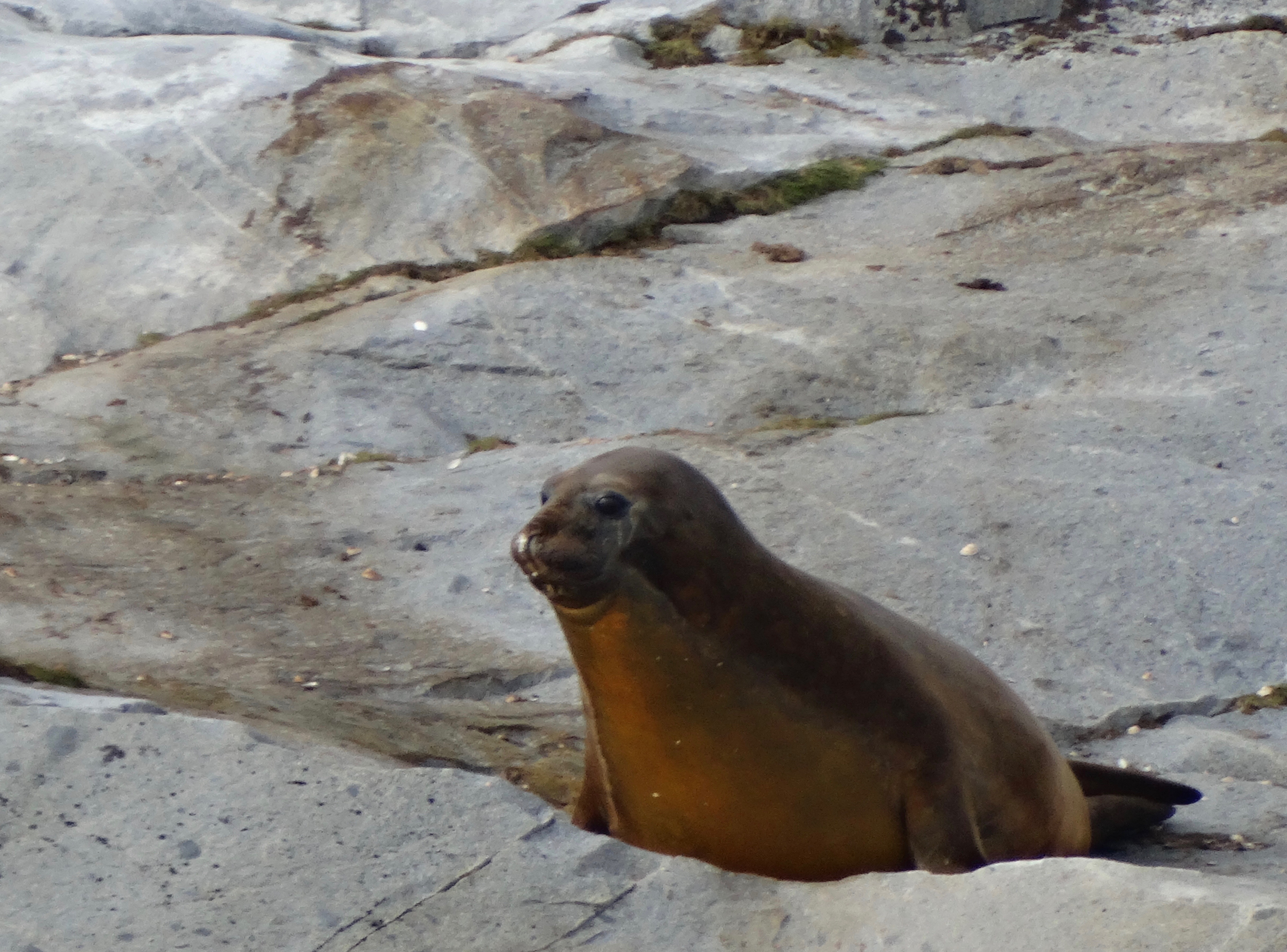
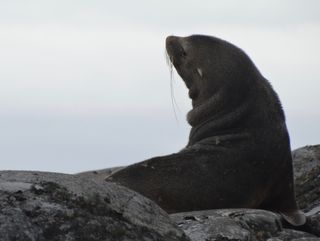 Antarctic fur seals (Arctocephalus gazella) started arriving in late January. At first just a few. Some people saw one. Others hoped to see one. More and more showed up, and soon everyone saw them. They're mostly subadult males. Teenagers.
I worried about them because many seemed skinny. Eat more krill!
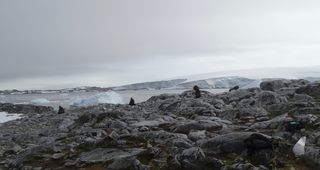 They're eared seals, in the family Otariidae. If you do crossword puzzles, you'll want to know that an eared seal is sometimes called an otary. I have never heard anyone say this word.
Seeing any Antarctic fur seals was rather thrilling. They were driven toward extinction by American and British sealers in the 18th & 19th centuries. (Fur collars and coats.) They were slaughtered as fast as possible, without pause until the sealers couldn't find any more.
One person who helped obliterate those seals was Nathaniel B. Palmer, who was a sealer for two decades, starting in 1820. He was co-discoverer of this and that in the Antarctic Peninsula and subantarctic islands, places he explored in search of new sealing grounds when fur seals had been wiped out at the old ones. In the early 1840s Palmer switched to the express freight business. Palmer Station is called after him. For the exploring part.
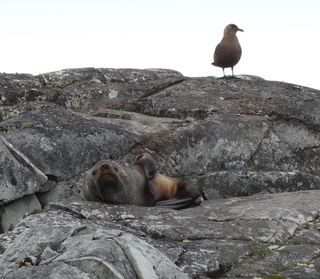 By 1900 it seemed people had succeeded in killing every single Antarctic fur seal. A single one was spotted in 1916. They killed him.
In 1931, a small breeding colony was found on Bird Island, with a few hundred seals. Weirdly, no one killed them. Now there are estimated to be a few millions. Having multiplied from so few individuals, they've been through a serious genetic bottleneck, which probably leaves them susceptible to epidemics. I couldn't find pictures of their massive breeding colonies, probably partly because most of those areas are protected and hard to get to, and partly because they made the PR mistake of breeding near king penguins.

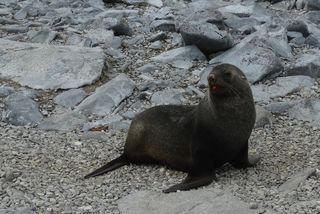
Now that there are so many fur seals down here, we encounter them more often. We usually see them lying on rock or snow on the land, not on ice. Unlike the elephant seals they don't lie in piles. They space themselves out, increasing the chance that as you are politely circumventing seals A, B, and C you will annoy seal D. Seal D will speak about this before you stumble on him. He may growl, or he may whimper like a puppy. He may charge at you.
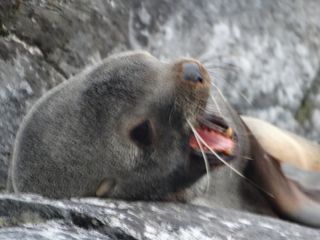 The word is that fur seals are ferocious. We stay back, for our sakes and theirs. There's a few-years-old story of a tourist nearby who had to be medevac'd out because of a serious fur seal bite. (We don't know what happened, so we don't know how to apportion tourist/seal blame.)
It's true they have surly attitudes. It's hard to guess how many of those charges are bluffs. You should be able to stay far enough away and show sufficiently respectful body language so they don't charge at all. Everyone here knows how to behave around them, and there have been no close calls.

Their bad reputation makes the whimpering very creepy. Imagine a dog whining and whimpering before it attacks.
When they're not being annoyed with human beings, they're often annoyed with each other. The growling and whimpering and charging are directed at other teenage male seals. They snap and snarl and insist that no one gets too close. I suppose they're practicing for adulthood at the breeding grounds, when each will hope to drive other males away and monopolize the presence of as many females as possible.
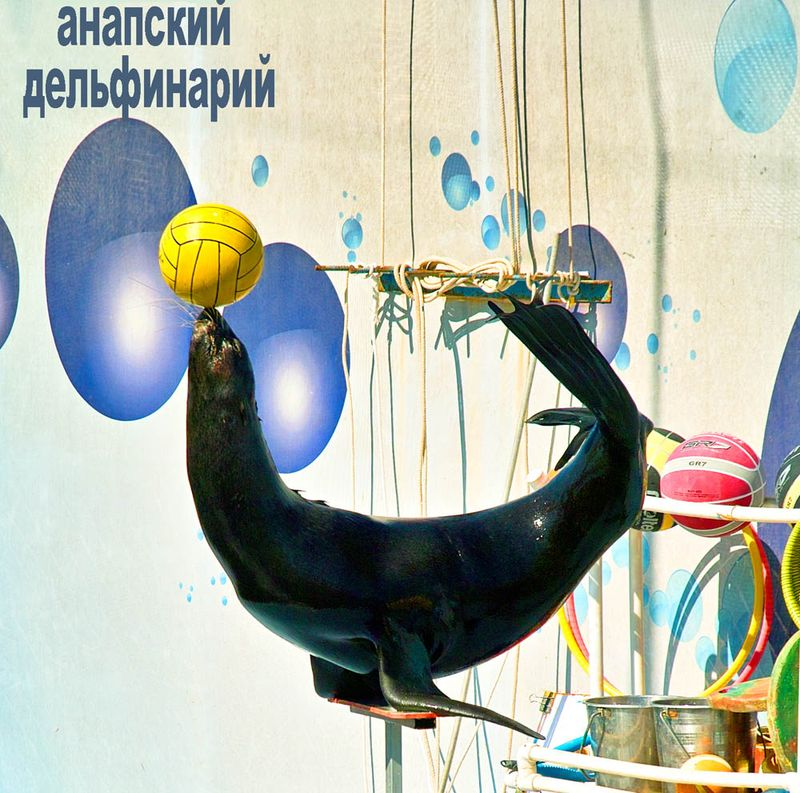
When they're not engaged in ugly little squabbles, they're elegant and showy. Long whiskers, long flippers. They look as if they could balance a beach ball. If they chose to demean themselves.
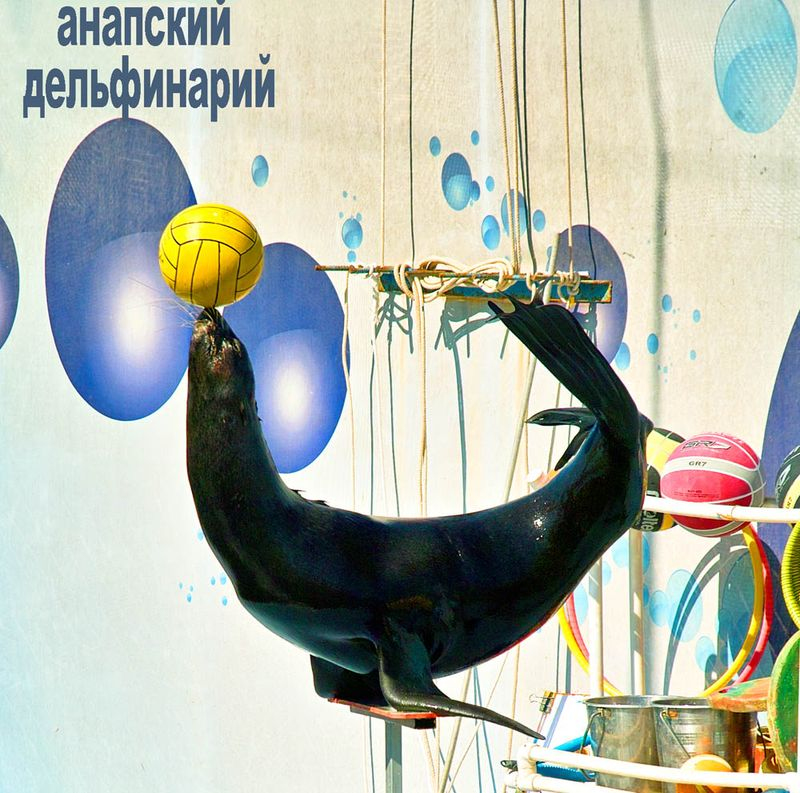 An otary public.
 -
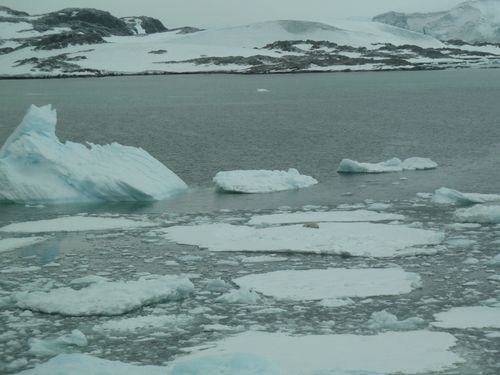
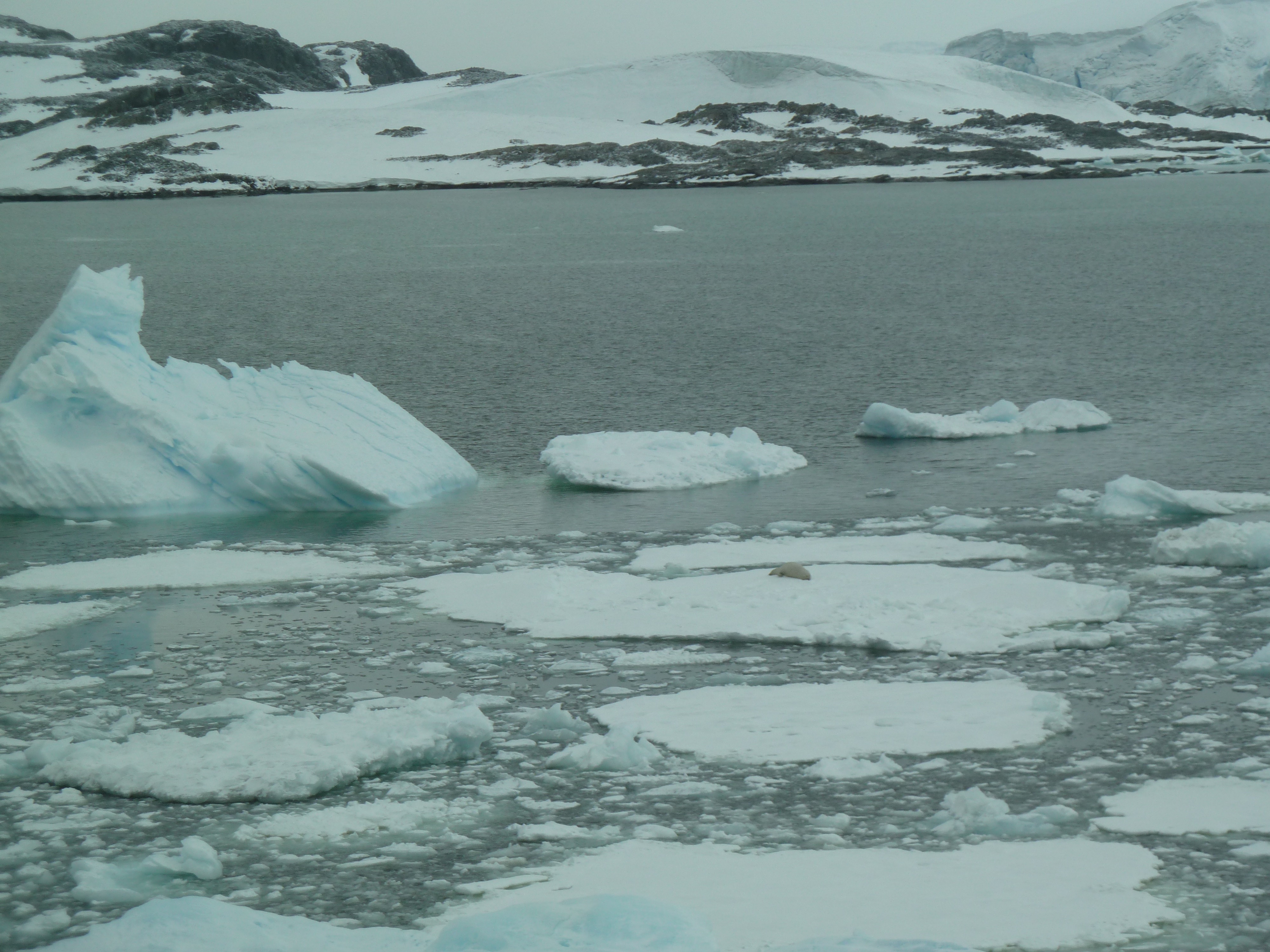
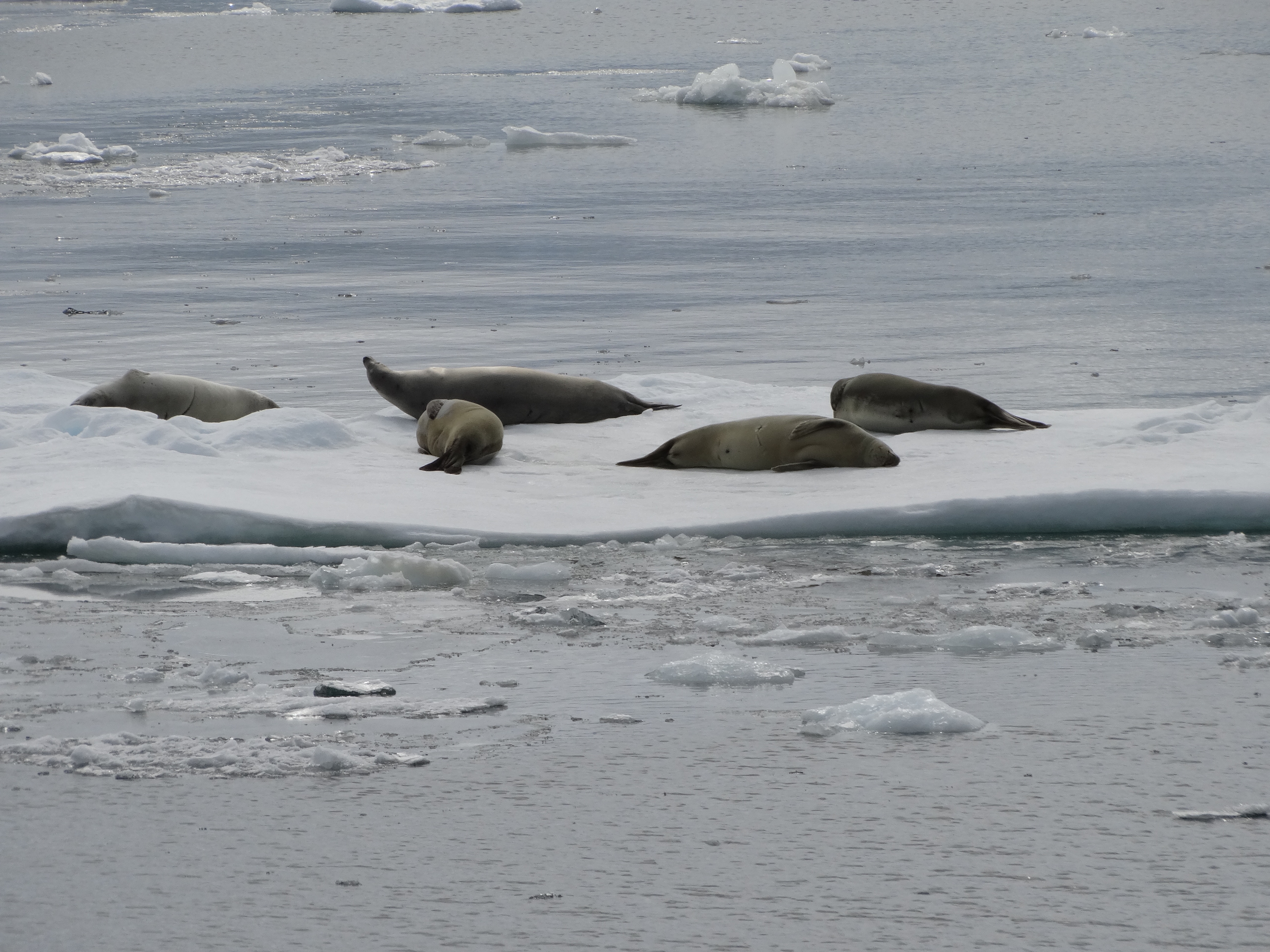
Crabeater seals mostly eat krill, not crabs. People here generally call them crabbies. Or Lobodon carcinophaga.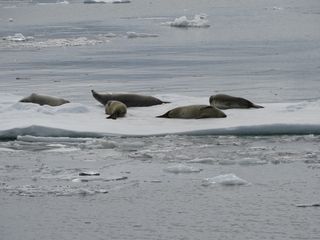
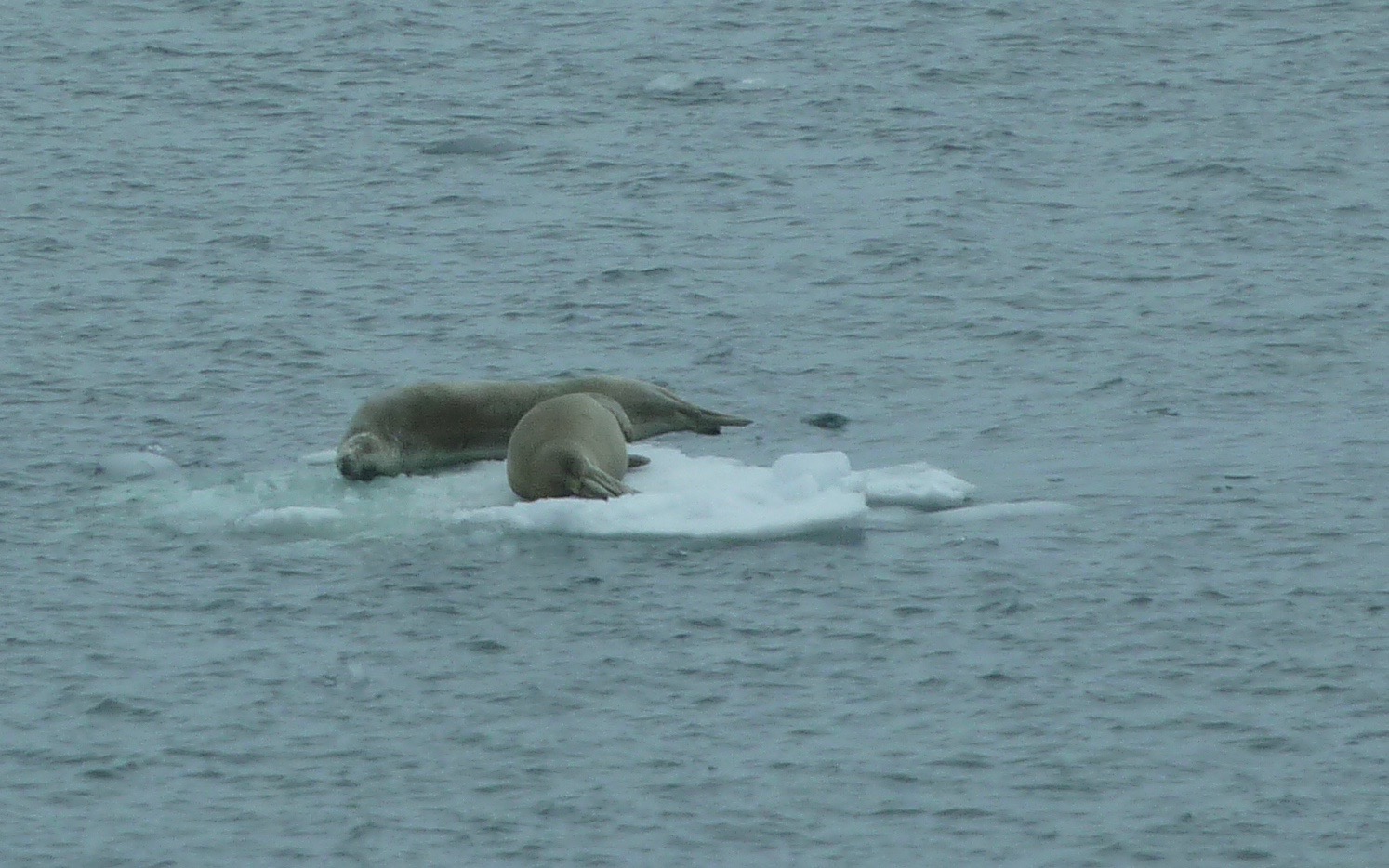
In November and December, crabeater seals were around in modest numbers. Typically lying on cakes of ice. It was a crabeater lying on ice that we saw being menaced by orcas.
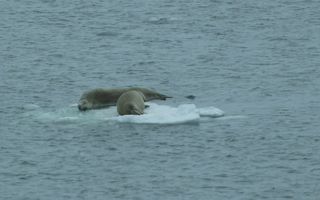
Sometimes they'd be on bits of ice barely large enough to support them.
They make a nap on ice look lovely.
Clip131 from Susan McCarthy on Vimeo.
They seemed to like to lie together, but not piled on each other, not quite touching. Not in elephant seal heaps. My colleague Terri Nelson remarks on their “stoned smiles.”
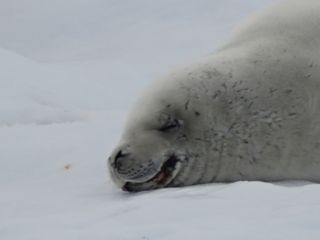 Crabbies are pointy-snouted individuals, with long soft-looking flippers like suede opera gloves.
In early January, crabbies suddenly appeared in the area in large numbers. One day the bird researchers, going from islet to islet surveying bird populations, kept rough track, and saw 450-500 crabbies lying around.
 Occasionally a sheathbill would land on a floe, studying a crabbie for food possibilities. Crabbies often manifest horrific injuries, apparently from leopard seal attacks.
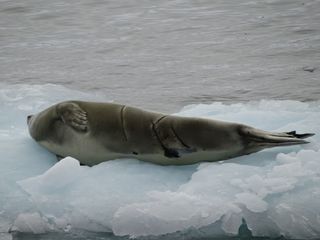 Crabbies don't spend all their time dozing and stretching. It's hard to be sure in this video snippet taken at a distance from a moving Zodiac, but I think these are crabeater seals traveling at a medium rate of speed.
P1030213 from Susan McCarthy on Vimeo.
Yet I think their best talent might be the sleeping.
-
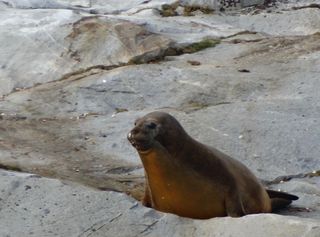
Tons of seals here. When I arrived in late November, the seals around were mostly (southern) elephant seals and crabeater seals. Recently fur seals and Weddell seals have shown up. All along there has been the occasional leopard seal loner.
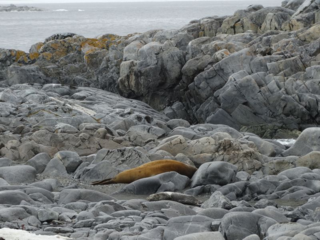 Big brown elephant seal, small spotted Weddell seal.
All the seals enjoy getting out of the icy water and lying on the relatively warm snow or land. They bask in air that's ungratefully cold to us. Many seals take the view that what Palmer Station residents believe to be a boat ramp is better thought of as a seal ramp.
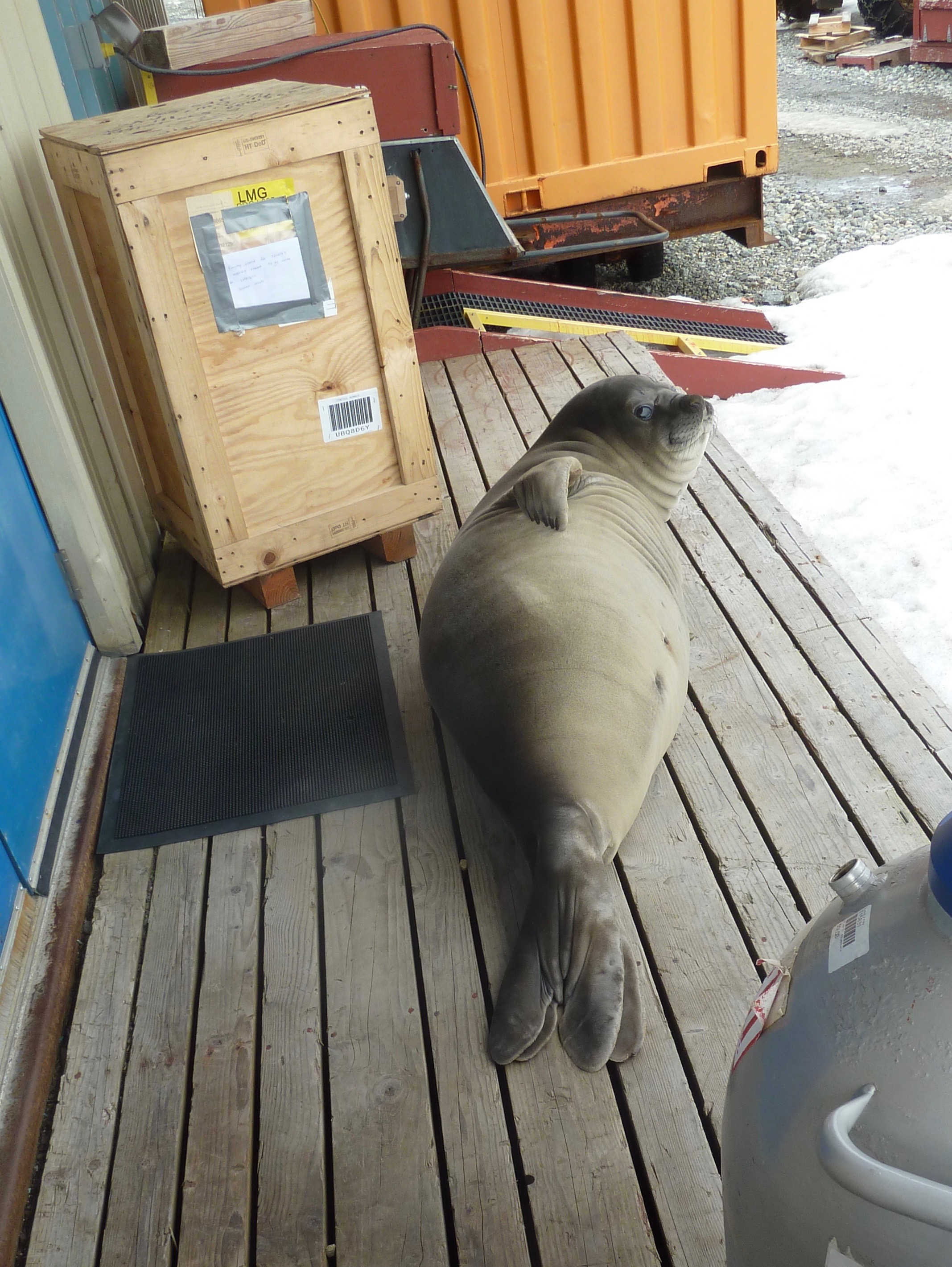
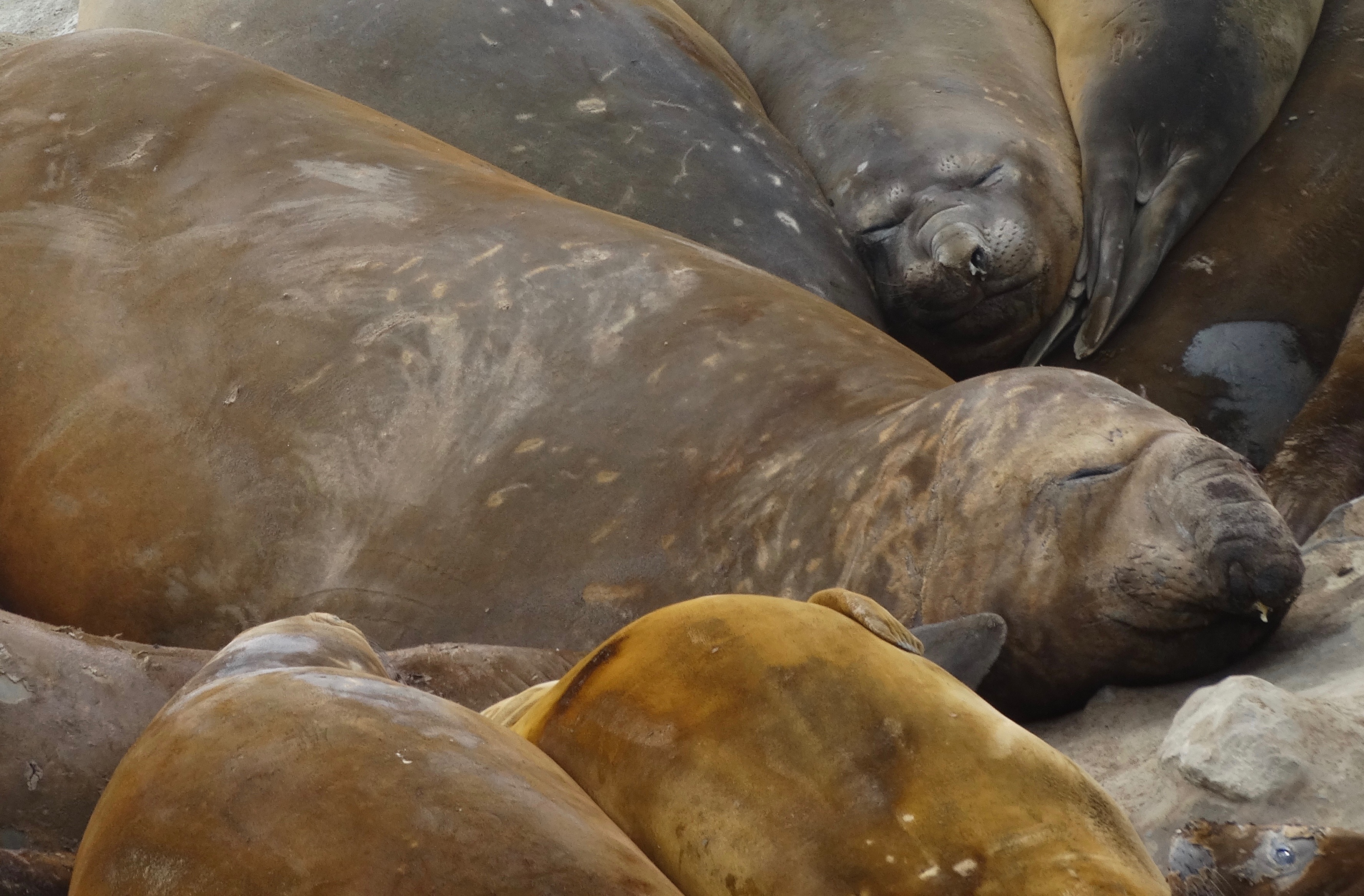
The first seals I got a good look at were elephant seals. (People here call them ellies or, more recently, e-seals.) Young elephant seals are charming. Their fresh new skin is unscarred by predators or by fighting with other elephant seals. They seem wistful, like they miss their mothers. Like they wouldn't mind hanging out with us for company.
 A few young elephant seals came to the station, and liked snuggling up to doorsills, presumably because some warmth radiated from under there despite the weatherstripping. We liked them.
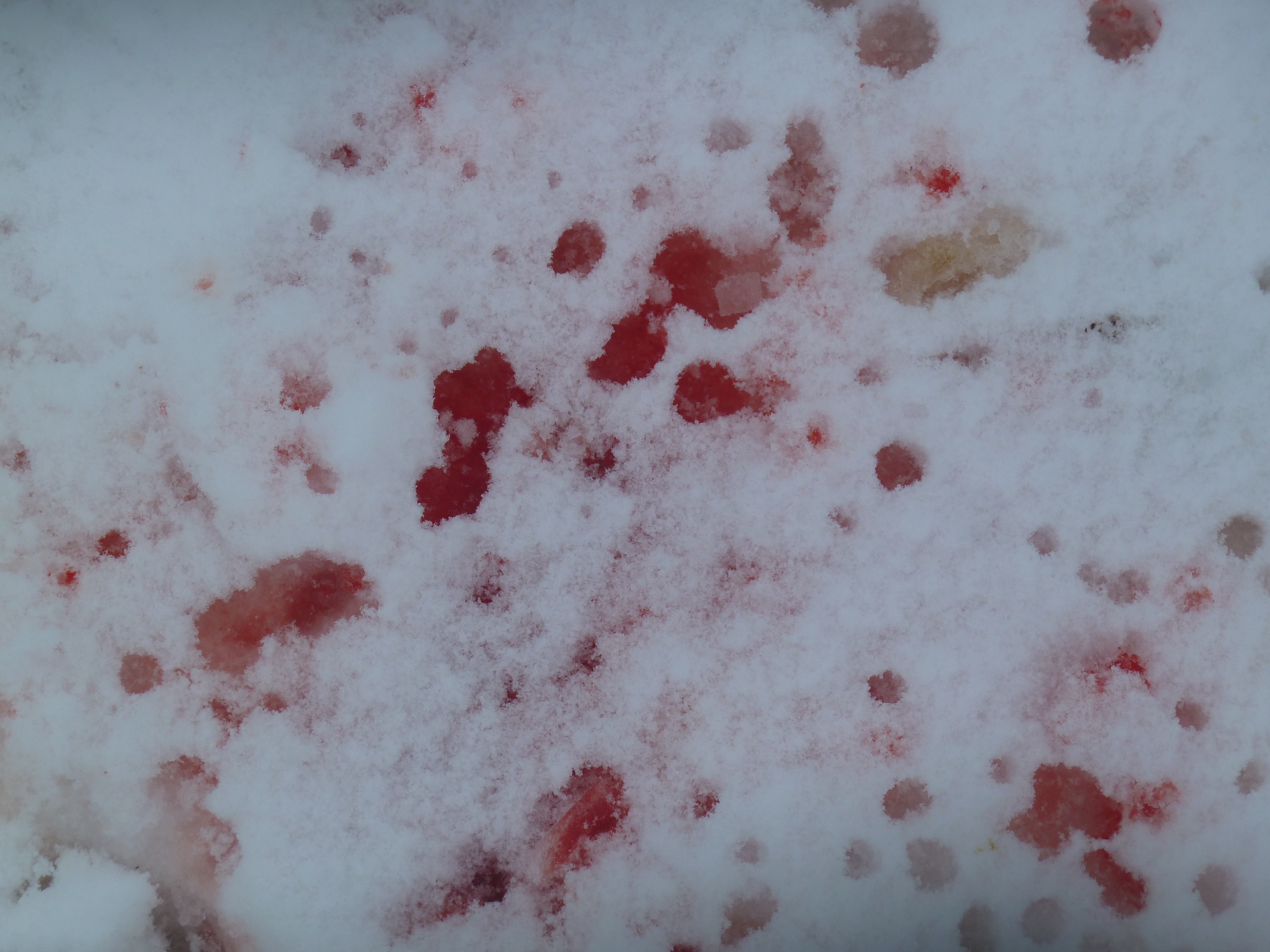
Soon their big gnarly cousins started arriving. They were scarred, shedding, combative. They uttered fart-like cries. They humped up the boat ramp and collapsed in big piles that looked snuggly until one of them woke up and randomly bit another one and they started fighting. (Blood on the snow! The sheathbills loved this.)
Clip54 from Susan McCarthy on Vimeo.
Less charming. Also the more elephant seals, the stinkier. Most importantly, the boat ramp was needed for launching boats, so science teams could go forth and gather data. The seals had to be persuaded to get off the ramp. This involved moving
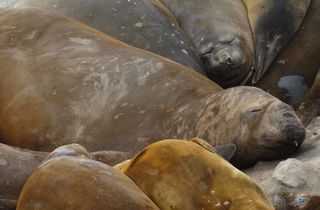 slowly toward them holding up tarps. They resented this, and roared and waved their heads around. Maybe the tarps, held high, made them respond as if to a Godzilla-sized elephant seal, because they would leave. Roaring and griping all the way.
Five minutes after a boat launched, they'd be back. Eventually a barricade was put up across the ramp. It was moved aside to launch a boat, then immediately replaced to keep seals from coming up the ramp again.
 The elephant seals finally got the message, and moved their cuddle-and-chomp parties across the inlet. Their roaring and belching carries well across the water.
We miss the kids, though.
-
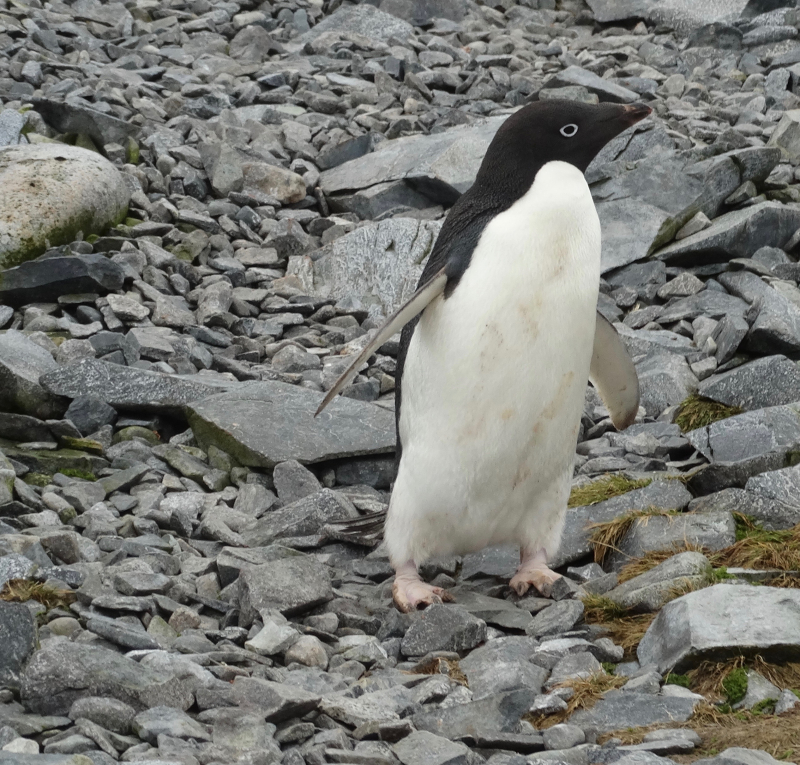
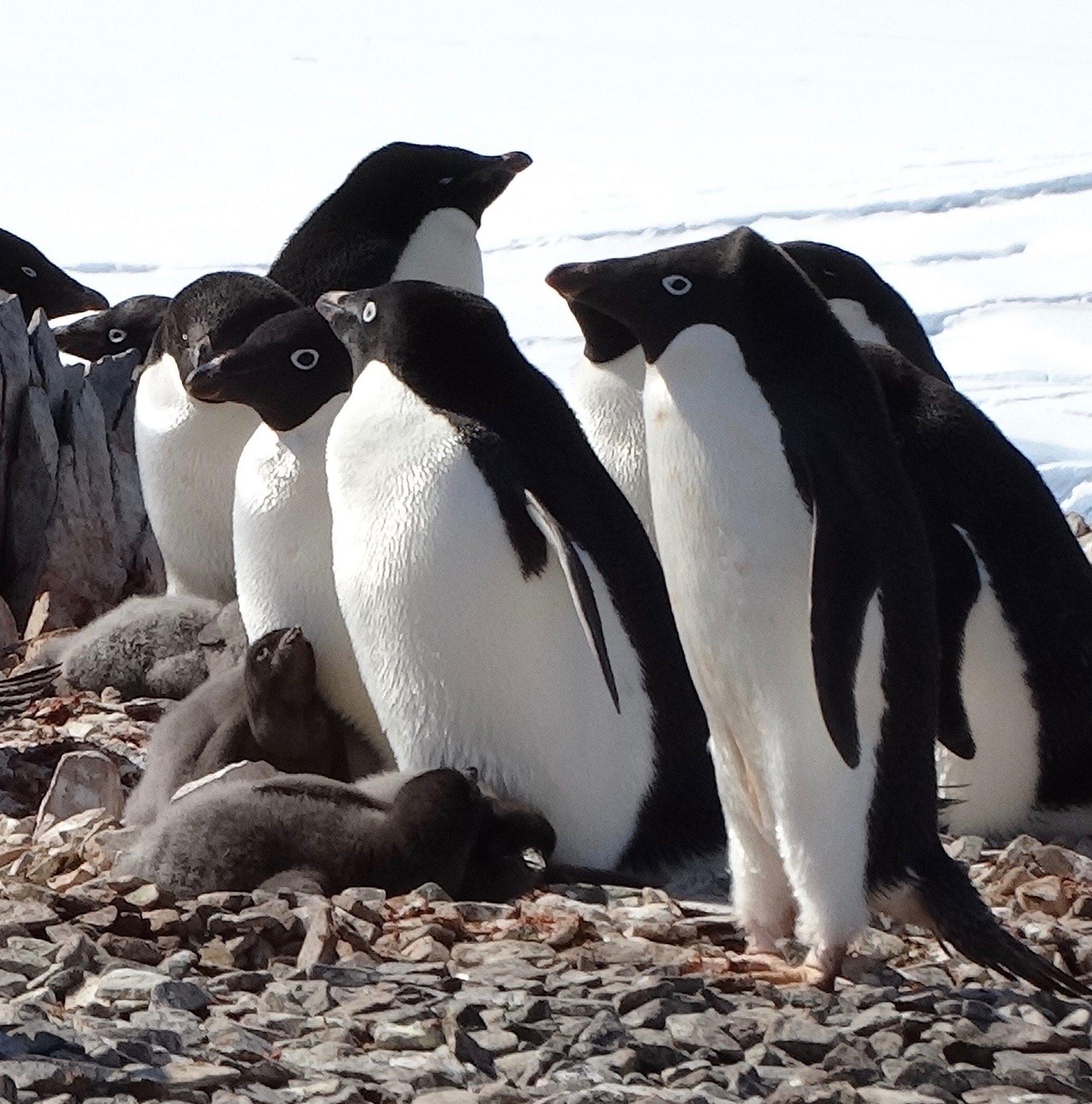
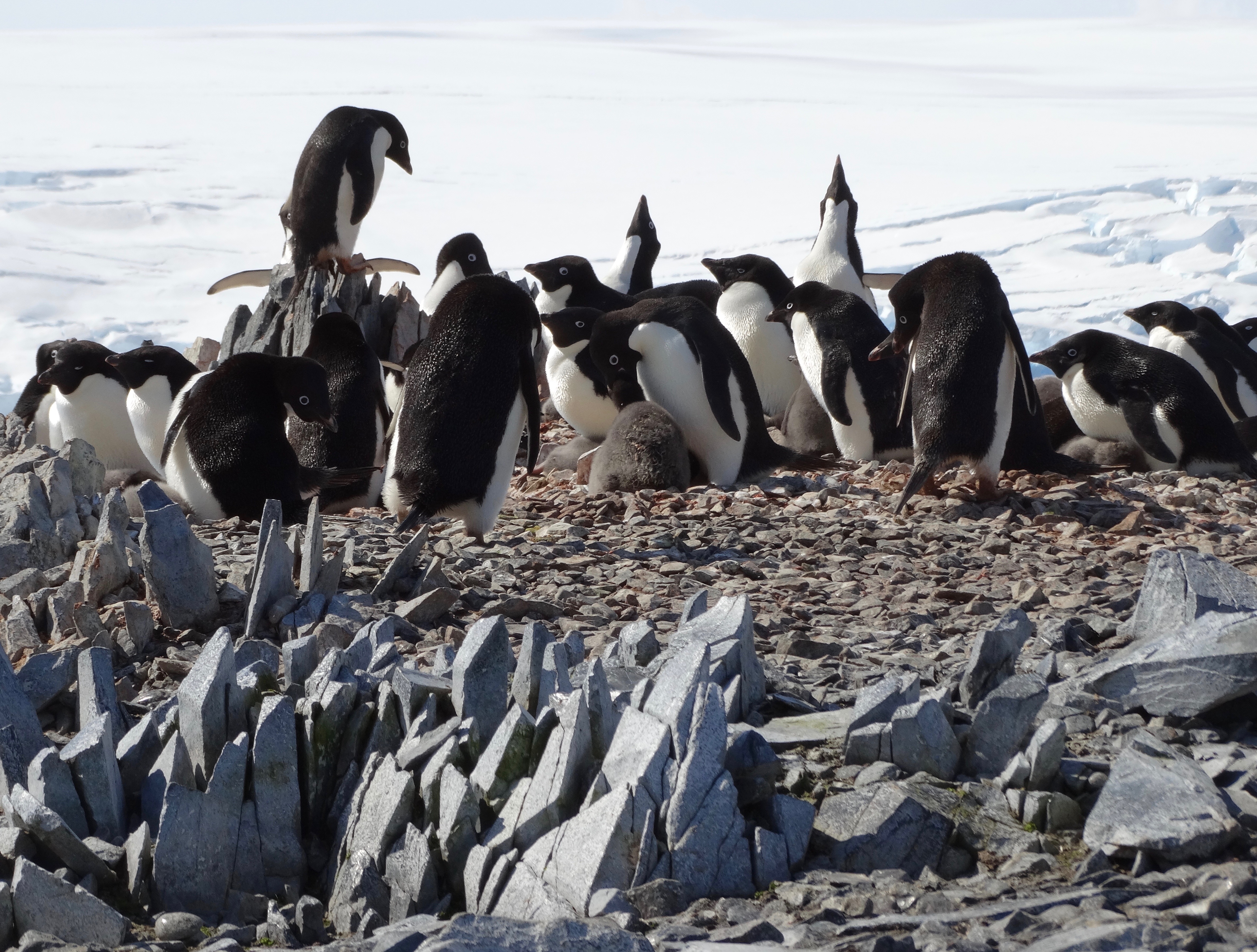
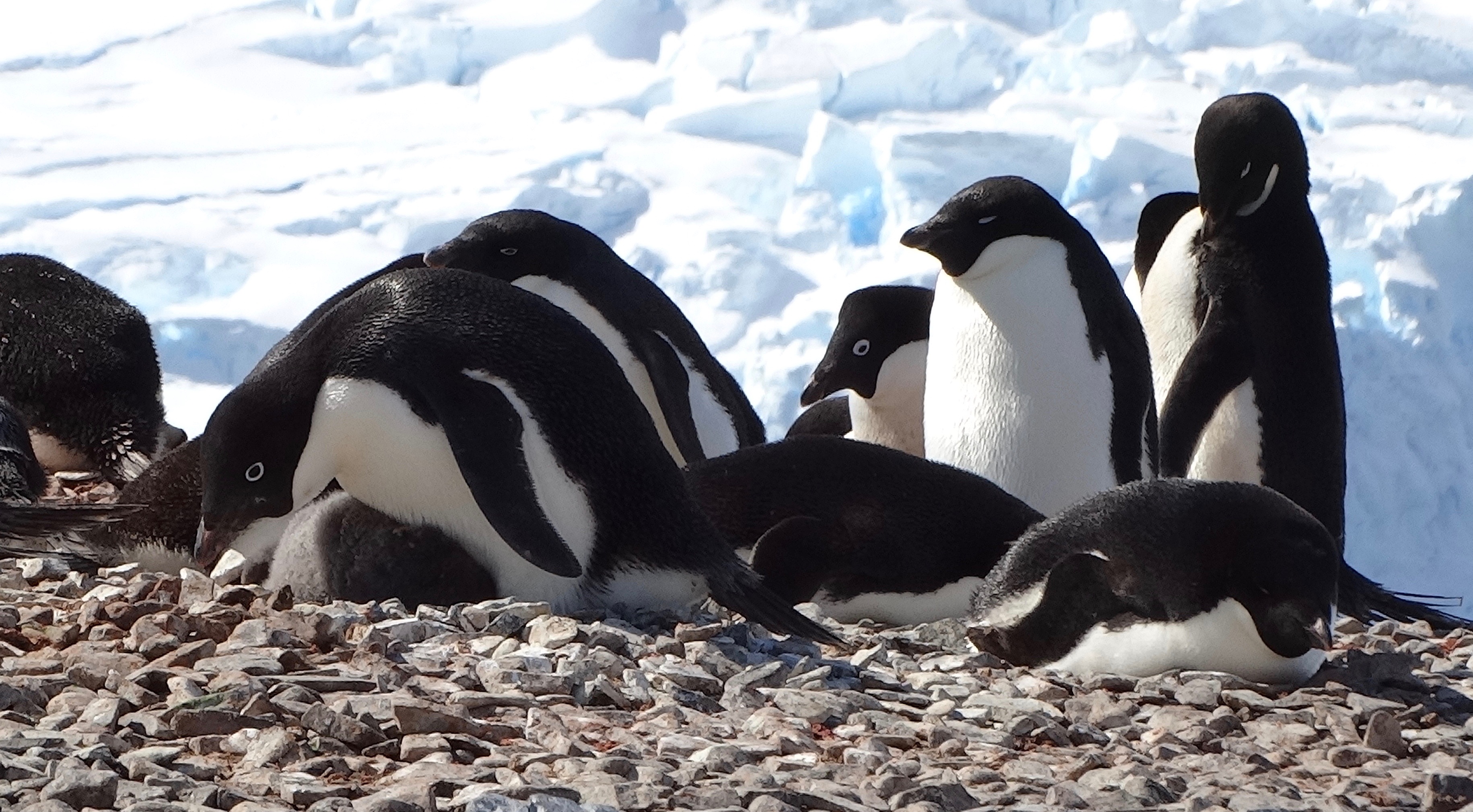
Grownup Adélie penguins look sharp.

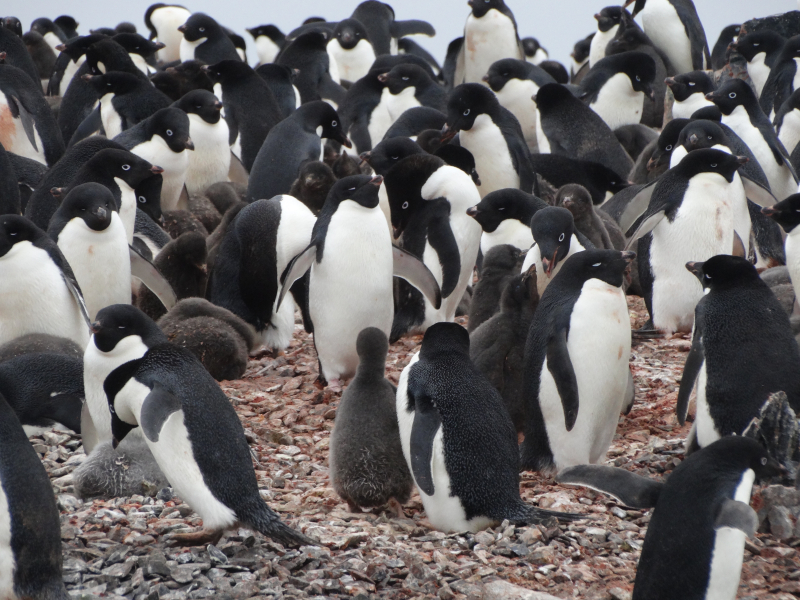
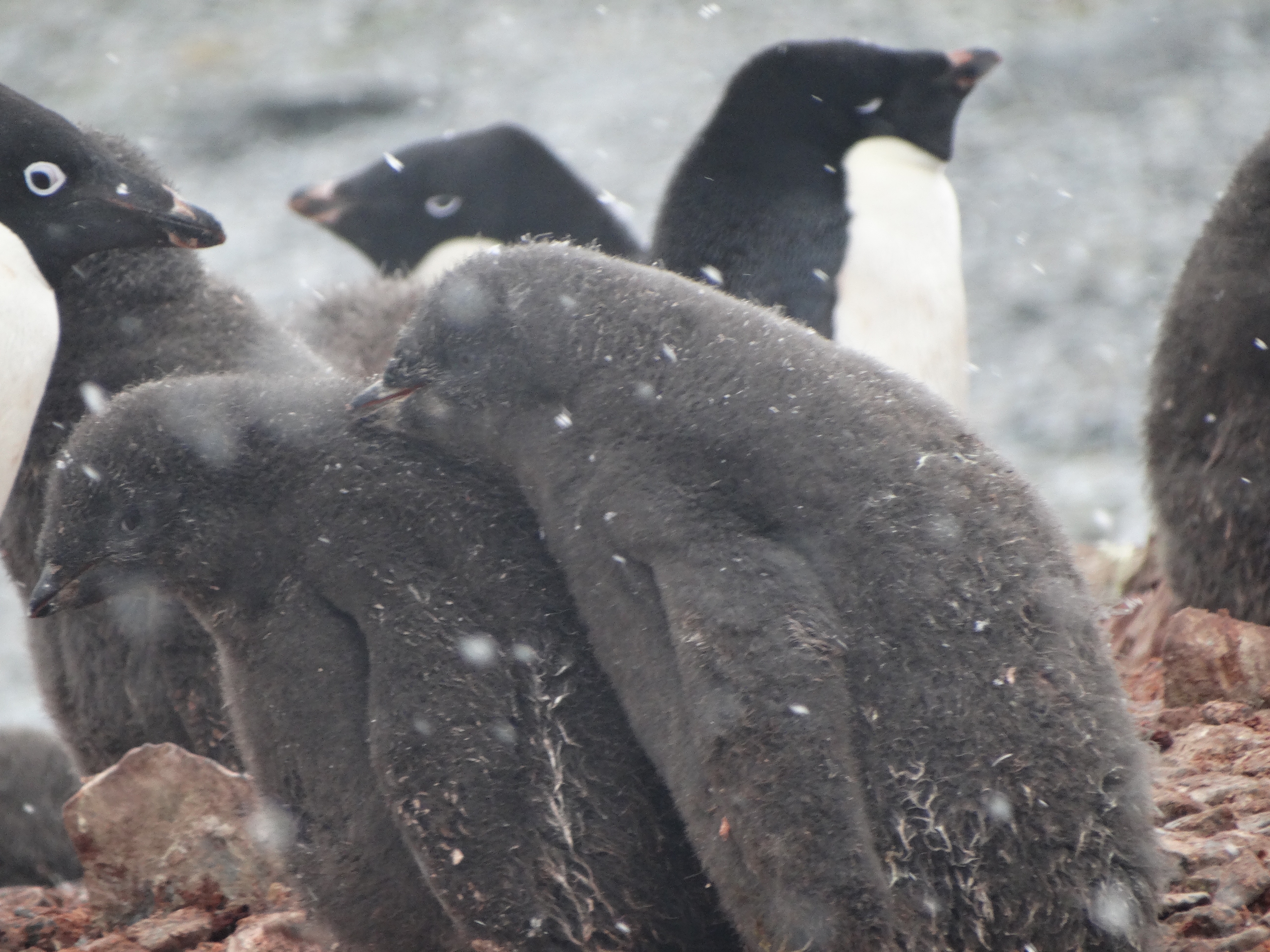
A young Adélie is covered with uniform dark-gray fuzz the color of an average rock. It is also shaped like an average rock. When it's tiny it is under its mother's or father's warm pouched-out stomach. When you first see them it's as if the parent was sitting on one or two large gray fur eggs.
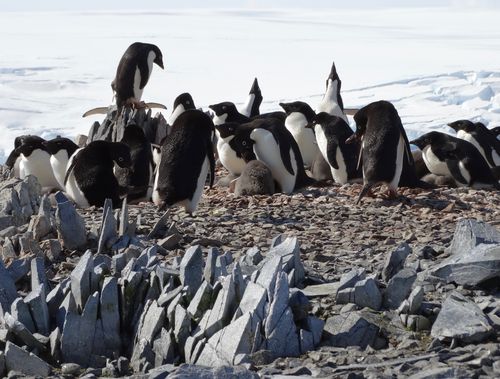
It grows fast. When it's a little bigger, it lies on the ground and stuffs its head underneath its father's or mother's warm stomach.
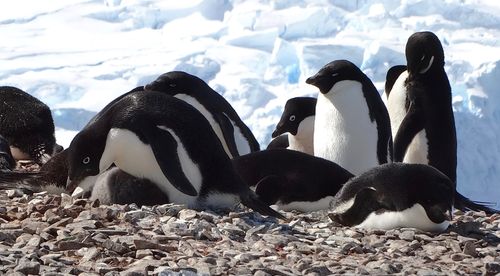
It keeps growing fast. Soon it can't even hide its head under its parent and it has to stand around. It may huddle against a parent or against another gray fuzzy chick.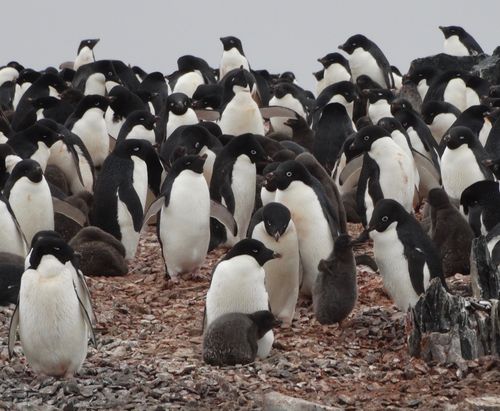
If it snows, they might catch snowflakes. I think this must be the way they'll catch krill when they're older.Clip128 (1) from Susan McCarthy on Vimeo.
(It's cold.)
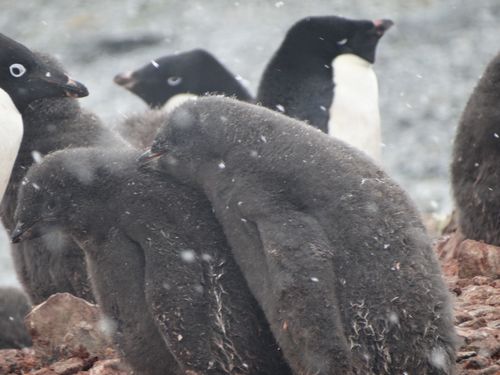
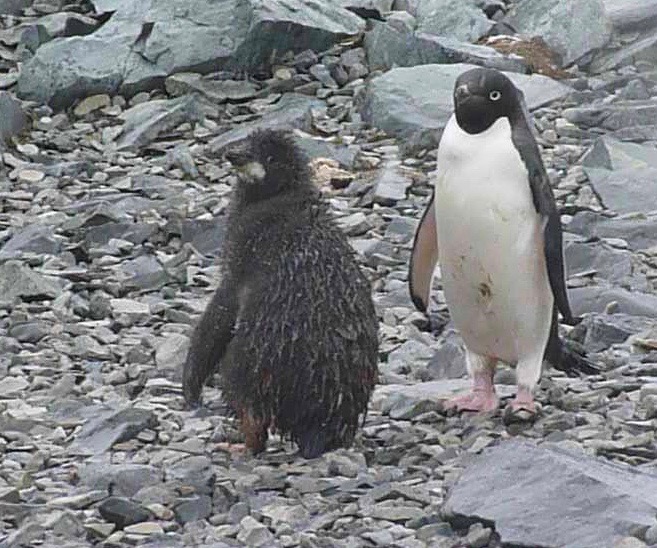
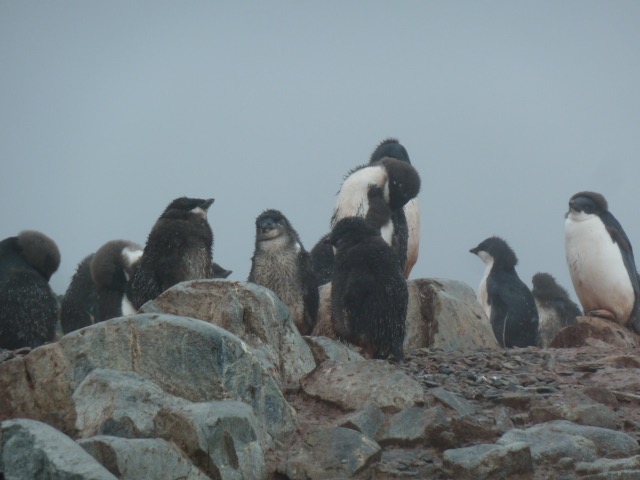
Now it's not growing bigger so much as it's growing a suit of legitimate penguin plumage underneath the fuzz. When it has the right outfit it will be able to swim underwater in the icy sea and not get soggy or chilled. In the meantime it stands around on the rocks amid puddles of guano.
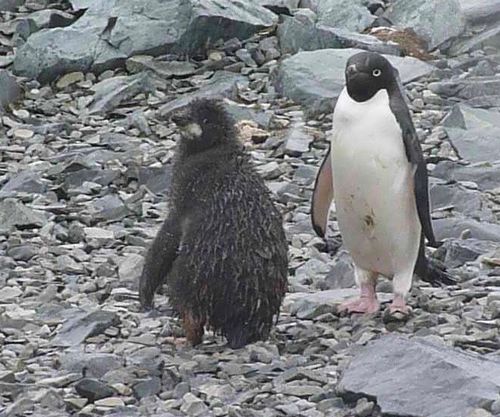
It needs to get rid of the fuzz by preening it off. This produces a patchy piebald creature with tufty places where the fluff hasn't been preened off. Often filthy as well as patchy.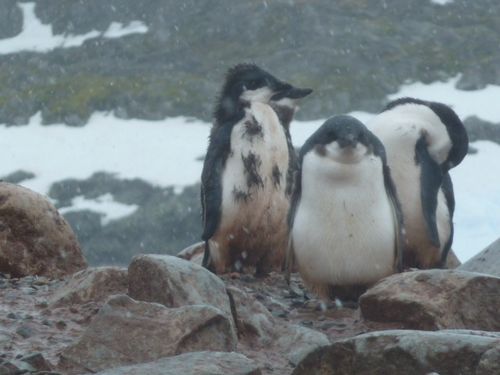
The places that are hard to reach stay fuzzy longest. The back. The top of the head. Perhaps the pride.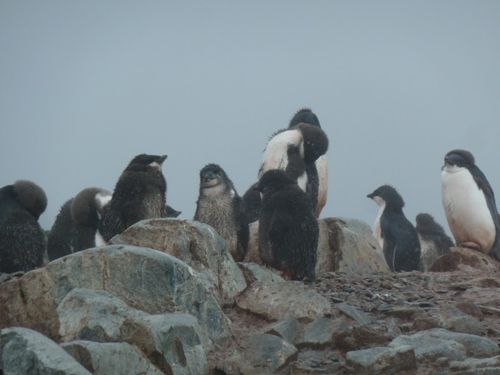
Kid. Hang in there.
-
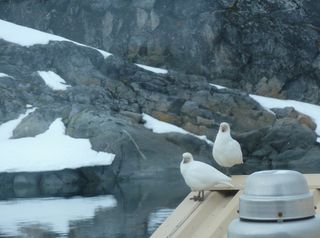 When I got to Palmer Station in late November, the sheathbills were rushing around in mated pairs. They did everything together, foraging, resting, hopping, tweaking elephant seal tails.
Often, they would break into a ritual we-are-partners display. Sometimes they'd mate.
P1020318 from Susan McCarthy on Vimeo.
They seemed to delight in each other's company. They seemed to be having fun. It looked like a honeymoon time.
Later, when nesting began, it was suddenly different. They could rarely be together. They had to schedule. One would be on the nest, and the other would race around solo until it was time to trade places. (Father and mother sheathbill each brood the eggs.)
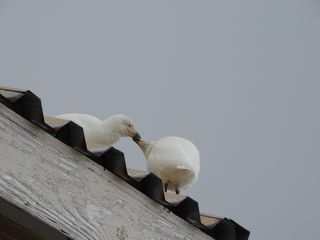
There's a webcam at one nest that allowed us to see an interesting thing. Sometimes when they switch off at the nest, they just switch off. Other times, they start doing the partner display, and then run excitedly out of the nest together. Fifteen or twenty seconds later, one races back into the nest chamber at top speed, only braking to lower itself tenderly on the eggs. They spend a little intense time together, but no more, because the eggs mustn't get too cold. A flash date night.
Chicks will probably hatch very soon. That will keep them even busier.
We have to leave before the austral winter. Reports are that sheathbills aren't seen in pairs in the winter.
Sheathbills haven't been studied to see if the same birds pair up every spring/mate for life. My guess is that they usually do, like other birds who seriously bond and raise chicks together.
P1020149 from Susan McCarthy on Vimeo.
Birds like that are interesting. Like many human couples, they fall in love, they have a time of double happiness, then a time of family togetherness…. And again next year, if both live.
If it's true they aren't together in winter, then it's interesting to imagine them going through the romantic cycle many times. Falling in love again, being a cute couple going dancing again, setting up house again, dancing attendance on the chicks again…. I could watch these birds all year.
P1030443 from Susan McCarthy on Vimeo.
-
Before coming to Palmer, we knew that sheathbills are ingenious seekers/thieves of every possible scrap of nourishment, and that seals are one source of opportunity for them. We'd read of sheathbills eating bits out of seal poop, snipping off scabs and dead tissue from seal wounds, and even of sheathbills snatching milk from the nipple of a nursing seal.
Thus no surprise when, during a period when Southern Elephant Seals suddenly decided that the station's boat ramp was the ideal place to relax, practically a spa, sheathbills gravitated to them and were seen plucking at them in a way the seals did not appear to appreciate.
esealandsbClip35 from Susan McCarthy on Vimeo.
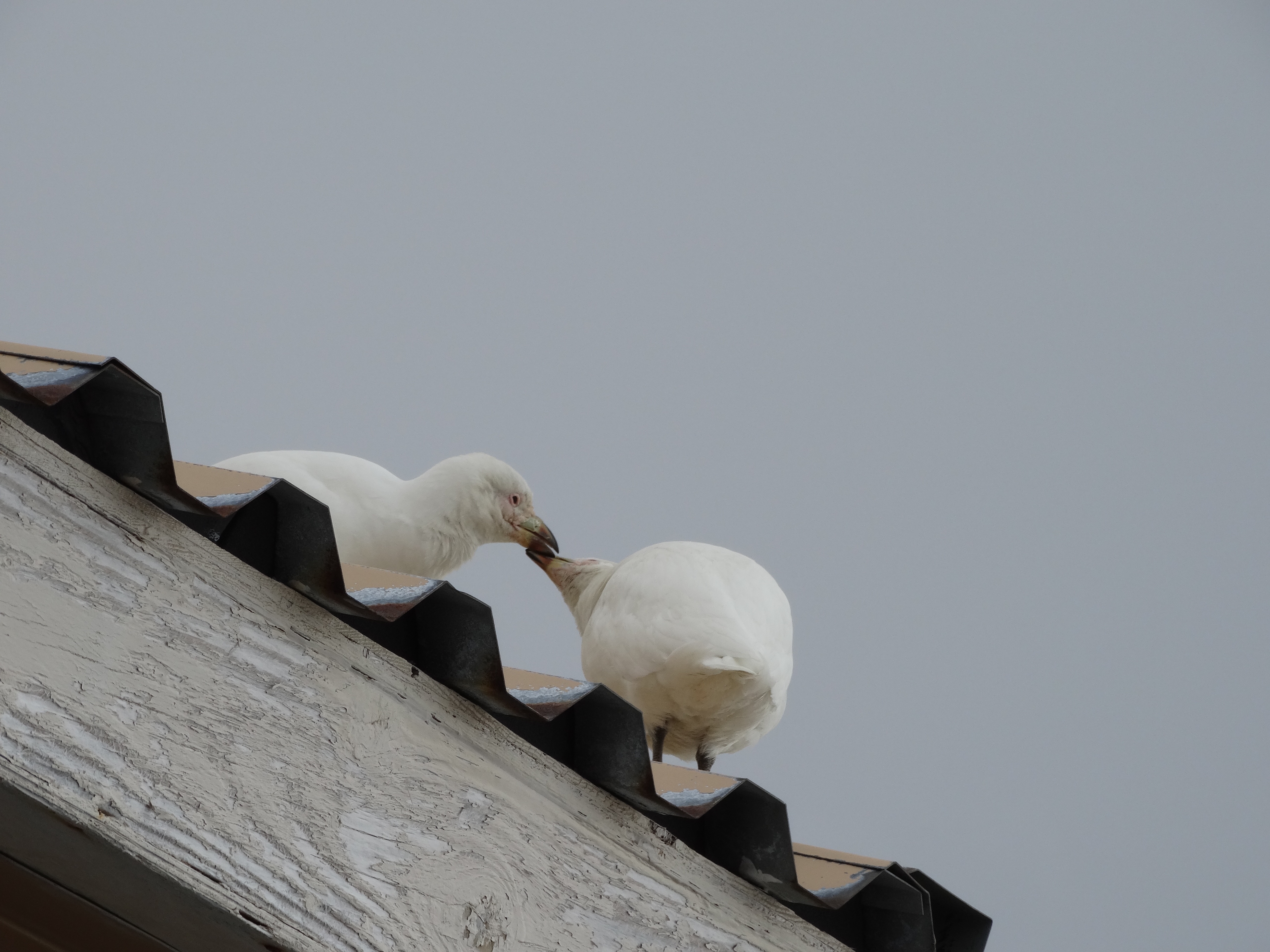
But it began to seem like more of a discrete thing, a phenomenon worthy of naming and studying. It began to seem as if sheathbills and elephant seals had a relationship that was somewhat similar to the relationships corvids – ravens, crows, magpies, jackdaws, jays, etc. – have with larger animals. The classic example is ravens tweaking the tails of wolves at a kill. This may make an angry wolf spin around, giving another raven a chance to run in and grab something.
All kinds of corvids do this, to all kinds of animals, as in this Youtube compilation. (Other videos and photos in this post are by me.)
Corvids are a famously smart group of birds. Other kinds of birds, including parrots – also famously smart – don't seem to. (I may be wrong about this, but my quick scientific survey of Youtube videos doesn't reveal parrots using their bills on tails of other animals.)
But the sheathbills of Palmer Station do. (I'll bet other sheathbills who are around seals also do.)
lastClip93 from Susan McCarthy on Vimeo.
What good does this do them? I'll start with the corvids. This is a behavior where I think it's useful to separate ultimate and proximate causes. The ultimate cause is the one that benefits the genes and causes natural selection to benefit the possessors of the genes: ravens who tease wolves get more food. More of their babies survive.
Ultimately, when a raven pulls or tweaks a predator's tail, there's a significant chance the predator will move. Maybe it'll turn and go after the raven, and that raven's mate will be able to steal food. Basically, if they create a disturbance, there may be opportunity.
The proximate reason is the one that actually motivates an individual raven. Which might be trying to get more food. Or showing other ravens how brave and funny you are. Or just seeing the wolf jump.
It may be that on a day to day basis, a raven tweaks a wolf's tail, or a magpie pecks a dog's tail because it's hilarious. This is the same reason you might surreptitiously sneak up behind a person sitting in the galley and zip-tie their ankle to a chair leg.
Why do sheathbills do it? The elephant seals aren't crouching over kills. Sometimes it seems as if a sheathbill is actually nipping something off an elephant seal. Something it will eat. A bit of peeling skin, a scab. Nutritious things. (Don't knock it if you haven't tried it.) Similarly, if a
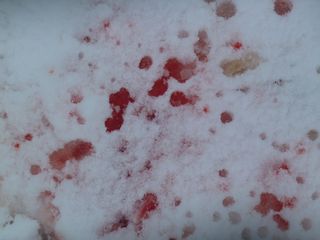 sheathbill tweaks a seal's tail and makes it swivel around, the move may expose something the sheathbill can eat – seal poop, or bloody snow if the seal has wounds from fighting.
I suppose it's possible, although I am not convinced of it, that a sheathbill also might tweak a seal's tail in order to impress another sheathbill. Seriously, that's the first thing some ethologists would look at. Although they would call it displaying fitness.
 But I personally suspect that, in addition to help them get stuff to eat, sheathbills also like to make elephant seals jump because it's funny.
Okay, so. If sheathbills have a twisted sense of humor, and super-smart birds like corvids have a twisted sense of humor, does that mean sheathbills are smart? Not necessarily. But I think it's a possibility worth looking at.
*****
Addendum: An intelligent reader (Hi, Anita!) mentions a duck she once had who used to sneak up and pinch her dog’s tail.
Interesting. Why might a duck have such a behavior in its repertoire? Not to scavenge on carcasses, or make an elephant seal shift position.
I’m guessing the answer is nest defense. All kinds of birds get bold when their nests are threatened, or they think their nests might be threatened. Sometimes crazily bold. They’ll chase larger birds, dive-bomb them, pluck at them. I once saw a pair of Western Kingbirds chase a Great Horned Owl. One landed on the flying owl’s back, grabbing feathers with both feet, before wisely peeling off.
An evil-minded duck might well decide to apply that behavior to a dog even if the duck had no nest.
-
Mid-morning break at Palmer Station, in the galley, somebody on the All Call said “Whales.” Then someone said “Minkes” but as the whales hurtled closer, everyone said “Orcas!” People rose and exclaimed. We could see tall fins of orcas racing toward us. They swam into Hero Inlet. Palmer overlooks Hero Inlet, and the deck on the galley provided a decent ringside seat. Except the boathouse was partly in the way, so many of us ran down to the reinforced bank to one side of the boathouse. I took the video below. Some of these events are on the video; some aren't. I hope you can ignore the voices & laughter – there were a lot of us down there.
The orcas began spyhopping all around a big flat cake of ice with a crabeater seal sleeping on it. The seal woke up and realized it was being inspected by huge murderous monsters. It looked around for a way to leave. Around 0:40 it almost seems to have a short fit of some kind.
Then some of the orcas found another seal sleeping at the end of the inlet, and went and spyhopped to get a view of that one and its possible vulnerability. After a moment the first seal, taking advantage of the switch in the orcas' focus, dove into the water.
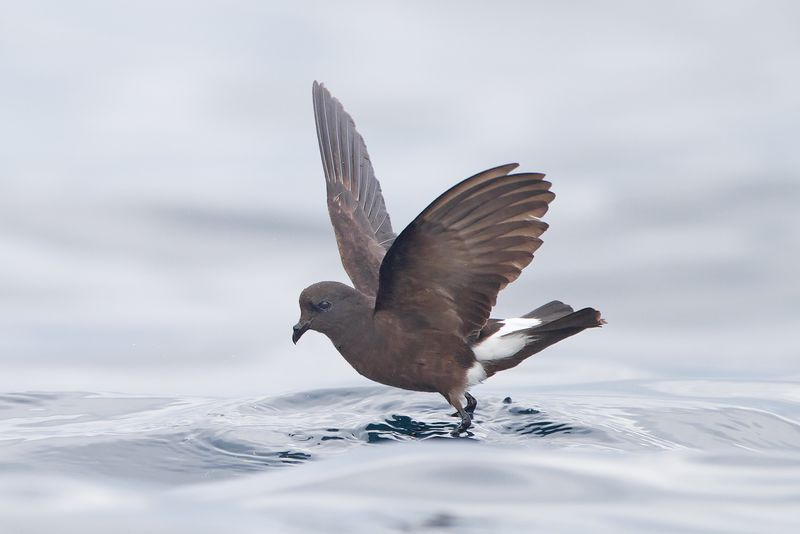
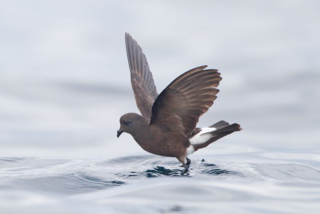 Wilson's Storm-petrel, Oceanites oceanicus.
The small birds fluttering over the water from time to time are Wilson's Storm-Petrels. They pick tiny food items off the water's surface. Soon, giving up on both seals, the orcas sped away, first passing within yards of thrilled people standing on the bank.
We agreed that some of us were on Team Seal, hoping for its escape, and some of us were on Team Orca, hoping for the hunting party to succeed. And many of us had divided loyalties. We all hoped the orcas would add Hero Inlet to their rounds so we could see them again. A little while after the orcas left, a seal suddenly leapt out of the water onto the ice. It looked like the same one, and we wanted to suggest to it that sleeping on land might be safer than sleeping on ice in this part of the world. But seals don't listen.
Orcas and seal from Susan McCarthy on Vimeo.
-
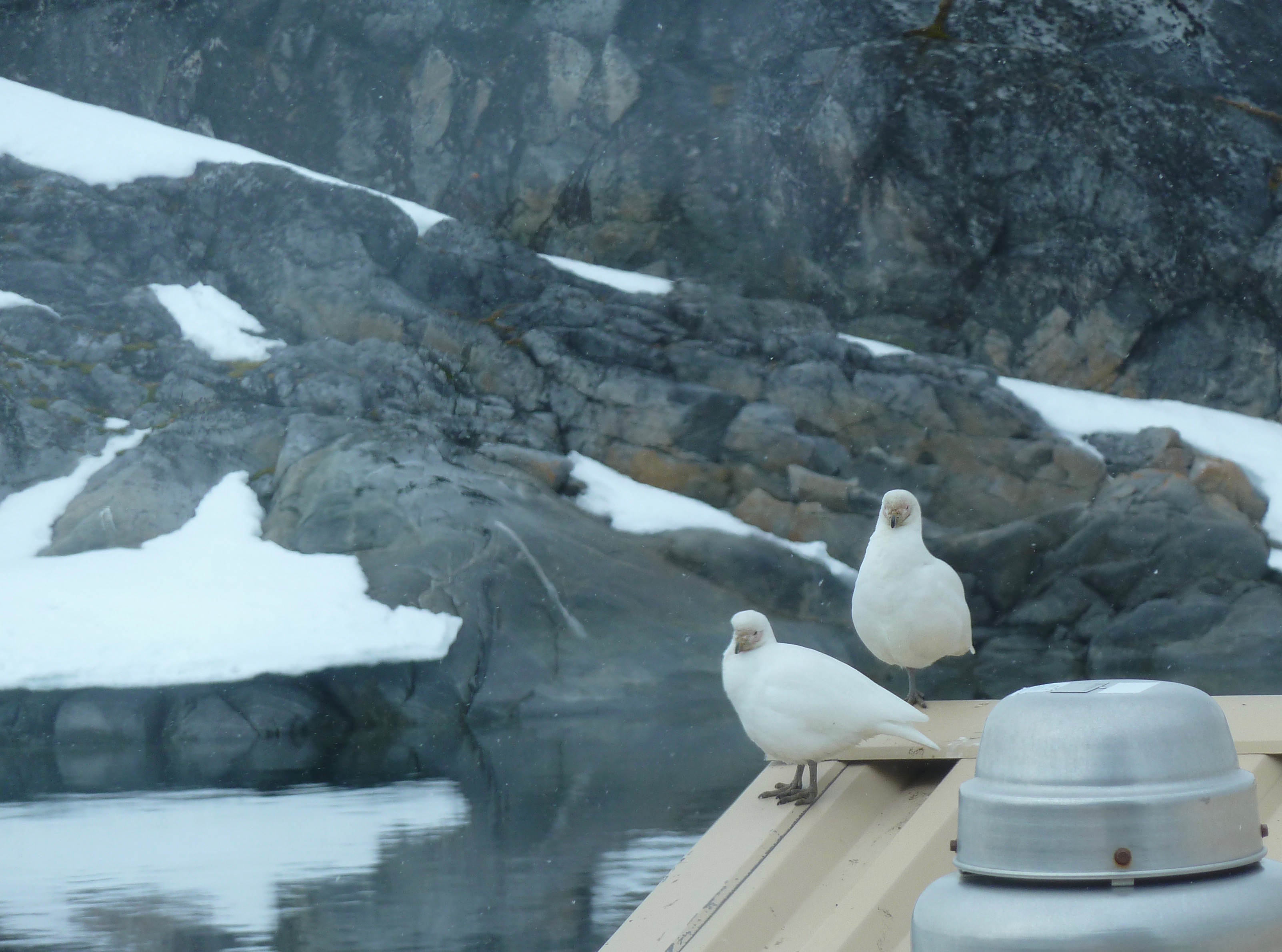
 Several sheathbills live right around Palmer Station, which is handy. Especially since pack ice has prevented me from leaving the station by water ever since I got here.
I am getting some useful photographs of sheathbills, documenting their behavior. It's important to focus on things they're doing in this part of the breeding season, which they may not be doing by the time a vital part of our project, the artist, gets here. That way there will be photos and video for Terri.
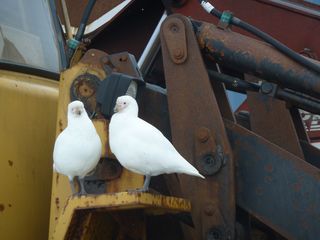 I'm also trying to document some behavior for the Macaulay Library at the Cornell Lab of Ornithology. This is harder, because they prefer their recordings of bird sound not to be filled with generator roars, tractors backing up, and people shouting “Where's the bucket? Bucket. I said BUCKET!” Anthropogenic sound, they call that.
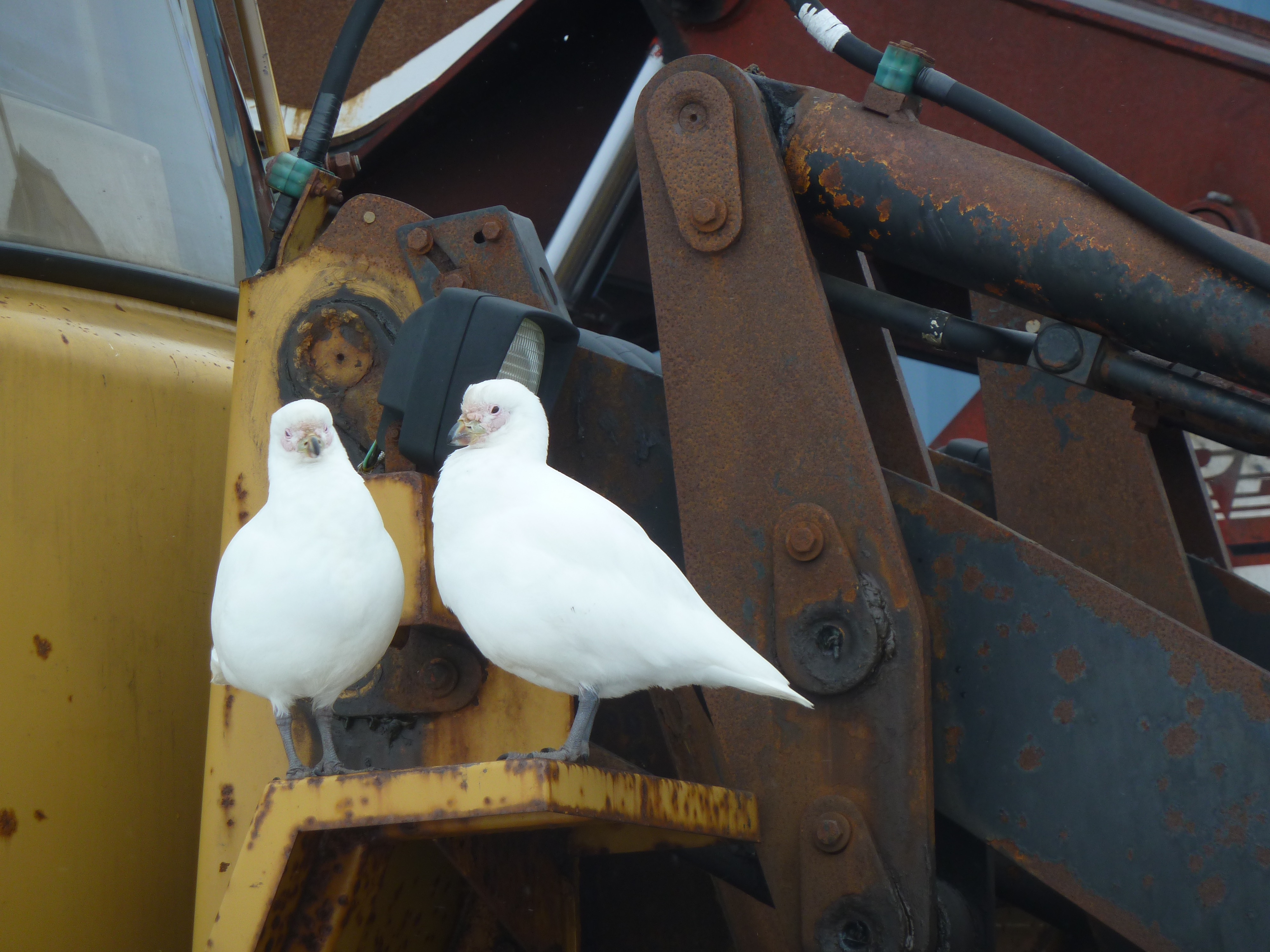
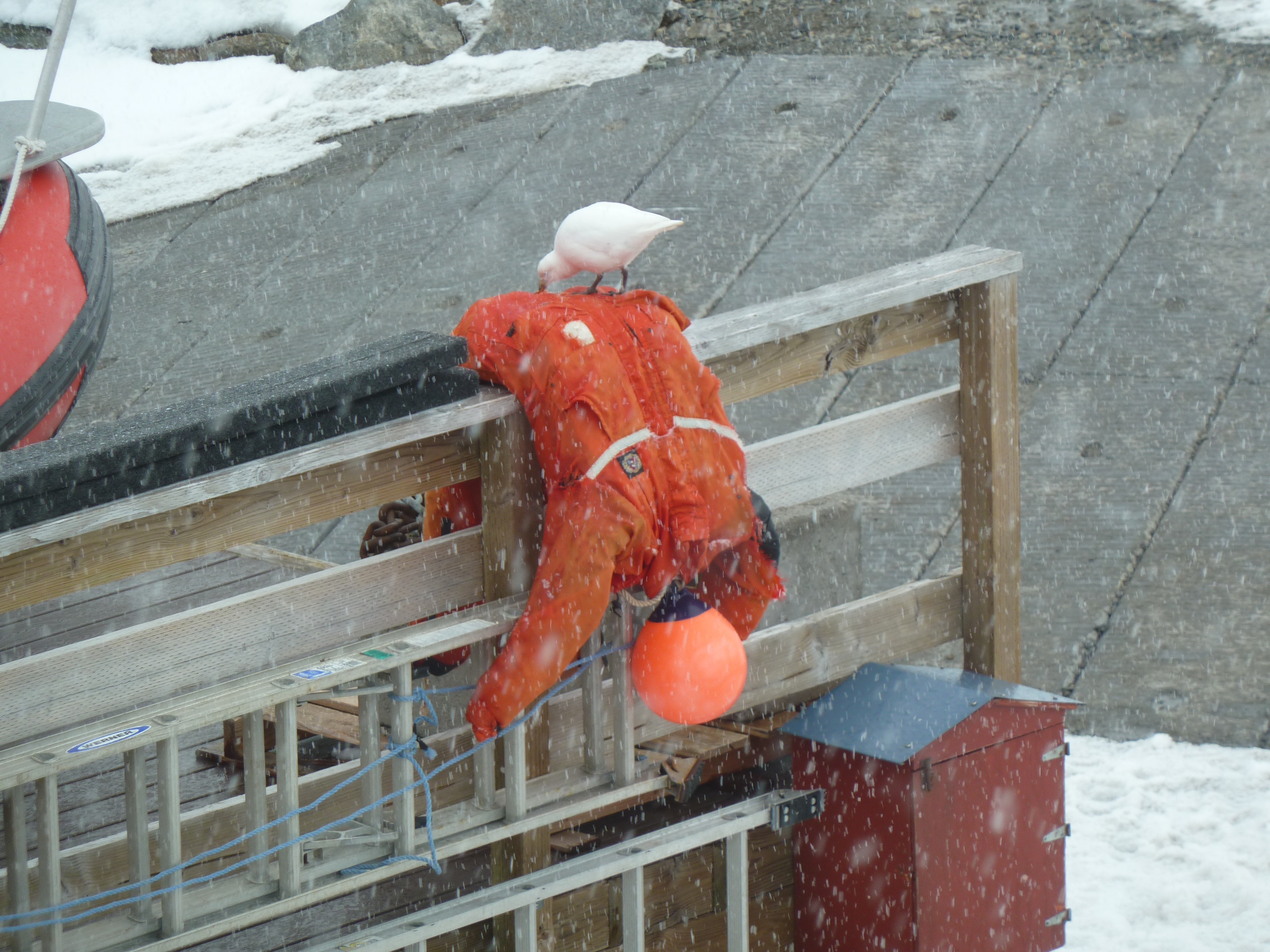
To a lesser extent, they prefer their video recordings not to feature birds in unnatural contexts, standing on man-made objects, and eating human junk food or, um, detritus. They want recordings of natural behavior in natural surroundings.
We all like that look.
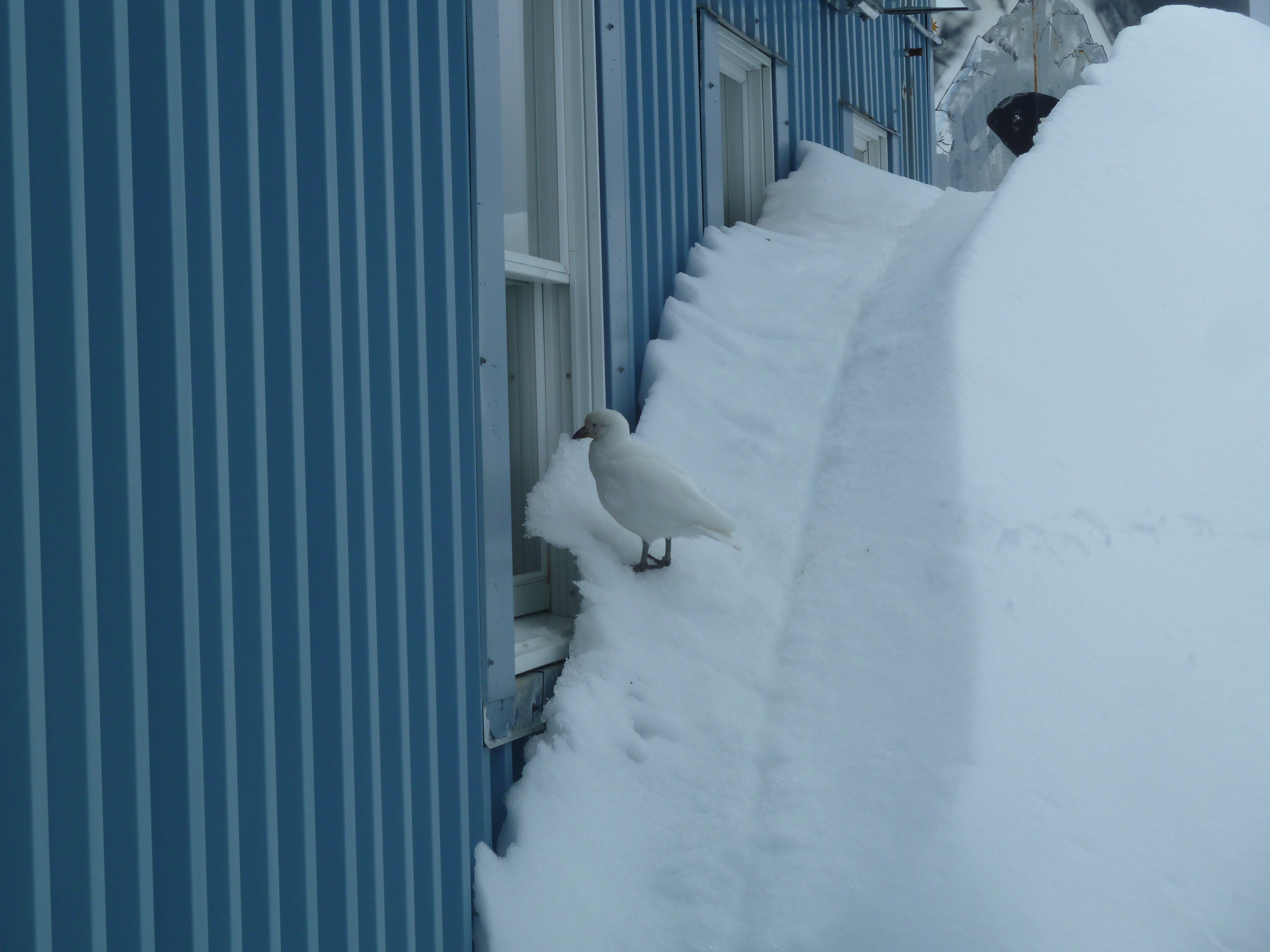
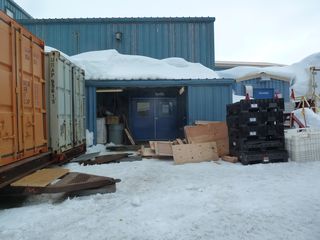 This isn't so easy on station. Birds like a good view, and that is best obtained on top of the roof. They like to nest in sheltered places, and that apparently is often best achieved under buildings or shipping containers.
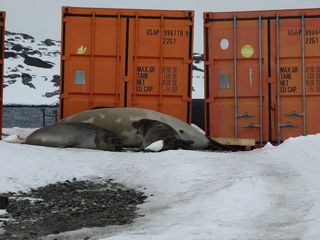
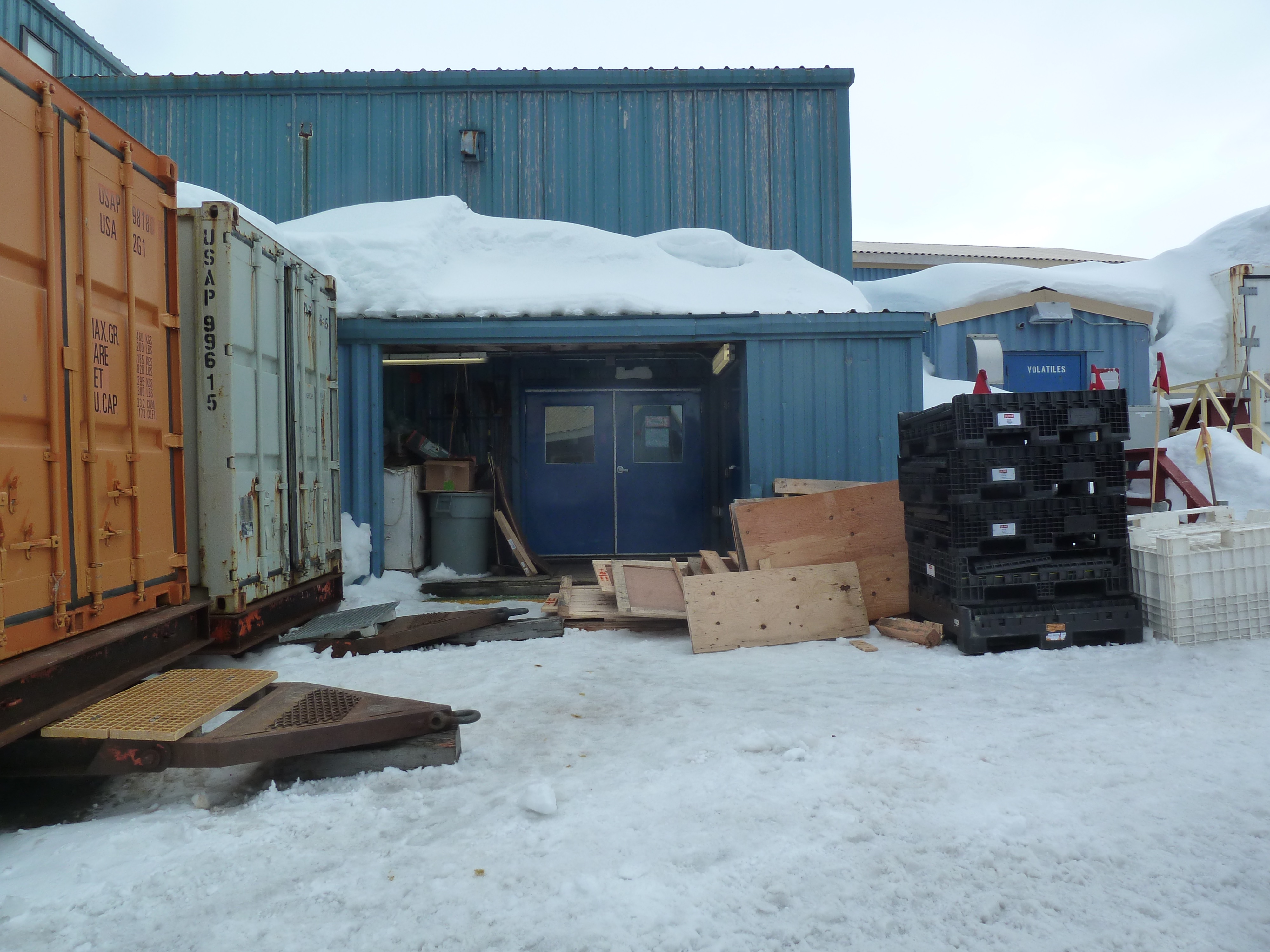
Or they may be engaged in a natural behavior – teasing elephant seals – but if the elephant seals choose to snuggle up to shipping containers, what can you do?
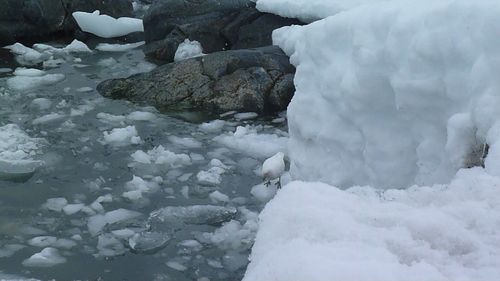
I was able to photograph sheathbills foraging by the water's edge, jumping from one piece of ice to another, in a natural behavior that looks as if it's taking place in a natural setting until you know that they are doing this right where the station's outfall pipe is, which carries (macerated) kitchen waste and sewage. It's a favorite spot for sheathbills.
Fortunately, Terri will not have that problem. She can draw and paint a sheathbill that is standing on a five-gallon drum and make it so it's standing on a tasteful rock, perhaps a rock splashed with lichen.
 Or she could make it so it's standing on a broken coffin, with a skeletal finger in its bill. Because art.
Meanwhile I'll wait for boating to resume, and try to find sheathbills acting natural. It's hard because I'm not allowed to bribe them.
















 Site Title
