• In the summer wildfires, what would the condors do? When flames and smoke tore through their Ventana Wilderness sanctuary, how many would survive?

    These California condors were raised in captivity. Some grew up in large aviaries with two-parent families, and others were fed by condor puppets and raised in condor playgroups (most unnatural for a species in which every child is an only child and neighbors never drop by for a cup of carrion). All were introduced into the wild without the benefits of the ancient condor culture, passing through release pens, decked with electronic transmitters, monitored by worried biologists.

    When fire hit, the Coast Guard airlifted out seven teenaged birds and their guidance counselor (a somewhat older and more experienced bird) who were in an aviary on the sanctuary awaiting release. But 43 birds were on the loose, and no one knew how they were doing. Nor could the biologists get in to the sanctuary. Usually the birds' wild food is supplemented by government handouts of roadkilled deer and stillborn calves, but in this time of trial they had to go without. (They get dead rats too. For all I know they get government cheese.)

    No venison, no beef? No worries. Instead of sticking around and hosing down their homes in a desperate attempt to save their dwellings, the condors went to the coast and had the seafood platter. They flew to Big Sur and lunched on a decayed sea lion and a dead whale. They didn't go home until the fires were out and the yellow tape was down.

    They knew the terrain, because this wasn't the first time they'd been to the coast. The sanctuary is inland, but ever since the condors were reintroduced, “we noticed the birds starting to really home in on the coast more and more,” senior biologist Joe Burnett said recently at the SF Zoo. “We didn't realize the historical significance of it till we started looking thorough the notes.” There hadn't been condors in Big Sur for more than a hundred years.

    The excellent to-hell-with-this-let's-go-to-the-beach survival tactics adopted by these condors show the value of exploration. These birds knew their options.

    If you are ever basking on a sandy beach, or lying on the cliff at Esalen, and you are lucky enough to see a condor drifting above, looking down at you thoughtfully, think of this inspirational tale. Do not focus on the idea that a giant vulture has you in its sights. Remember, they only eat dead things. Be supportive; be safe. Wave!
  • We have been asked how to repel macaques. Or rather, we have noticed that someone arrived at this website by searching for “how to repel macaques,” which we took as a cry for help. Unfortunately, there was nothing here about how to repel macaques. Nor is there an obvious site to refer the thwarted searcher to – nothing for Macaque-B-Gone, Macaque Solutions, or Macaque Motels. (“Macaques check in, and they order six of everything on the room service menu, and they trash the suite, but they don't check out!”) We hate to disappoint people who are nice enough to read the blog, so we're trying to catch up.

    There's no way to know where these macaques are. Are they the macaques who hustle tourists on the Rock of Gibraltar? (Macaca sylvanus.) Are they the crab-eating macaques who raid the nests of endangered birds on Mauritius (where fools introduced them)? (M. fascicularis,) Or are they Japanese snow monkeys again (M. fuscata), invading someone's jacuzzi. So we'll have to take a broad-based approach.

    No violent methods will be recommended – most macaques are protected. We reject violence. We prefer threats of violence.

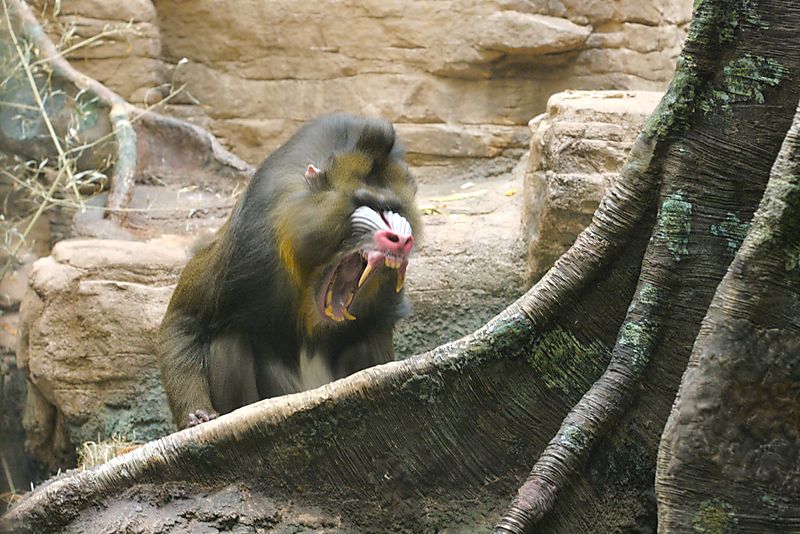
    Many primates have a threat display which consists of yawning widely, showing all one's fearsome teeth. It's not just that they're bored. They yawn more when they're not alone, males yawn more than females, and teenage males start yawning all the time. Macaques yawn more if some meddlesome scientist shoots them up with androgens (steroid hormones like testosterone). In the wild, male baboons yawn less if there's another male around with better, scarier teeth.

    Mandrill_Yawn_2

    Photograph, Ryan E. Poplin.

    This is why monkeys treat us with disrespect. We have puny teeth.

    So for all your macaque-repelling needs, we say Think Teeth. Try the costume supply store and the fake Dracula teeth. Go for the biggest fangs available. Flash those macaques a big toothy smile. That should make them step back. Beam at them, letting the light glint off your canines. They'll start darting their eyes around, looking for an escape route. Say, “Are you as tired as I am, my furry little friend?” and do a long, huge yawn. Watch them flee.

    What if macaques invade while your back is turned, when you're at work or out of town? Try leaving a great white shark's jaw on top of the fence post. Put big Jaws posters on the wall. (Hey! Wouldn't it be cool if just as the macaque is sneaking toward your refrigerator, one of those sets of chattering wind-up teeth comes hopping out? Rig up something like that! Send us the video!)

    These methods are untested. Here at The Nature of the Beast, we have no macaques to repel. But we hope, intrepid searcher, that we have given you some useful ideas.

    One thing, searcher. We advise against any effort to trap your macaques. As anyone knows who has trapped unwanted mice, relocation can be extremely problematic. They say that if you build a better mousetrap, the world will beat a path to your door. If you build a better monkey trap, you'll have a trap full of furious monkeys, and the world may beat a path to your door in the form of angry mobs of animal rights defenders waving pitchforks. And showing the big teeth may not work on them.

  • A tiger's scientific name is Panthera tigris. There are several subspecies, though not so many as there used to be, and one is the South China tiger, Panthera tigris amoyensis. It's said to be the “stem tiger,” the one from which other subspecies diverged. (Which doesn't imply that it has stayed unchanged since then.)

    Sadly for the South China tiger, Mao Tse-Tung took against it in 1959, called it an enemy of the people, and instituted eradication programs. He didn't like flies or rats, either, but they resisted eradication better than tigers. “Paper tiger” is an old Chinese phrase for something that only looks scary. (Mao famously used it to describe the US and the Soviet Union.) Actually, real tigers never qualified as enemies of the people of China. The threat posed by real tigers was a paper tiger that Mao used as a propaganda device. They made great posters.

    By the time the Chinese government, long after Mao, decided to preserve the magnificent South China tiger, they couldn't find any, except in zoos. It was said that a few survived. China had tiger expert Ron Tilson do a survey to tell them how many were left. The answer: zero.

    The government also offered a reward for evidence of a wild South China tiger.

    Not giving up, China's State Forestry Administration planned a system of tiger preserves. The idea is to set up protected areas, stock them with suitable tiger prey, and then add captive-born South China tigers from zoo stock. Programs were started to teach captive-born cubs hunting skills, one in Fujian province, one in South Africa. (Perhaps you have been told that there are no tigers in Africa. There aren't, except the ones doing junior year abroad.) The plan includes releasing tigers into preserves as part of the 2008 Olympic Games ballyhoo.

    Then, last October, exciting news came that, despite Mao (and poachers), there were still wild tigers in South China. Zhou Zhenglong, a farmer and hunter in Shaanxi province, came forth with photos of a tiger in the woods, and of its footprints.

    Wow! Press conference! Cash prize for Zhou!

    Experts at the Shaanxi Forest Administration Bureau confirmed the pictures were authentic.  "[T]he tiger has been found again after more than 20 years." It was inspiring news.

    But some people in China's internet community weren't so inspired. They pointed out certain discrepancies. Why did the tiger look so shiny? Why was its pose identical in each photo? Shaanxi officials stood by Zhou and their South China tiger. The internet investigators kept clamoring. Why did the tiger not only look exactly the same in each photo, but also, excuse us, why did it look exactly the same as this tiger poster?

    Alas, it turns out that Zhou Zhenglong, that simple farmer, had employed his humble computer graphics skills, an old poster, and a fake tiger foot to produce his pictures and claim the prize. The Shaanxi forestry department backed down.

    Ugh! New press conference! Jail for Zhou! Bitter references to paper tigers!

    The South China tiger continues not to roam Shaanxi province, wild and free. But there are wild tigers in China. Up in Jilin and Heilongjiang provinces, bordering Russia, a few North China tigers roam. Their subspecies is Panthera tigris altaica, also called the Amur tiger or the Siberian tiger. They are beginning to get protection.

    I'd like to see both the North and South China tigers protected. The South China tiger will first have to be reintroduced, a pathbreaking event. Since this zoo-bred population, deriving from few animals, will surely have slightly different bloodlines than the population that used to range South China, I suggest designating it a new subspecies. In honor of its history: Panthera tigris papyrus, the paper tiger.

  • Mike Wood is a scientist who studies salmon. He has a little remote-control submarine for observing salmon underwater, a self-propelled fish cam about the size of a slightly flattened washing machine. It was poking around the sea floor west of Vancouver Island in 2005 when it was suddenly attacked by a giant octopus.

    In the video from the fish cam as it scans for salmon, the view swings slowly, swings past a Pacific giant octopus, and then swings quickly back to look at the octopus. Yikes! The octopus makes for the little sub at high speed, and reaches out to grab it by an antenna.

    Wood says he was panicked by the idea of losing the uninsured little sub. What if the octopus bit it? Desperately, he throws the engine into reverse, kicking up a ferocious cloud of sea-floor debris. The screen fills with billowing clouds and flailing tentacles. Octopus and sub struggle until the octopus goes off, presumably wiping sand out of his face and planning to try again after taking a muscle-building course.

    My favorite thing about this was a vocabulary sighting in a CBC News story. Jim Cosgrove, of the Royal British Columbia Museum, was asked what on earth the octopus (Enteroctopus dofleini) thought it was doing. Was it angry, curious, hungry, looking for love in one of the wrong places? “It’s certainly a mature male from what I can see in the video,” Cosgrove said. “Old octopuses become what we call senescent, or senile, reaching the end of their life. 

    "And sometimes their actions are very inappropriate.”

    Inappropriate. Never mind the image of octopus as senile old man cruising the ocean looking for targets to whack with his cane or ram with his wheelchair. He acted inappropriately. That is serious condemnation.

    “Inappropriate” is one of those weak words which people use to camouflage their ferocity. They're used by those who have power but don’t want to seem powerful, like bureaucrats; and by those who have savagery, but don't want to seem savage, like parents.

    Once upon a time “inappropriate behavior” was going out without gloves. Now it is often a psychiatric symptom. Children are expelled for inappropriate behavior. Restraining orders are granted against people who display inappropriate behavior. People are locked up and fed industrial-strength medication for inappropriate behavior. (If you think this is exaggeration, you’ve never found yourself being observed by medical personnel who don’t understand your nervous jokes and write “laughs inappropriately” on their assessment form, followed by the dread “inappropriate affect.” Me neither.)

    Another camouflaged attack word is “uncomfortable.”

    When a bureaucrat says he’s uncomfortable with your idea, he doesn’t mean that he is restless, twitchy, unable to keep from shifting from buttock to insincere buttock in his chair, he means that he will oppose it tooth and nail. If necessary he will have government attorneys seize your car, condemn your house, and arrest your brother on outstanding traffic warrants. (Or he may have you beaten, stabbed, and cast on the garbage heap to be eaten by jackals. Depending on the jurisdiction.) Unless you stop making him uncomfortable.

    When a parent says she’s not comfortable with your lesson plan, she does not mean that she is unfamiliar with the ideas you present, doesn’t know how to fit them into her vision of a seventh-grade curriculum, and can’t stop fiddling with her hair. She means that like a tiger defending cubs, she will see you dead before you implement your plan, if she has to pour the lighter fluid on you herself.

    If you do not seem to grasp what these people are saying, they may escalate. Keying your coordinates into their shoulder-mounted rocket launcher, they declare, “I’m afraid that’s simply unacceptable.”

    They have issues with that. They have some concerns. They are troubled by your remarks. They never say they’ve already made up their minds. They do not say that they equate compromise with ignominious death. They never actually say no.

    (I shouldn't complain about these euphemisms. That's so negative. A more positive approach would be to get new ones. Long latinate words seem to be the popular choice for disguising rage, so we’ll need a bunch of those. Inadmissible. Disproportionate. Inapplicable. Exiguous. Rudimentary.

    When they give you the death stare and say your views are unacceptable, stare back. Say, “Your response is disproportionate. I think you’re inapplicable. I'm sorry for you, exiguous fool.”)

    So that giant octopus was lucky that he only got a face full of seafloor sludge for acting inappropriately. Had there been any way of apprehending him he would have been taken into custody, assessed, and sent to rehab. After all, is it acceptable to have a giant octopus freely seizing research equipment? Are you comfortable with that? Wouldn’t it be more appropriate if he were, say… deep-fried?

  • The friends I was visiting in Massachusetts had a groundhog in their yard. They saw it regularly, usually grazing the rich growth of plants next to the gate between the driveway and the back yard. Where I live in California, we have no groundhogs, although I have seen their cousins the marmots in the Sierras. The groundhog, Marmota monax, is the same animal as a woodchuck.

    My friends said it was very fat, appropriate for an animal that hibernates in the winter. If you say to a groundhog, “Wow, you're a real tub of lard!” it's a compliment. (But don't get addicted to saying this.)

    One afternoon, while we were studying sangria in the yard, my friend said “Look! Groundhog! Quick!” I couldn't turn around in time to see it dash across the yard and dive under the toolshed. I did hear it, because it was very noisy. Pounding feet, rattling against plants — we practically heard change rattling in its pockets. A bear makes less noise.

    We went to the other side of the shed, and the groundhog put its nose out and looked at us thoughtfully. It had a nice face. With its body safely underground, or undershed, it wasn't worried by our regard. It wasn't all that interested, either.

    That weekend there was a barbecue to celebrate the graduation of a son of the house. As soon as we went out to the yard, my friend asked “What is that horrible smell? Like sewer gas?” While I stood around with condiments saying “Where?” two quick-thinking guys spotted a heap of dung, carried it away on shovels, and covered the spot where it had been with leaves.

    It had been a really dreadful smell, apparently, a foul smell, a disgusting smell, an H. P. Lovecraft smell (i.e., too awful for human vocabulary to describe). And it had been an enormous ghastly heap of dung. They said it must have been the groundhog. They said the groundhog had to go.

    I said it didn't sound like the work of a groundhog, but since I hadn't actually viewed it, and since there was little enthusiasm in the crowd for a detailed description of the monstrosity, my comments lacked impact. My friends said they hadn't minded the groundhog before, but literal partypooping was intolerable. They would ask the city to trap it and take it far away. “It might not have been the groundhog,” I squeaked. But the conversation swept relentlessly to daintier matters.

    When I got home, I did an internet search for “groundhog” and “scat.” I hoped to clear the groundhog's name and save it from captivity and exile. Just as I had suspected, groundhog scat consists of dry pellets of plant matter. It is not as big as The Thing that appeared at the party. And since groundhogs are vegetarians, it's not very stinky.

    Anxious to avert injustice, I hastened to present this testimony I hoped would exonerate the groundhog. My friend was amused. She was glad to hear that the creature was innocent, but my argument was beside the point. That morning her husband had gotten up early and seen the groundhog in the yard – playing with a baby groundhog.

    She had a baby. The groundhog was safe now, even if that had been groundhog poop at the party. She was safe even if she pooped in the yard every day. She would be safe even if she went out in the front yard and flung poop at passing cars.

    The question of who the actual offender was could now be considered at leisure. What creature is big enough to create the heap described? No bears or moose currently roam the back yards of Arlington, as far as I know. So our current suspect is a raccoon. They're stinky omnivores. They're not large animals (except the one you saw that time), but they like to accumulate scat in one spot, a “latrine.” Perhaps it's a way of saying “This is my real estate!” Sort of like renting a porta-potty. Maybe they repel competitors with the sheer volume and stench of the thing.

    This strategy is ineffective against people with shovels. If raccoons wish to be welcomed in Arlington, latrines won't work. The raccoons will need to invest in actual plumbing.

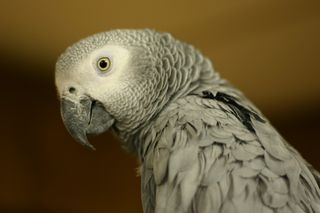
  • Sometimes people get sentimental about the nobility of animals. But it depends on the animal. Perhaps you saw the story of Yosuke, a pet African Grey parrot in Japan. One day he got out. As parrots do, he flew around for a few days and a few miles before landing and seeking human help. (“Free! I'm free! I can go anywhere I want! I fly, I soar! — Hey, where am I? Where is everybody? Where's lunch? Oh no! Lost! I'm lost!)

    The police picked up the bird, and an officer tried to chat, but the parrot wouldn't speak. He was deposited at a vet clinic, and after a while he opened up. “I'm Mr. Yosuke Nakamura,” he confided. He
    Photo: grendelkhan. Creative Commons Attribution-Share Alike 2.0 Generic. (All they had to do was ask politely.) gave his address. The vet told the police, who found that yes, there was a Nakamura family at that address who had lost their bird. They said they'd been drilling Yosuke for two years on how to ID himself. (Smart. I never even thought of teaching my cockatiel, “I'm Ms. Beak-of-Steel McCarthy.”)

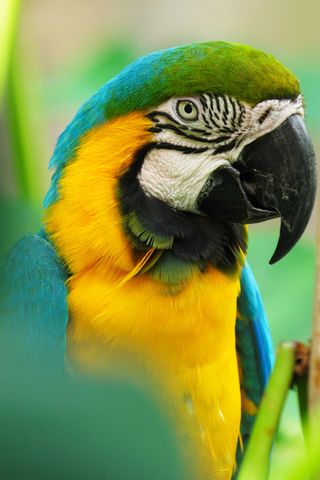
    Mr. Nakamura contrasts with the last talking bird I read about in the news, a blue-and-gold macaw at a wildlife sanctuary in Warwickshire. Barney, formerly a lorry-driver's pet, is a classically
    Photo: Ralph Daily. Creative Commons Attribution 2.0 Generic. (Come a little closer and I'll explain what those asterisks mean.) foul-mouthed parrot who is no longer allowed to meet the public after telling “the local mayoress to f*** off.” He cursed some children. He cursed the vicar. Like Yosuke, he doesn't trust law enforcement, and told two police officers, “You can f*** off too, w******!”

    Those asterisks were in the original. I am a simple natural history buff and can only guess what they stand for.

    Two African Greys at the sanctuary have picked up these effective phrases from Barney. The Daily Mail reported that sanctuary owner Geoff Grewcock says the three birds sit around swearing. “It sounds like a builder's yard, with all the abuse flying about.” A fourth bird, Sunny, shrieks “Shut up!” when the cursing starts, but they ignore him.

    According to the Sun, Grewcock hopes to clean up Barney's conversation by making him listen to documentaries and “posh Radio 4.” As a simple American, I can't even guess what that means Barney will be saying next.

    The contrast between nasty rowdy Barney and articulate well-informed Mr. Yosuke Nakamura reminds me of a dog encounter I witnessed. On Market Street in San Francisco, a woman with a white cane was led along the sidewalk by a guide dog, a golden lab. They were near the curb when a pickup truck pulled up at a red light. Two dogs in the back of the truck glanced down, saw a dog below, and instantly began barking loudly. (“Hey! A******! Get away from our truck! Back off, flea-bus!”)

    The startled guide dog, suddenly assaulted by hostile sound from above, shrank in terror. The woman with the cane knelt and put her arms around him as the dogs in the truck kept yelling. The driver of the truck looked back, saw what her dogs were doing, and started frantically banging on the back window, yelling at them to stop. Her dogs, encouraged that she was joining the ruckus, barked even harder. (They could have used a bird like Barney to ride shotgun.) Finally the light changed and the truck drove away.

    The hard-working guide dog, who had devoted his life to service, stood on the sidewalk trembling. The idlers in the truck, loudmouth jerks who threatened others for the fun of it, zoomed off into the West, probably congratulating each other on effective pack-work and flinging beer bottles into the gutters.


    It was a moral scene suitable for a Hogarth engraving. (Okay, I know, like I spend so much time looking at engravings. It would be perfect for Goofus and Gallant.)

  • To attract wildlife, we've historically offered water, food, and salty snacks. Hunters and ecotourists can both be found hanging around waterholes. Some people put out bird feeders to watch birds. Others put out cheap corn to attract deer year-round so they'll be available in hunting season. Animals have always been drawn to salt licks. That draws people, which is why there were all those early settlements called French Lick, Boone's Lick, Blue Lick, etc. So some people put out salt blocks.

    I propose a new way of attracting animals: spa weekends.

    Okay, animals don't much observe the work week, so let's just say spa vacations. Spas. Places animals could visit for food, water, salty snacks – and a nice back-scratch, mudbath, massage, or pedicure.

    Animals are always trying to get their backs scratched, rubbing against trees, fences, and one another in the attempt. They'd flock to a spot where toothed surfaces were mounted at convenient heights and angles. There'd be rubbing, and groaning, and clouds of fur, and great happiness.

    It might take a little more ingenuity to get animals to make pedicure and massage appointments, but a nicely-scratched back ought to lower their sales resistance, to say nothing of a good hot soak.

    Most animals love a nice bath, and while they are typically envisioned frolicking in a crystalline lake or a mountain stream, they gladly take hot water when they can get it. The famous Japanese snow monkeys (a species of macaque) appear to spend most of the winter in hot springs.

    In the mid-90s, a cinnamon bear (a black bear with natural auburn coloring) was raiding garbage cans and fruit trees in Monrovia, California. While on the prowl he discovered the pleasures of jacuzzis. After he ate, he'd relax in a hot tub. Some people didn't like a scum of coarse black hair and bear grease in their tubs, but Connie and Gary Potter took advantage of the photo-op and videotaped the bear, called Samson, luxuriating in their tub.

    One day the Potters saw Samson rolling in agony on their lawn. Concerned, they called Fish & Game to help. By the time the wardens came, Samson, who had incautiously eaten a plastic bag, felt better. Because he was a known “nuisance bear,” they trapped him. They found that he was an old bear, with worn-down teeth, who wouldn't be able to support himself in the wild.

    Fish & Game has views on the unwisdom of people feeding formidable wild animals. (F&G would get the blame if Samson gummed a Chihuahua.) They have experience with relocating garbage-eating bears (who return to favored garbage dumps with lightning speed). They also know that zoos are full up with black bears. They announced that they would euthanize Samson. Horrified, the Potters took their videos of Samson bathing to the television news. The public was appalled, as anyone would be who can identify with an innocent woodland creature lolling in a hot tub after a satisfying meal of garbage. The governor issued a stay of execution.

    The Orange County Zoo, with a sharper eye to public relations than F&G, announced that it would take Samson in. They built him a big enclosure with a waterfall and a pool. (But no hot tub, and I am betting no salty snacks.) He lived there for years, until he got so sick he really did have to be euthanized.

    So if we already have wildlife trying to sign up for the spa treatment without encouragement, think of the business we could do if we were trying. Spas where they didn't have to dodge wardens, where the salty snacks were laid out on buffets, where dogs wouldn't bark at them.

    We'd need to be clever. We'd need to be sure that a rabbit coming out of the massage room (blissfully relaxed), didn't encounter a coyote (invigorated by a back-scratching session), back into a bobcat exiting a meditation class, jump sideways and bump into a moose heading for the jacuzzi, and startle a bear into swallowing a loofah. Since none of these animals really want to meet humans either, we'd do it by monitoring video cameras and not opening gates that would let predator and prey or any kind of enemies into the same space.

    (It wouldn't be right to use spas to attract animals for hunting purposes. What if the custom spread? What if manicurists and masseurs went Sweeney Todd on their clientele? Think about it.)

    Why on earth would we do this? It's not like animals can pay. We would do it because it would be cool, because we like animals, because it would be interesting to see what happened, and mostly, as the story of Samson shows, because we would get Such. Cool. Video.

  • A few years ago, Terri Nelson and I went to the San Francisco Zoo, and came upon the Nocturnal Gallery. This is closed now, but it was a little building with glass-fronted cages with small primates. It was dark inside, with double doors so people entering  wouldn't let in daylight. There were dim red lights. If you waited long enough, your eyes would adjust and you could dimly see small nocturnal animals hustling along tree branches, sorting leaf litter, and grooming each other. Most people didn't take the time, and went out again. We were alone with tiny primates.

    Terri and I were spellbound. Bushbabies! Then we saw the mouse lemurs, infinitesimal primates you could hold in the palm of your hand, if it were allowed. We felt compelled to peer at them in case there was a still smaller baby mouse lemur clinging to its mother.

    Then we spotted the aye-ayes, and were stunned with delight. Aye-ayes are rare and endangered, five and a half pounds of nocturnal weirdness from Madagascar. Few zoos have them. Aye-ayes eat grubs that burrow in decayed wood, so they fill the ecological niche of a woodpecker. (A big woodpecker. Given their size and rarity, let's say an Ivory-billed Woodpecker.) They have opposable thumbs and skinny witchy fingers, especially their middle fingers, which are ridiculously long, Edward Scissorhands long. In the Malagasy night, they tap on trees, listening with big bat ears for hollow sounds, and for a grub squirming. Then they bite a hole in the wood and pull the nutritious and no doubt tasty grub out with that long middle finger.*

    In the dimness of the nocturnal house we could see the aye-ayes parading along horizontal branches, making daring leaps from one branch to branch, and pausing so we could drink in the spectacle of their crazy staring eyes, their disheveled fur, and those bizarre hands. They popped in and out of a wooden nestbox.

    We had been looking silently for a long time, bewitched, when we saw a quick flash in the enclosure. It was a red bar of light that appeared for a second and then was gone. It came again. “Did you see that?” “Yes — what was it?” We stared. Nothing. Then, again, from a different spot. We couldn't figure it out. Were there lights in the enclosure with the aye-ayes? Some kind of motion detectors? It flashed from a different spot. Then, gone.

    It flashed twice, in the same spot. We peered and suddenly saw an aye-aye sitting on a branch. Facing us. Brandishing a large wrench.

    “Do you see that?!” one of us asked in disbelief, and the other one hissed, “Yes.”

    When the wrench was tilted toward a red light, it reflected a red bar of light from the handle. The flashes from different places must have come as the aye-aye paraded around with the wrench. The aye-aye manipulated the wrench thoughtfully, then jumped up and disappeared into the nestbox. When it came out, it had no wrench.

    We tried to figure it out. When one of the cages was being repaired, someone had left a wrench lying around. The aye-ayes had stolen it. They were hiding it in the nestbox. Clearly they planned a break-out. “They plan to use it to unbolt something and escape,” I hazarded. Terri showed a better understanding of basic primate thinking. “They plan to hit the zookeeper on the head with it and escape,” she said.


    Ayeaye_forsumac
    *There are no woodpeckers in Madagascar. Feel free to use this remark the next time conversation falters.

  • I've been thinking recently about ways to use technology to improve the lives of animals, and to communicate with them. I was lucky enough to get to talk about this at the Science Buzz Cafe  at Maker Faire , and I hope to write on the subject from time to time.

    It would be a mistake to be too serious. We shouldn't think only in terms of animal needs, feeding them, protecting them, providing them with affordable health care. People love to use technology to play and animals are likely to feel the same. My brother Tim remarks that since pigeons are better than people at spatial thinking, maybe we could use that to create a pigeon video game.

    To quote from Becoming a Tiger:

    At the task of looking at two shapes and figuring out which is the mirror image of a third shape, pigeons and college students were equally accurate. But pigeons were faster. The researchers suggest that pigeons use some different, automatic process, and that they need it more than we do, because they fly around and look down on things that are oriented arbitrarily, whereas the things we look at are more consistently oriented. …navigating in three dimensions must be harder than navigating in two. So we shouldn't feel bad about being inferior to pigeons at mental rotation. But we should avoid going on game shows where we would face teams of pigeons at mental rotation tasks, because that really would be embarrassing.

    (The more I think about this, the more I am grieved by this vision of our species swarming spiderlike across the plane of Flatland. Memo to self: remember to look up.)

    Pigeon_portrait_4861_2

    The experiments showing that pigeons are spatial thinking virtuosos take place in labs. Pigeons peck at keys to indicate which of several images is the same as another one, but rotated in three dimensions. If they're right, they get a snack. That's practically a game already. A boring one.

    So maybe you could design a video game that involved lots of three-D navigation, maybe through virtual forests. Players would have to swoop through without touching anything. Pigeons might play that, because, like people, animals enjoy doing things they're good at. (Germans call this Funktionslust.) I think a pigeon would have to play by pecking keys, since a joystick could be a problem.

    Maybe pigeons can whip us when it comes to rotating 3-D objects, but I'm sure there are lots of areas besides joystick technique where we would totally whip pigeons. For one thing, I'm not sure a pigeon could identify with an avatar.  It might have to be a first-person shooter type game.

    This brings us to frigatebirds, also called Man of War birds. They're huge glamorous seabirds, mostly black, with long long pointed wings, and long forked tails. Brilliant flyers, they can stay in the air for a week at a Magnificent_frigatebird_fregata_m_2
    time. They're one of several species that get a lot of their food by robbing other birds. They spot another bird with a fish, say a gull, and they chase that gull, they outfly that gull, they invade its airspace, they pull on its feathers, they harass it until the gull drops the fish or coughs it up, and then the frigatebird grabs it on the fly.

    You see where I'm going with this, don't you? That's right. Grand Theft Frigatebird.

    Would a sweet, peaceful pigeon get a kick out of role-playing piracy? There's only one way to find out. In fact, if you proposed to shed light on whether violent video games make people violent, you could even get grant money.

    We could try adding a magnetic steering component to the game. New research on how birds use the earth's magnetic field to orient themselves indicates that they may use fancy molecules that link a carotenoid, a porphyrin, and a spherical fullerene. In the test tube, these molecules react to very weak magnetic fields. These molecules resemble molecules in birds' eyes called cryptochromes. (Wait a minute. A spherical fullerene? You mean… a buckyball? Yes! If birds had them first, I wonder if they took out patents?)

    I think it would be a good practice for us to design systems geared to sensory systems we don't have ourselves. Echolocation videogames for bats and dolphins. Sophisticated olfactory videogames for dogs and wolves. UV videogames for bumblebees.

    It would be good intellectual exercise. It would be good moral exercise. And it would give us valuable experience, which would help us get cool jobs if people suddenly need to communicate through new and unusual channels when our civilization encounters aliens.

    **

    (Pigeon: Photograph taken by Dori. . Frigatebird: Photograph from putneymark .)

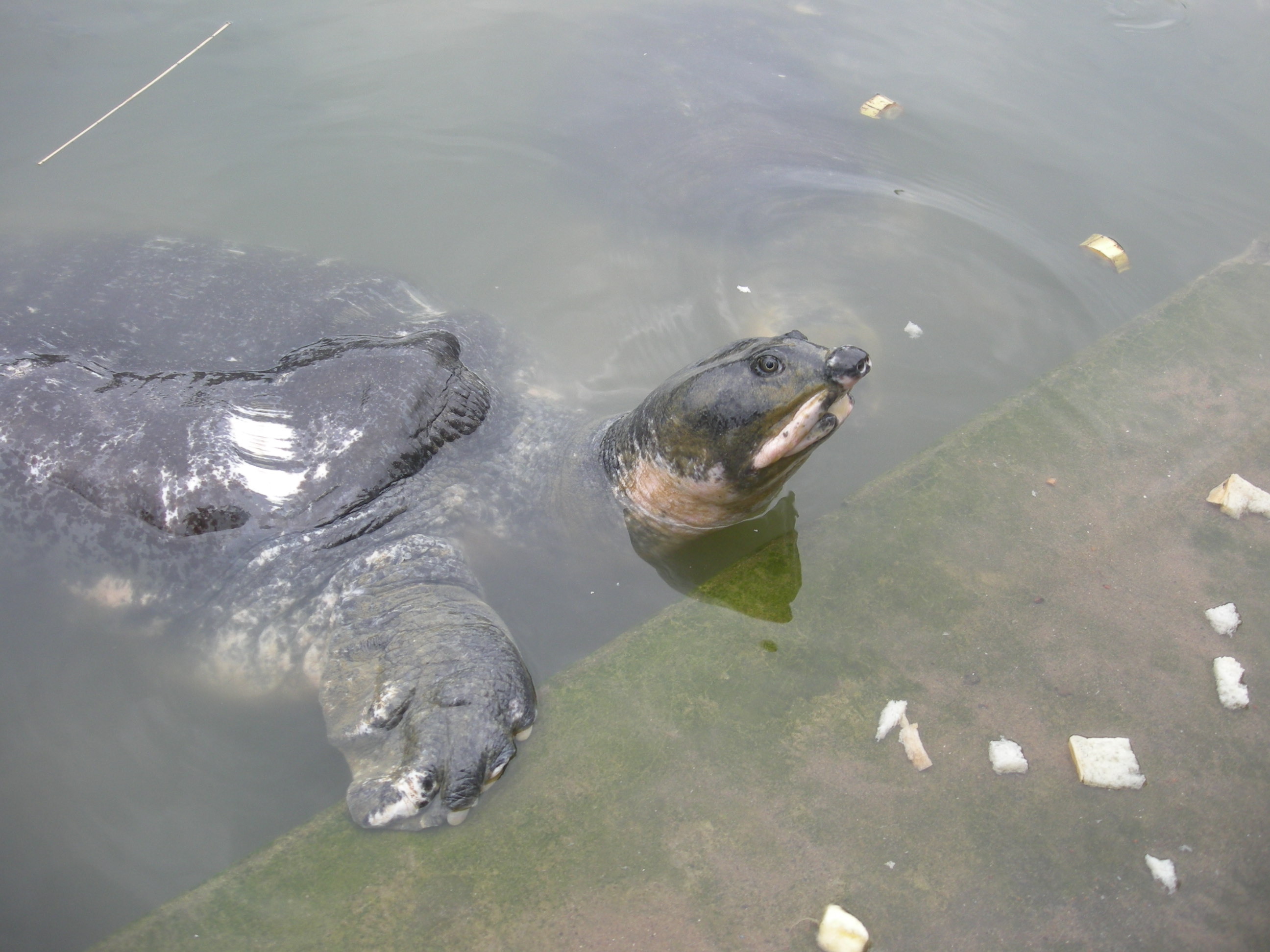
  • I came across the story of the most endangered turtle in the world while researching the question of whether “worm stomping” in Wood Turtles is a cultural behavior. (Alas, no.) In Ronald Orenstein's Turtles, Tortoises and Terrapins: Survivors in Armor (2001), I read of Aspideretes nigricans (formerly Trionyx nigricans), the Black Softshell turtle, or Bastami (or Bostami) Softshell, which “survives for religious reasons. The entire population of some 400 animals is held in
    semi-captivity in an enclosed pond, or tank, about five miles from
    Chittagong, Bangladesh, where visitors and pilgrims feed them bread,
    bananas, and offal. The tank is attached to an Islamic shrine…” Other
    sources confirmed that it was “critically endangered,” “extinct in the
    wild,” and “the 'holy' turtle of Bangladesh.”

    Photo: Rohan Uddin Fahad. Creative Commons Attribution-Share Alike 3.0 Unported license. (Aw c'mon. Do I look evil?)

    Not evil, just hungry.

    The shrine is of a ninth century Sufi mystic, Bayazid Bastami, of whom I had not previously heard. It is said, apparently, that Bastami encountered evil spirits, and turned them into turtles. What a nice man. He didn't bind them in eternal chains, cast them into flame, or even drive them out. He just turned them into turtles. From evil he brought good. Or if not from evil, good, at least from evil, turtles.

    The former evil spirits are protected. Orenstein quotes an early report that “the turtles are so tame that they come to feed when called, placing their forefeet on the edge of the platform or even climbing upon it and stretching their necks out of the water. Some even allowed us to touch them, and ate pieces of chicken from wooden skewers held in our hands.”

    The species was taxonomically described by J. Anderson in 1875. The general assumption was that the rest of the species had gone extinct in the wild and only these few captives hung
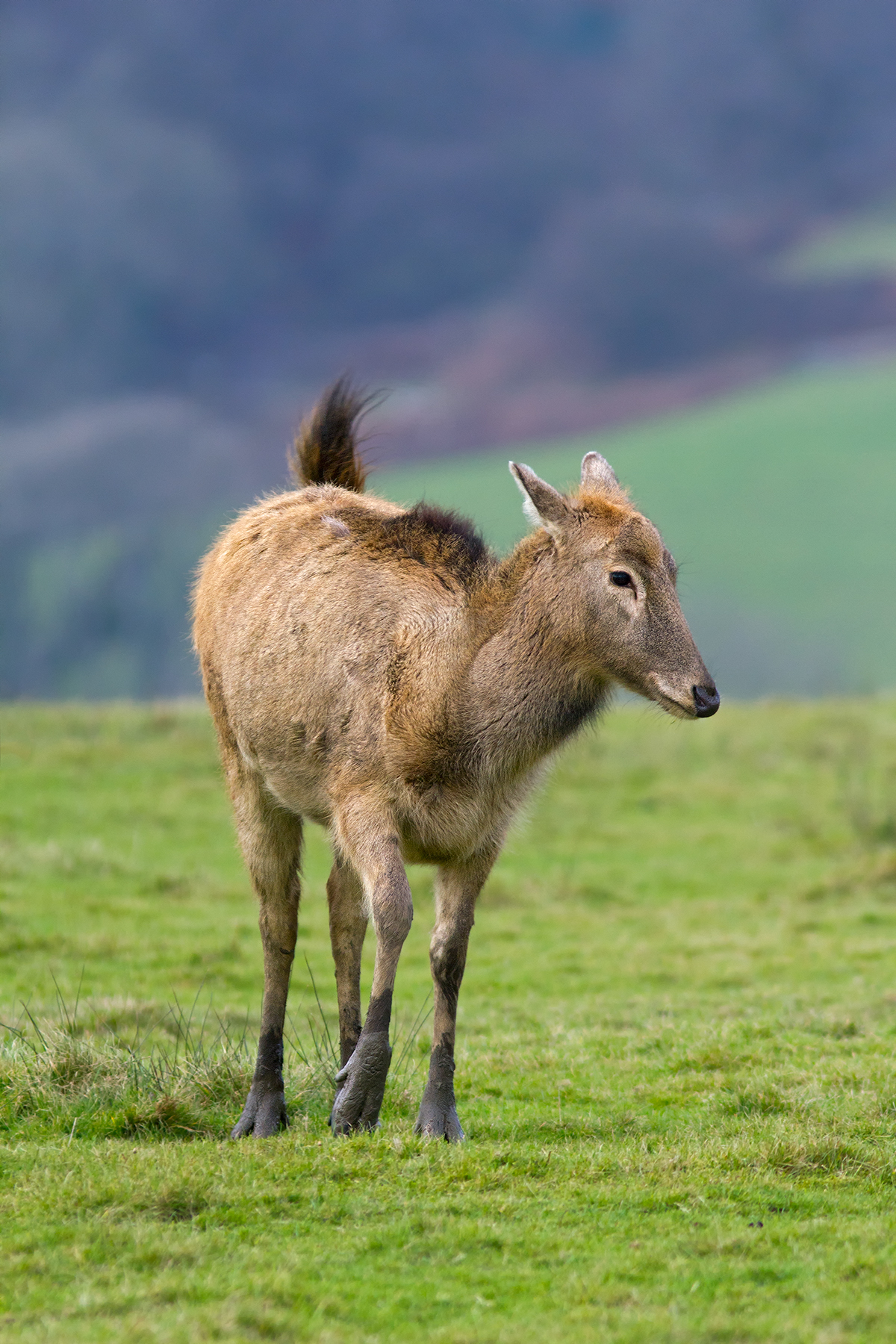
    Photo: Paul Whippey. Creative Commons Attribution-Share Alike 3.0 Unported license. (I am in an evil mood...)on (like the Pere David's deer, a herd of which survived on the estate of the Emperor of China, while all the rest were exterminated). A few herpetologists suggested that the Bastami turtles were just a bunch of inbred descendants of A. hurum, the Peacock Softshell, or A. gangeticus, the Ganges Softshell. How insulting.

    But now Peter Praschag and colleagues have done the mitochondrial DNA work and even some field work, and have

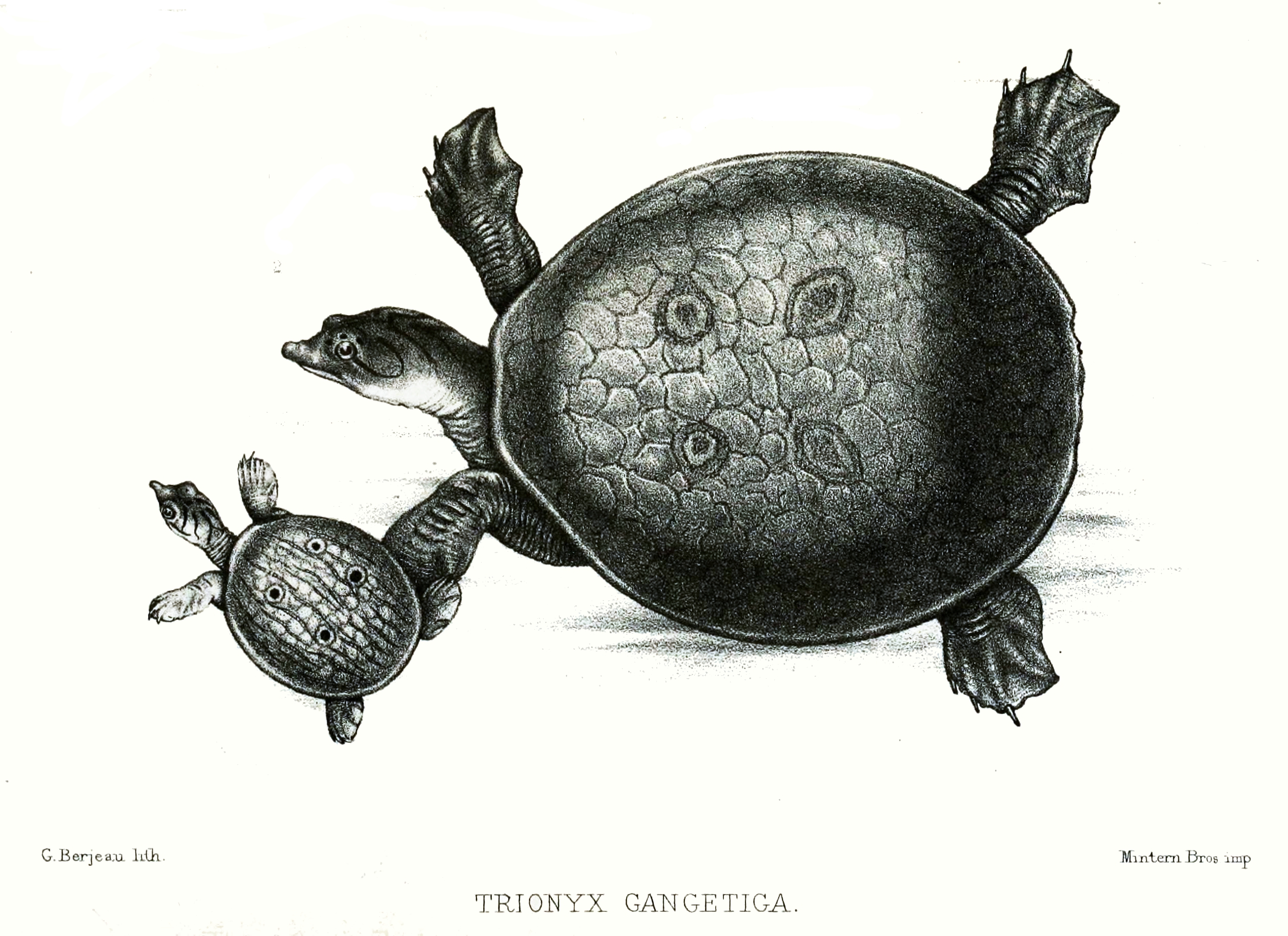
    Engraving: C. Berjeau. Public domain. (You would be lucky to be my inbred descendant.)

    The Ganges Softshell

    illuminated the matter in a paper in Zoologica Scripta, complete with cladograms and excellent drawings of baby turtles. It is not true that the Bastami Softshells are merely inbred, aberrant, Peacock Softshells or inbred, aberrant, Ganges Softshells. They are a distinct species in their own right. (Praschag et al. advise changing their name to Nilssonia nigricans).


    However, the DNA work indicates that they are the same species as some turtles in a pond next to the Kamakhya Tantra Temple in Assam. (Note to self: if build temple: install turtles. Query: charge pilgrims for turtle chow?) They are even the same species as a turtle that was caught swimming wild in the Jia Bhoroli River, also in Assam. Praschag et al. don't know how many Bastami Softshells are out there, but they figure it's a lot more than just the ones that hang around the shrine.

    What a revelation! As a fan of plot and anecdote I would much prefer that the temple have the only Bastami Softshells in the world, saved from extinction by the pious – but as a crazed fan of fauna I am very glad there are more Bastami Softshells  in the world – saved from extinction by their own efforts.