• A black bear is being sought by New Jersey police on suspicion of stealing a minivan. Officer Dave Dehard came across the stolen minivan abandoned by the side of the road with dented door panels and a broken passenger window. Looking for clues…, Dehard found the front seat covered with drool, candy wrappers, and coarse black hair… Police theorize that the bear smelled candy…, smashed the window, then “accidentally released the emergency brake” while foraging inside, causing the vehicle to roll down a hill. —The Week

    Photo: Luca Galuzzi. Creative Commons Attribution-Share Alike 2.5 Generic.  I did not eat the candy.

    “Mom, Dad, I theorize that a black bear smelled brownies, entered our home through the dog door, was attracted to your purse by the smell of gum, inadvertently swallowed a twenty dollar bill, lurched against the computer, accidentally linking to that porn site, which automatically linked to a couple other porn sites, and then exited through the mud room, probably picking up a six-pack of the Moosehead as he went. I knew you'd be upset about the mess, and I was trying to clean up, but I only got as far as vacuuming up a whole bunch of coarse black hair.”
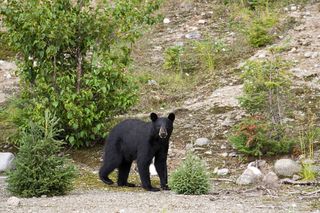
                        Photo: Luca Galuzzi. Creative Commons Attribution-Share Alike 2.5 Generic.  Any candy. I mean, I didn't eat any candy.

    “Sweetheart, I just came home a minute ago and found the place like this. I theorize that a black bear smelled that shaving cream you got on the rug the other day, entered our home via the chimney, found itself in our bedroom, spritzed itself with your aftershave, and then exuberantly rolled on the bed, dislodging that pair of somebody's boxer shorts which must have somehow gotten accidentally included with our dry cleaning. What a mess! I got what must be bear drool on my clothes when I came in, so I took them off right away. Ugh! Bear drool! So gross! Hold me!”

                                             Photo: Luca Galuzzi. Creative Commons Attribution-Share Alike 2.5 Generic.  I am a wild animal. How would I even know what candy is?

     “Captain, my theory: looks like the perp was a black bear. Bear smells something in the evidence room, sneaks into the station house. Maybe hid in the back of a squad car, lay low in the garage until the day shift went home. Then made unsuccessful attempt to break and enter the evidence room. Grabbed and consumed snacks from the detective bureau desks. Then detected candy scent in that piñata of the commissioner the detectives have. While attempting to access the candy the suspect climbed onto a computer that was logged on, through the use of a back paw got into the discretionary fund, accidentally clicked with its claw to bet it all on European stock indexes, then, hearing a noise, exited out the side. Doesn't it seem to you like there's more coarse black hair than usual lying around? Too bad about the money. You wouldn't really expect good investments from a bear. Though of course if the indexes had gone the other way, he'd be a total hero.”
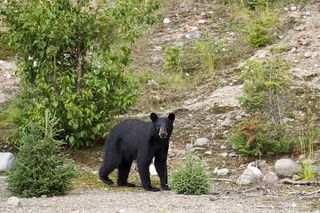
                                                                 Photo: Luca Galuzzi. Creative Commons Attribution-Share Alike 2.5 Generic.  So typical of your species. Obsessed with candy and projecting your obsession onto animals.

                                                                                                          
    Editors—I hypothesize that a bear, attracted by the lure of publication, which the animal took for the scent of fame and for the deep primordial call of self-expression, made its way into a small office in the downtown area of a Western city, where it raked its long curved claws across a keyboard with a grace surprising in such a large creature–one typically thought of as ungainly, and one which does not invariably feed only upon the canonical “roots and berries,” but on rare occasions reveals itself as a formidable predator–creating a short work of apparently lighthearted prose. Accidentally releasing its own innate sense of literary restraint, the bear, or if not a bear, a person strongly identifying with bears, composed a brief fantasia addressing the human penchant for relentlessly deterministic explanations of animal behavior, and the equally marked human penchant to employ these explanations in self-justification. The innocent animal—and I knowingly use the term “innocent” for its several meanings such as “not cognizant of current normal literary channels,” and “free of the imputation of original sin,” and “hasn't killed anyone yet, or even hurt anyone, and knocking over dumpsters is hardly a felony”–then flicked a claw rapidly across the metallic device which it simultaneously found disquietingly natural and so familiar as to be almost invisible, sending the odd missive on its electronic way, exhaled a bitter gust that seemed to speak of the high mountain ranges, spun once in the office chair, and lumbered away, leaving the workspace littered with drool, candy wrappers, and coarse black hair.

    Where is the CANDY?

  • The Italian wolf, Canis lupus italicus, is doing better than it was before. In the 1970s there were guessed to be only about 100 wolves surviving in the mountainous parts of Italy. Now there are more like 500 or 600 and they're fanning out into France and Switzerland.

    An Italian wolf likes to hunt medium-sized prey like deer, boar, and chamois. If those aren't available, sure, rabbit is fine. And Wikipedia says of the Italian wolf that it has “adapted well in some urbanised areas and as such, will usually not ignore refuse or domestic animals.”

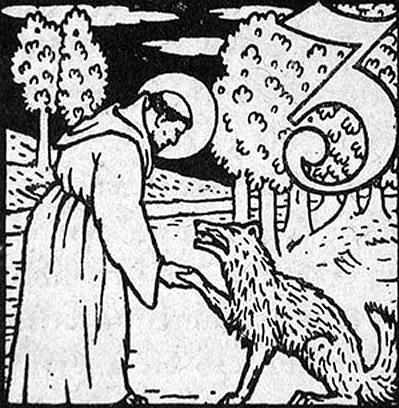
    This is clearly accurate, not only because St. Francis of Assisi made a deal with the sheep-killing, man-eating Wolf of Gubbio that it would stop its destructive ways if the townspeople of
    Engraving: Carl Weidemeyer-Worpswede. Public Domain.Gubbio would give it food instead, but in light of an observation I found in a paper about Italian wolves and foxes in the Abruzzo. The authors were remarking that the foxes seemed to be nervous around wolves. “Uneasy.”

    They gave as an example an account of a wolf, a fox, and a cat all eating at a garbage dump outside the village of Caramanico one November day. The cat carefully stayed out of the way of the fox and the wolf. The fox carefully stayed out of the way of the wolf. The wolf, one gathers, strolled calmly wherever it chose, despot of the dump. The fox was jumpy, constantly looking up to see what the wolf was doing. Whenever the wolf moved, the fox rushed over to the place where the wolf had been, to see what it had been eating.

    Eventually the wolf, the fox, and presumably even the cat went away, and the researchers inspected the dump, seeking dietary data. They found that all three predators had been eating from a giant heap of discarded spaghetti.


    Okay, I like spaghetti, but that is sad. I figure those Italian wolves invading France and Switzerland are young wolves looking for better territories, asking themselves where the vast ancient forests are (the ones full of deer), and grumbling that pasta is good, pasta is great, but you know what? After a while you don't want to eat pasta for every. Single. Meal.


  • I was reading Tupai: A Field Study of Bornean Treeshrews by Louise H. Emmons because that is the kind of thing I like, and learned about the absentee maternal system found in some treeshrew species.

    First I should say that treeshrews are the same as tree shrews, and the closing up of the word is probably meant to indicate that they don't really live in trees and they're not really shrews. This is a case of TC, Taxonomic Correctness, like the argument that you should call a starfish a sea star because it's not really a fish. Oh please. But a big issue about treeshrews is whether they're descended from very primitive primates and so are our distant cousins, or whether the connection goes further back so that the primates and the treeshrews are both descended from the clade Euarchonta, making them even more distant cousins. I have no opinion on this.

    Image: John Gerrard Keulemans, Proccedings of the Zoological Scoity of London (1876), Public domain. This is Tupaia tana, the Large Treeshrew. (In this creature's opinion we are not related at all and may expect no invitations to family events.)

    In the absentee maternal system the mother treeshrew builds two nests (yeah, in trees). They are far apart. She puts her babies in one and she sleeps in the other one when she's not racing around snuffling through the leaf litter and catching bugs. Every other day she secretly visits the babies, taking a different route each time, and nurses them. When she's not there the babies lie still and don't make a sound. If an intrepid wildlife biologist like Louise H. Emmons takes a baby out of the nest, it lies silently in her hand with its eyes closed.

    One day when they are old enough the mother treeshrew drops by as usual, but instead of just nursing them she takes them out and shows them Borneo. Here's a bug, here's a little trail, here's what you do when you hear a scary noise — there's another bug! Let me see you grab it! She brings them with her on her rounds and protects them while they learn the business of treeshrewing.

    According to a report from the wild, the babies were "shaky" the first time they came out of the nest hole.

    The reason treeshrews do this has to be that it makes it much less likely that predators will find the nest and eat the babies by observing the mother. (That's the sort of creepy trick that jays and crows do, for example.) And obviously it's very convenient for the mother treeshrew. Which makes me lean toward the idea that treeshrews aren't primates – what baby primate holds that still for that long?

    Like other wildlife biologists who write books for general audiences, Louise H. Emmons tries to find a balance between the stuff working scientists mostly do, and the stuff that people are actually interested in hearing about. Most of the work of wildlife biology doesn't involve playing peekaboo with baby gorillas, swimming with whale sharks, or filming hippo hijinks. It involves data sets. Perhaps Emmons leans too far in the direction of hard science, because her best story was walled up alive in an appendix. (I read appendices so you don't have to. Or at least I skim them.)

    In Appendix 1, Emmons explains why a trapping data set is incomplete.


    In the January trapping period, a group of elephants went through the study area, systematically destroying man-made objects (rain gauges, signs, trail markers, etc.). They stomped on seven baited traps but interestingly did not step on one that contained a treeshrew, while flattening the two on each side (trapping in January was curtailed, and this month is excluded from most data).


    The elephants spared the tiny prisoner! Of course I think they did it because they felt compassion for the treeshrew, but I realize that there is also a compelling quality to  the explanation that they did it because they didn't want to get their feet sticky.

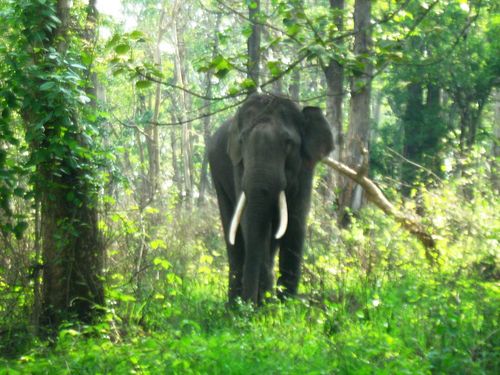
    Photo: Moorthy Gounder. Creative Commons Attribution 2.0 Generic license.  http://www.flickr.com/photos/11533508@N07/3528044078 (My advice: Don't push the compassion thing unless you are as helpless as a treeshrew in a trap.)

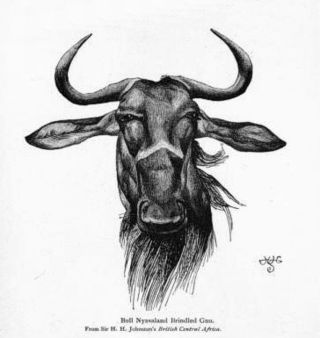
  • It's hard work being high on the food chain, and predators are always looking for labor-saving ways to catch prey. In national parks in Kenya, the lions have not Photo: Stig Nygaard, Creative Commons Attribution 2.0. http://www.flickr.com/photos/10259776@N00/2442595237 (Heh heh.) only gotten blasé about trucks full of ecotourists, they've started to use them as cover. They'll sneak around behind a vehicle and then rush out to lunge at a wildebeest. Imagine you're the wildebeest – Public domain. (Actually three-quarters is my best angle.)one minute you're making sure they get your good profile, and the next minute you're running for your life. 


    In the Canadian Pacific, biologist Alexandra Morton was observing killer whales She was disconcerted by the way one of them, Kwatsi, kept surfacing directly behind her boat. “No matter how I tried to alter my course, his 5-foot fin stayed right behind my engine. After a while I realized what he was doing: Kwatsi was using my boat and its engine noise as a Photo: Kirsten Poulsen. Dual license: GNU Free Documentation License, Creative Commons Attribution ShareAlike 2.5.  (Heh heh heh,)moving hunting blind.” Great minds think alike. “These humans mean me no harm. They are friendly! Friends help friends catch dinner.”

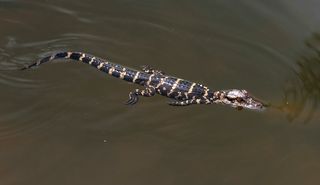
    I performed a similar function once, without actually being a human shield. Driving across Florida, I pulled over to eat lunch at a picnic table, and tossed crumbs from my sandwich to minnow-sized fish in the Photo: Hunter Desportes. Creative Commons Attribution 3.0 Unported.waterway next to the road. The tiny fish were thrilled with the crumbs and mobbed them enthusiastically. As I gazed at them I heard a small clomp! and then another clomp! Two minuscule alligators had cruised up, disguised as minuscule floating logs, and were snapping up the fish I had lured to their doom. Oh yeah, they call this road Alligator Alley.

    Photo: Ianaré Sévi. Creative Commons Attribution-Share Alike 3.0. (Oh, this is gonna be great  I mean, heh heh.)To be fair, I should have thrown the fish an alligator purse. They could have nibbled on it after it decayed a bit. But I didn't have an alligator purse. That's how it is. You try to pack everything, and you pack all this stuff you never use, and then the one thing you don't pack, you wish you had. It's hard to be a responsible ecotourist.

  • Oh_my_bigish_file_3

    My sister took this photograph. (Click on it for a better look.) It shows Sky, a Thoroughbred mare, and her first foal. The foal's about 5 minutes old.

    Because it was her first foal, Sky had no idea what was happening when she went into labor. First she felt bad, and then she felt really bad, and it hurt a lot, and it went on and on. That's a big foal, and labor was difficult. The foal got stuck twice, even with two people pulling on it.

    In the picture, Sky is astonished and thrilled. A baby! There's a baby! It's her baby! Sky, like a lot of mares, always liked foals, but could never get her hands on one, so to speak. Their mothers wouldn't let other mares near them until they were older.

    My sister, Dr. Sarah McCarthy, is an equine veterinarian, and she helped me decode Sky's expression. That wide eye means just what you think. It's true Sky's glancing at the camera, but that's not why her eye's so big. She's wide-eyed with amazement. A child of her own has magically appeared in front of her (and just as she was getting over the worst colic ever). As described in Becoming A Tiger, some first-time mare mothers have been known to get up from the straw and walk away, not having any idea that there's a baby horse in the vicinity. My sister knows of cases where a mare has to be grabbed as she walks away, led back, and shown the foal she'd just given birth to. Wow! Look, a baby! Wow!

    Sky's ears are straight up, which shows excitement and attention. Her neck is stretched out in eagerness. Also, and this is harder for a non-horse person like me to notice, Sky's lips are protruded and her nostrils are flared, as she drinks in the delightful smell of her new child. She's beside herself with joy and surprise.

    I met Sky's chestnut filly when she was 5 days old, racing around, doing little kicks and leaps, followed every moment by the still rapturous but much calmer Sky.

    Next time Sky goes into labor, she may suspect what's coming. My sister tells me that Rosie, one of her other horses, had definitely figured it out by the time of her 3rd foal. Alerted by a 3 a.m. phone call that Rosie's water had broken, she went down to the stall. As soon as Rosie saw my sister she began to nicker tenderly as a mare does to a foal. It was as if a woman in labor greeted her obstetrician's arrival by saying, “Oh, who's the best little baby in the world?”

    [This photograph is copyright by Sarah McCarthy and may not be used without her permission. You may not, for example, put it up on a LOL cats site, with the horse on the left captioned I CAN HAZ FOAL? and the horse on the right captioned CALL ME CHEEZBURGER.]

  • Often when a cat does something in secret, it's a wicked thing. A certain cat belonging to a relative recently discovered how to enter a lidded hamper full of clean folded laundry, urinate on the laundry, and leap out without knocking over the hamper or otherwise being detected. Until my relative wanted a clean shirt.

    But sometimes a cat does a good thing in secret.

    Photo: K Fink, National Park Service. Public Domain.Cougars are amazingly secretive creatures. You can spend years in cougar country without spotting a cougar, though chances are good that cougars spotted you. (Cougars are the same as mountain lions, and the same as pumas. Puma concolor.)

    So there's not nearly as much information about the customs of cougars as there is about the customs of wolves or the folkways of bears. But new technology is helping. In Wyoming, biologists who put radio collars on cougars are learning things that change the picture of the species.

    There was a nice story in the  Jackson Hole News & Guide about a female cougar they call F27. She was leading her invisible life, raising three 8-month-old cubs, in wild terrain along the Gros Ventre River. Biologists couldn't watch her, but because she wears a GPS/radio collar that reports her location four times a day, they knew what she was up to. Nearby, another female cougar, F1, was raising her own three 20-month-olds, until she was shot by a hunter. (How do hunters find cougars if they're so elusive? Dogs.) Photo: WL Miller, National Park Service. Public Domain.

    F27 adopted the orphaned kittens, giving her a sit-com family of six. Because most of the cubs had been collared too, researchers could tell that they all ate, slept, and played together. Since then, one of the adoptees (F69) has declared herself an emancipated minor and gone out on her own, but the rest are still one family.

    Biologists used to think cougars were almost perfectly solitary animals, but the more we learn, the more convivial they turn out to be. “This solitary carnivore is actually pretty social when it comes down to it,” researcher Howard Quigley told the News & Guide.

    Naturally, there may be selective advantages to this kindly behavior. For one thing, it's likely that F1 was related to F27, so that F27 wasn't adopting perfect strangers, but biological kin. It's possible that F1, an older cat, was F27's mother. If so, F27 has adopted her half-siblings—and she's promoting her own genes. But that doesn't mean that's why she did it. I find the idea of adopting cougar kittens very tempting, and yet there are no cougars on either side of my family.

    Quigley also hypothesizes that a large cougar family, especially one including the two hulking male cubs from the adoption, might be able to defend their kills from local wolf packs. It often happens that a cougar will kill a deer or an elk, eat some, step away to nap, and get up repeatedly to eat a little more. But if wolves find it, the pack will gobble it, and a cougar won't dare to rush up yowling “That's mine! Get your own!” Five cougars, though—a cat pack—might able to hold onto their kills.

    It's virtuous to do good deeds, and even more virtuous to do good deeds by stealth. (Most of the time.) By this standard of Maimonides, F27 deserves double praise, once for good behavior, and again for being furtive with it. She's not in it for the glory. The only reason we know about it is the GPS data – and it wasn't F27's idea to wear a radio collar.

    The truth, I suspect, is that F27 didn't adopt those children because it was the right thing to do. She adopted them for the same reason I would have been tempted – because she liked them and wanted to have them around and take care of them.

    So maybe it's not pure virtue.  Photo: Mailans. Creative Commons Attribution-Share Alike 3.0 Unported. But at least F27 stays out of laundry hampers.