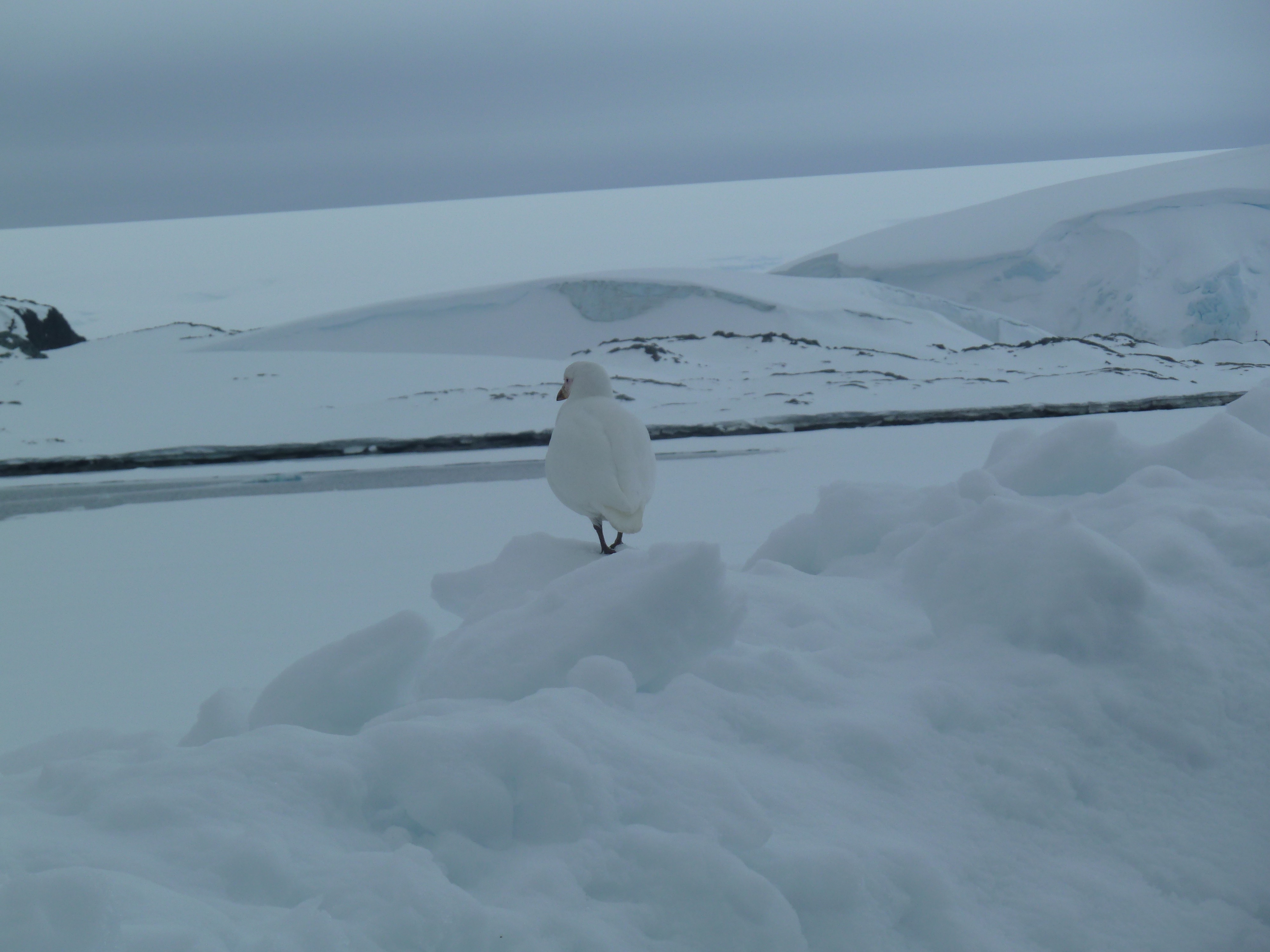
•   P1020046(Artist Terri Nelson and I have gotten an NSF grant to observe a fascinating little-known bird, the Snowy Sheathbill, at Palmer Station, Antarctica.

    Mysteriously, the NSF sent one of us down before the other. Terri arrives in January, and we'll both be here until mid-March. )

    As the ship from Punta Arenas drew in to Palmer Station, a sheathbill took to the air. Before I set foot on land, I knew the bird we'd come to see actually… exists. Reassuring.

    P1020146Snowy Sheathbills (Chionis alba) live very far south. They're the only land bird that breeds in Antarctica, on the Antarctic Peninsula. They also go to various islands and to the tip of South America, where Darwin saw one and marveled.

    Very few people have heard of sheathbills. For two reasons, I believe. One: penguins. Once people see penguins, they generally have eyes for nothing else. OH MY GOD, PENGUINS.  P1020156

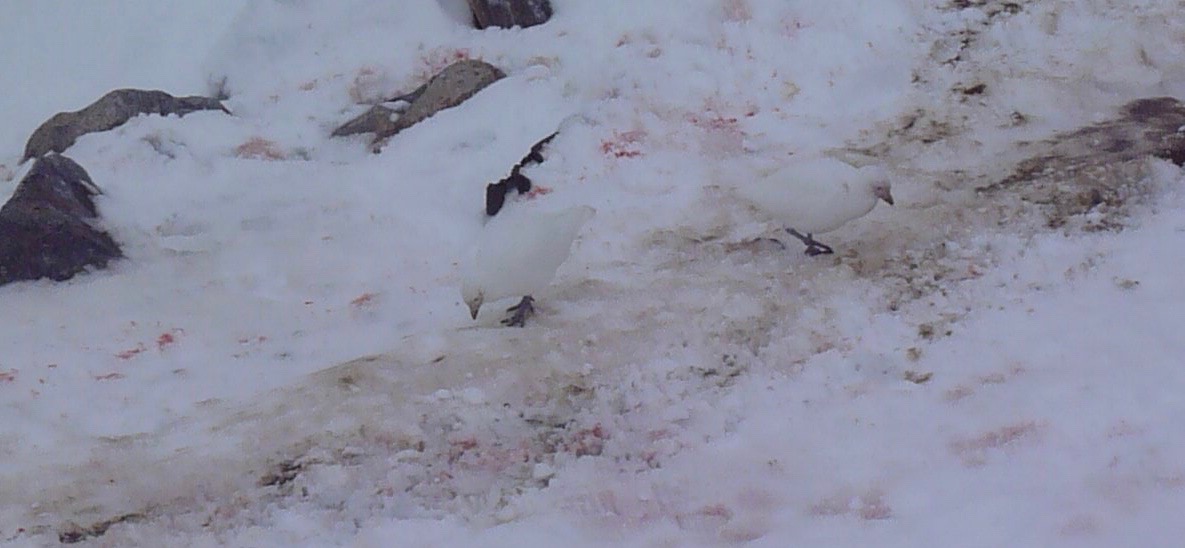
    Two: the sheathbill diet. They are scavengers. Carrion is one of the daintier things they eat. The people at Palmer Station, knowing we had come to Antarctica specifically to observe sheathbills, tried to break it to me gently that they are often called shitchickens. I knew about their eating habits already. But this is not something everyone likes to discuss.

    Change the subject! What shall we talk about?

    Penguins?

    P1020261

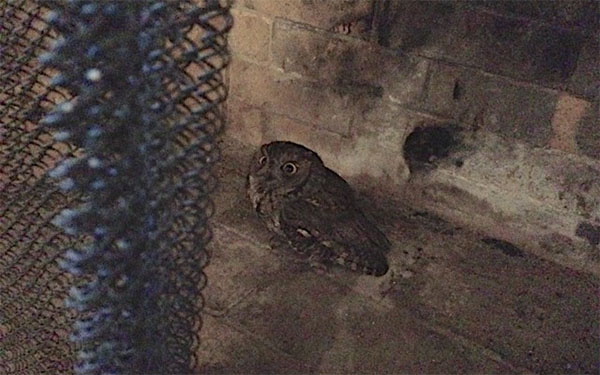
  • A screech owl got trapped in a chimney. Peering up with a flashlight, residents glimpsed the little owl, but when they got close, it hopped higher, onto the fire box, out of reach.


    Photo: Randy R. Magnuson. Creative Commons Attribution-Share Alike 3.0 Unported.

    I thought I heard a still, small voice in the grass, saying “Eat me! Eat me!”

    One resident called around for help. Wildcare's Hungry Owl Project gave advice. The Marin Humane Society sent out an officer. But the owl didn't trust them either, and again hopped up out of reach.

    After five days, the resident was quite worried. She called Wildlife Emergency Services, which specializes in emergency response wildlife rescues, among other things. (Disclosure: I volunteer for WES.)

    But they were 115 miles away. Knowing the owl must be hungry, WES director Rebecca Dmytryk made a suggestion: Go to the nearest pet store. Buy a bag of crickets. Put the container in the fireplace. See what happens.

    The resident came back from the pet store, carrying a sack of crickets. Many were chirping. (“Hellooo, CRICKET LADIES!!! Any CRICKET LADIES out there? Sure would like to meet some CRICKET LADIES!!!”)

    Before she got to the fireplace the owl was down and looking around avidly. (“I got yer CRICKET LADIES right here, fellas!”) Apparently for a hungry screech owl the sound of chirping crickets is as alluring as the sound of hamburgers sizzling on the open grill for Chuck Berry.

    Design: Pearson Scott Foresman. Public domain.

    Let's talk more about these hamburgers. Are any of them… ladies?


    It literally popped through the damper opening as I was approaching with the bag of crickets,” the resident told Dmytryk. “I hadn't even opened the bag, but they were chirping loudly!”

    Also, at the Hungry Owl Project's suggestion, a dish of water had been put in the fireplace, and the owl had shown interest in this too. The advantage of crickets over cool clear water being that crickets have a sound track.

    Seeing this, the resident asked Marin Humane to return. Using the water-and-noisy-food technique to draw the owl close, they scooped it up. The actual owl. Used with permission.

    Meanwhile visitors from France, ignoring WildCare's “We don't name our patients” policy, had called the owl Bartholibou. (Hibou is owl in French, so: Bartholomew Owl. Ish. Esque.)

    WildCare took Bartholibou into their expert care, fed and watered him, and checked to make sure he hadn't gotten injured in the chimney and could still fly proficiently. Meanwhile, heavy-duty wire mesh was installed over the attractive-nuisance chimney caps to keep Bartholibou or other inquisitive creatures from going in.

    Bartholibou was set free.

    None of the accounts say what happened to the crickets, but I bet they were set free too. “Cricket laaadies! Cricket laaadies! Boy do I have a story! You're gonna want to hear this! CRICKET LADIES!”


  • Rich Stallcup died December 15, 2012.
    He was a kind, wonderful guy and a brilliant naturalist. Once he told me a
    story about a bristle-thighed curlew, and the people who
    admired it. Before the story I want to say what a freakily great bird
    the bristle-thighed curlew is.


    First, the bristle thighed curlew
    (Numenius tahitiensis) spends the summer in Alaska and the
    winter in Hawaii. Or Tahiti or other tropical Pacific islands. Nice
    work if you can get it. Maybe not that easy to get, since there are
    only about 7,000 bristle-thighed curlews in the world.
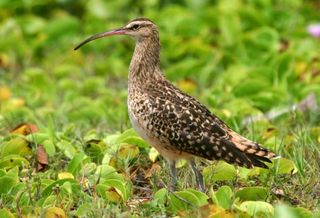
     

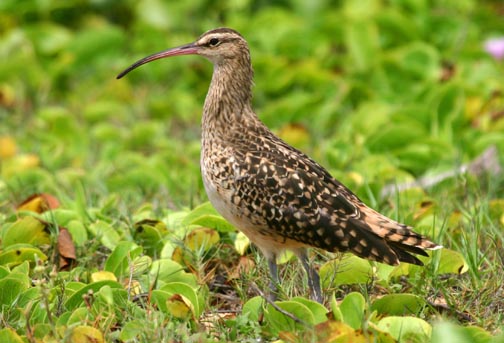
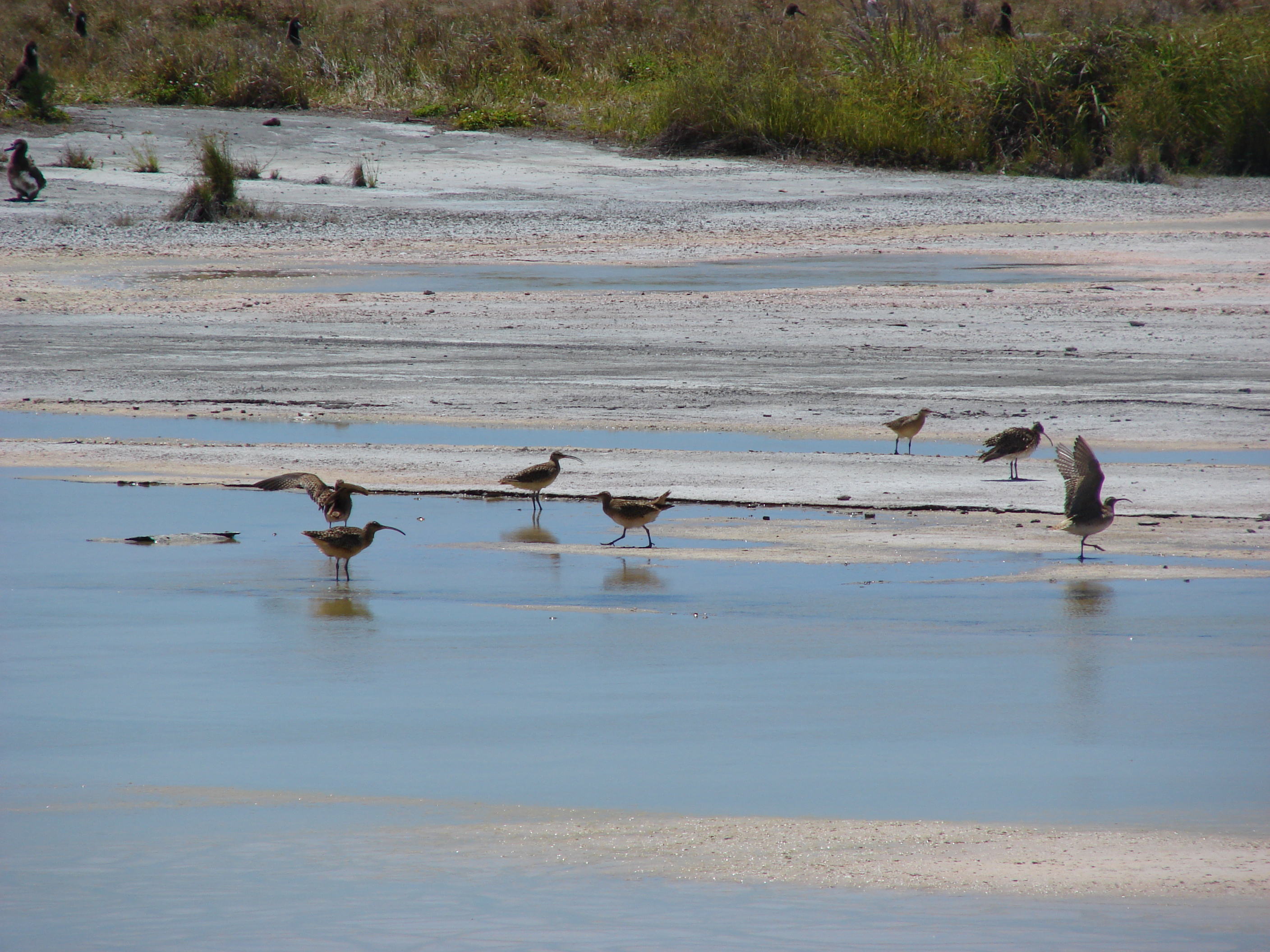
    Bristle-thighed Curlew. Photo: NPS, Bryan Harry. Public domain.

    That might be tundra with dwarf willow, so I'm guessing this bird is in Alaska


    They're hard to see. The Hawaiian
    birds aren't hanging around Oahu, they're out on uninhabited islands.
    And the Alaskan birds are off in low-lying, mosquito-infested tundra.
    If you do see one, you might mistake it for the very similar whimbrel. Hearing its distinctive call might be your
    best bet for identifying it. Birdwatchers, especially birders who are
    trying to see every breeding bird species in the US, or in
    North America, long for sightings of these rare curlews, but most have
    never seen one.
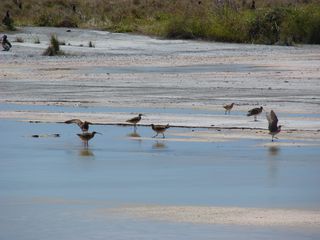
     

    Photo: Forest & Kim Starr. Creative Commons Attribution 3.0 license

    Bristle-thighed Curlews on a Pacific island beach. Not Waikiki, Midway.


    This curlew is a large brown
    moth-patterned shorebird with a long sickle bill. From a distance
    they just look brown. You can't see the complicated plumage patterns
    or the bristled thighs. I don't know why they have bristled thighs. I
    haven't run across any speculations. If you held a gun to my head and
    made me guess (part of a really sick scenario), I'd say it might have
    something to do with courtship, and showing another bristle-thighed
    curlew of the appealing sex that you too are a bristle-thighed curlew
    and you'd like to get to know them better. (Please put the gun down
    now.)


    They eat almost anything. Flowers,
    bugs, berries, land crabs, invertebrates, and the eggs of other
    birds. Here's a startling thing: they use tools to break open large
    eggs. The long sickle bills aren't the best tool for smashing things,
    so they grab rocks or pieces of coral and slam them down on the egg.


    They're the only shorebirds known to
    use tools, a habit that has been beautifully documented in a paper by
    Jeffrey S. Marks and C. Scott Hall, published in the 1992 Condor.


    Marks and Hall observed
    bristle-thigheds on Tern Island and Laysan Island, in the far
    northwestern part of the Hawaiian Archipelago. When the curlews get a
    food item too big to swallow, like a largish ghost crab, they slam it
    against the ground or a rock until it breaks into delightful
    bite-sized morsels. Adults haven't been seen doing this in Alaska,
    but baby curlews there will slam bits of moss, lichen, or plastic
    flagging (presumably put up by curlew biologists trying to get their
    bearings).


    When the young curlews arrive in the
    islands for the first time, having traveled 2,500 miles from their
    birthplace, they are in a slammin' mood, and will slam feathers,
    shells, or bits of seaweed. I presume they soon learn to focus on more edible
    things to slam.
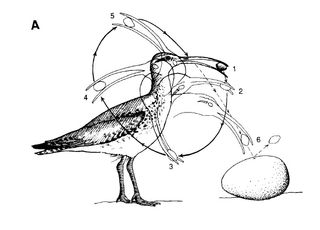


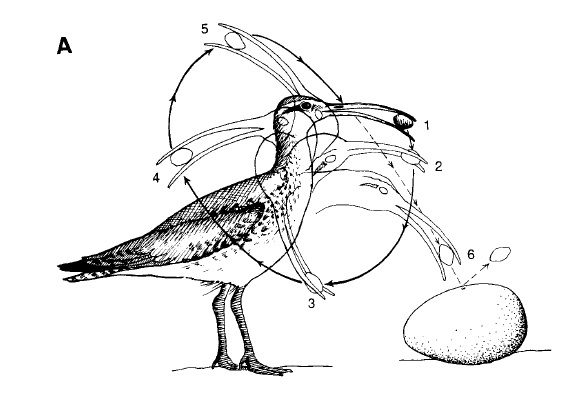
    Bristle-thighed Curlew breaking into albatross egg

    From "Tool Use by Bristle-Thighed Curlews Feeding on Albatross Eggs," Marks, Jeffrey S. & Hall, C. Scott. Condor 94: 1032-1034. 1992. Used with kind permission of the Cooper Ornithological Society. Is this not the greatest bird? Note bristled thighs.

    But sometimes a curlew comes across an
    abandoned albatross egg. It's too big to
    pick up and slam, and the shell is too thick for a curlew to puncture
    with its bill. That's when the tool use happens. Marks and Hall say
    it's probably an extension of slamming behavior, and I agree. But I
    still think it's clever. 


    So: smart rare mysterious long-distance
    travelers. A bird I'd love to see.

    * 

    At one time Rich Stallcup led 30-day
    Alaskan birding tours for the company Wings, tours for the fanatical
    and obsessed. On his fifth tour his group – 20 devoted birders –
    was exhausted from days of camping. They flew to St. Paul Island
    in the Pribilofs, arriving at 9 p.m. There were three hours of
    daylight left in the long Alaskan summer day, but word on the birder
    grapevine was that no notable rare birds were about. No vagrant
    Siberian birds had been spotted. The seabird nesting colonies – the
    two species of kittiwakes, three auklets, two murres, two puffins –
    would still be there in the morning.

    Rich assembled the weary group in the
    lobby of the King Eider Hotel, the island's only hostelry, run by
    Aleuts. He went over the next day's plan. Since there were no
    rarities around, he said they could all go to bed early, and sleep
    in.

     After five hours sleep, Rich found
    himself wide awake. He wandered down to the beach. “I'm just
    admiring the Kittlitz's Murrelets,” he told me, when he heard a
    bird call he'd never heard before. (He whistled this for me –
    Sibley gives the flight call as “teeoip.”) “I go, 'Ho, shit.
    What's that?'” Teeoip!
     

    “Straight in from Hawaii, here comes
    the Bristle-thighed Curlew, one of the most wanted and rare birds in
    America. It flies right in front of me – teeoip! – real low. I'm
    just quivering because it's so great.” The curlew flies away, low
    and to the west, whistling teeoip “as if it wanted to land,”
    leaving Rich on the beach, in awe and dread, wondering “What am I
    gonna say at breakfast?”
     

    The trip leader is not supposed to
    sneak off and see the good birds himself after telling everyone to
    sleep in. And the Bristle-thighed Curlew is an unspeakably good bird.
     

    Rich spent the day trying to atone. If only they could find the curlew again! He dragged the group all over the island,
    even when they whimpered about missing lunch. (They must have
    despaired of seeing the curlew by then, to complain about such a
    petty thing. And maybe they had been too agitated to eat their
    breakfasts. Still.)
     

    Late in the afternoon, at Stony Point
    Lake, the curlew sprang up. It landed where everyone could see it and
    drink in its exotic beauty, marvel at its thighs. They returned to
    the King Eider in triumph, rejoicing mightily.
     

    “That evening we went over in a bus.
    We brought most of the Aleuts, the seal-killers and the mechanics.
    Everybody wanted to see this wonderful thing.” That's not something
    that usually happens on birding trips. That Rich's excitement was so
    infectious, and that he was so intent on sharing the experience,
    tells you a lot about him.
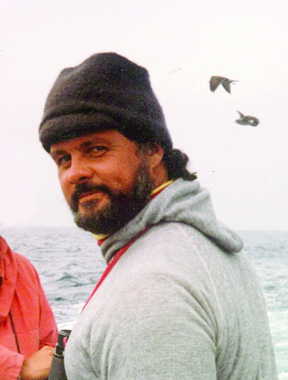
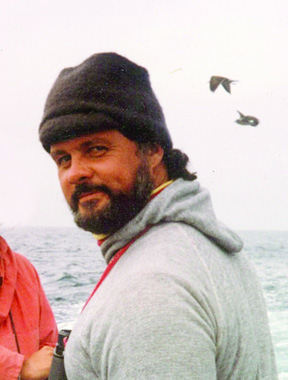
    Rich Stallcup

    This photo of Rich Stallcup appears in a lobby display at the headquarters of PRBO Conservation Science (www.prbo.org). The building is dedicated to Rich, who co-founded PRBO in the 1960s and served as Naturalist and Bird-A-Thon Committee chairperson until his death in December 2012. Photo by Janet Wessel.

    At the lake the curlew was bathing in
    company with a Eurasian Whimbrel (Numenius phaeopus phaeopus),
    a bird ordinarily notable in itself. Eventually the Whimbrel wanted
    to leave. “The Whimbrel jumps out of the water and starts
    screaming. Quiquiquiquiqui! The curlew gets out. Quiquiquiquiqui! The
    whimbrel's so anxious, it jumps up into flight, and finally the
    curlew jumps up too, and they tower up to a thousand feet – with
    oldsquaws chittering, and Black-legged Kittiwakes – kitti-weeik!
    Kitti-weeik! – and they fly off. People were on the ground
    weeping.”


    Teeoip!


    Teeoip, Rich.


  • I volunteer at a wildlife rescue
    center, one which specializes in aquatic birds. Sometimes volunteers
    and staff apologize to the birds.


    Red-throated loon (Gavia stellata). Photo: Dick Daniels. (http://carolinabirds.org) Creative Commons Attribution-Share Alike 3.0 Unported license

    What's that you have in your hand? Oh, a camera? Are you sure? It can't take temperatures, can it?


    A Red-throated Loon is brought in and
    has an intake exam, in which we try to figure out what is wrong with
    the bird. What made this wild creature so ill or hurt that it fell
    into human hands? What are its problems? Are they things we can fix?


    We handle it, pull its legs out and
    study its feet, extend its wings and fold them up again, stare into
    its desperate face with our huge monster faces. We draw blood from
    one foot. We take its temperature, and it flinches as the thermometer
    goes into its cloaca. “I know. I'm sorry,” murmurs the person
    inserting the thermometer.

    Photo: Henrik Thorburn. Creative Commons Attribution 3.0 Unported license.

    Adult Red-throated Loon, suspicious of photographer. Chicks in background show a fish what a loon can do when it's not being pestered.


    We'll learn more about his condition
    when we get the results from centrifuging his blood. We can already
    tell the bird is skinny and cold. His temperature, which would be a
    fever for a human, is low for a bird. We keep an eye on his
    temperature, and end up moving him into a warm intensive care room.


    These are wild birds, and our practice
    is not to talk to them, and to minimize talking around them. We work
    quietly. But occasionally apologies slip out.


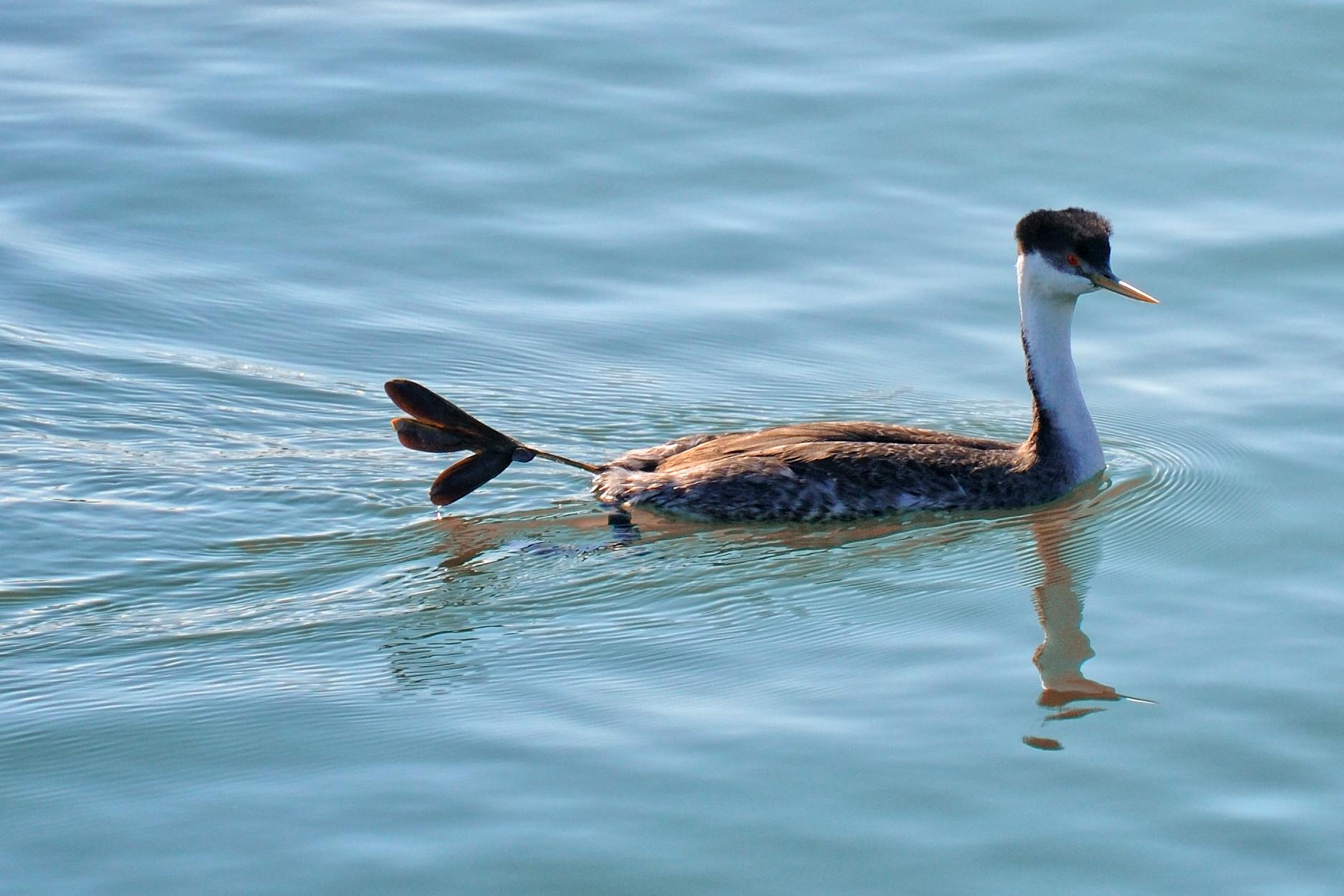
    Western Grebe (Aechmophorus occidentalis). Photo: dominic sherony. Creative Commons Attribution-Share Alike 2.0 http://www.flickr.com/photos/9765210@N03/3204305698/

    You don't put any tubes down my throat and I won't put any beaks in your eye. Deal?

    A lot of Western Grebes have been
    brought in lately. An indignant grebe has just been examined, and is
    being returned to a big pool where he can swim around with other
    grebes. He's wrapped in a towel. Right before we put him back in the
    pool, we'll give him some medicine, and a feeding through a tube,
    because he's still too thin, and doesn't really have the hang of
    eating dead fish out of the basket on the side of the pool. He
    doesn't want the tube down his throat, and we don't blame him. He
    struggles. “Calm down,” the other volunteer tells him. As he
    jerks his head, she says quietly, “I don't like it either. I
    apologize.”

    Photo: ©2009 Britta Heise. Creative Commons Attribution 2.0 Generic license. http://www.flickr.com/photos/40630886@N03/4113791594/

    A rude gesture? I don't know why you would assume that.


    Some of the people who work here have
    pet birds at home. Those birds understand human tones of voice. Not
    these wild ones. Soothing voices don't soothe these guys. In their
    natural lives, they're never around terrestrial mammals. They don't
    have much intuition about our noises.


    So why do we apologize to them? It's
    not to help them. They don't understand the words, or the tone.


    We say we're sorry, and we go right on
    doing it. We're sorry in the sense that we don't want to hurt and
    frighten them. We regret the necessity, but we do think it's
    necessary. Taking the loon's temperature gives us information that's
    likely to save its life. Tube-feeding the grebe will keep it alive
    until it's well enough to eat on its own. They'll both go free when
    they're healthy enough to survive.


    The little sorries just slip out. Maybe
    we're apologizing for our own sakes, to stay aware of where we are on
    the long slick slope of our concern for them. On one end of the slope
    we would take over their lives, make them into pets or livestock or
    exhibits. Unwild. On the other end we'd treat wild animals as wholly
    other, wholly responsible for their own welfare – we'd let them
    die, or at best, “put them out of their misery.”


    One reason we don't is that wild
    creatures no longer live in a world that humans haven't affected
    drastically. We've changed their habitats: we've shrunk, depleted,
    invaded, and tainted those places. Humans have taken away some of the
    resources wild animals use to support themselves. This wildlife
    rescue center came to be, and specializes in aquatic birds, because
    of oil spills.


    So we've placed ourselves somewhere in
    the middle, neither disclaiming responsibility nor trying to manage
    them like unruly pets. We work at not going too far toward either
    extreme. Maybe saying sorry helps us keep that balance.


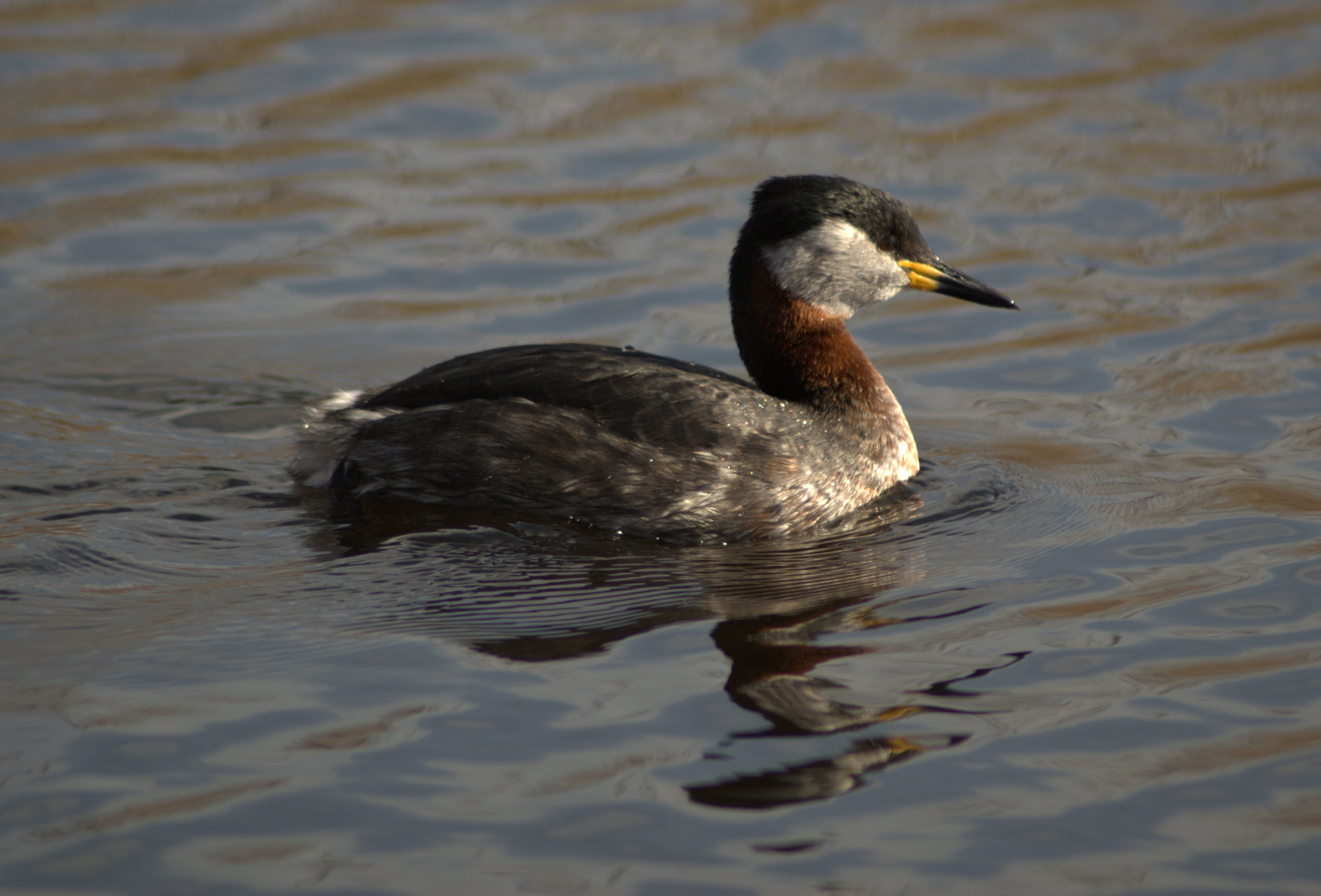
    Red-necked Grebe (Podiceps grisegena). Photo: Martin Olsson. GNU Free Documentation license, Version 1.2.

    The loon told me about you. Sicko.

    Here's a Red-necked Grebe, with wounds
    on its feet. For these birds, foot injuries are dangerous. Like
    bedsores, they can rapidly turn ugly, grow, spread infection through
    the body's system, and kill. The birds need to have decent feet
    before we let them go.


    At night, in winter storms, some birds
    try to land on rain-slick surfaces that look like water to them –
    roads, roofs, or pavement. They may break bones or tear up their
    feet. Maybe that happened to this grebe. Its feet are starting to
    heal, and to help the process along we have to debride the wounds.
    That means someone has to take (sterilized) retractors and pick dead
    tissue out of the site. Sometimes it hurts the bird.


    The small grebe twitches, tries to jerk
    its foot away. Softly, the caregiver says, “I know. Sorry, buddy.”


    Photo: Łukasz Łukasik. GNU Free Documentation license, Version 1.2.

    They love their Halloween costumes so much I didn't have the heart to make them change. They're warrior ninja grebes and I have to warn you: I have NO CONTROL over them.


    Note: This post is the first ever to
    be cross-posted on SorryWatch and The Nature of the Beast.


  • The writing here focuses on animal behavior (and humor). I’m co-author, with Jeffrey Moussaieff Masson, of When Elephants Weep: The Emotional Lives of Animals, and author of Becoming A Tiger: How Baby Animals Learn to Live in the Wild.

    With Marjorie Ingall I publish SorryWatch, a blog that analyses apologies. It would be great to find material that would work on both the apologies blog and the animal behavior blog, but so far, not much luck.


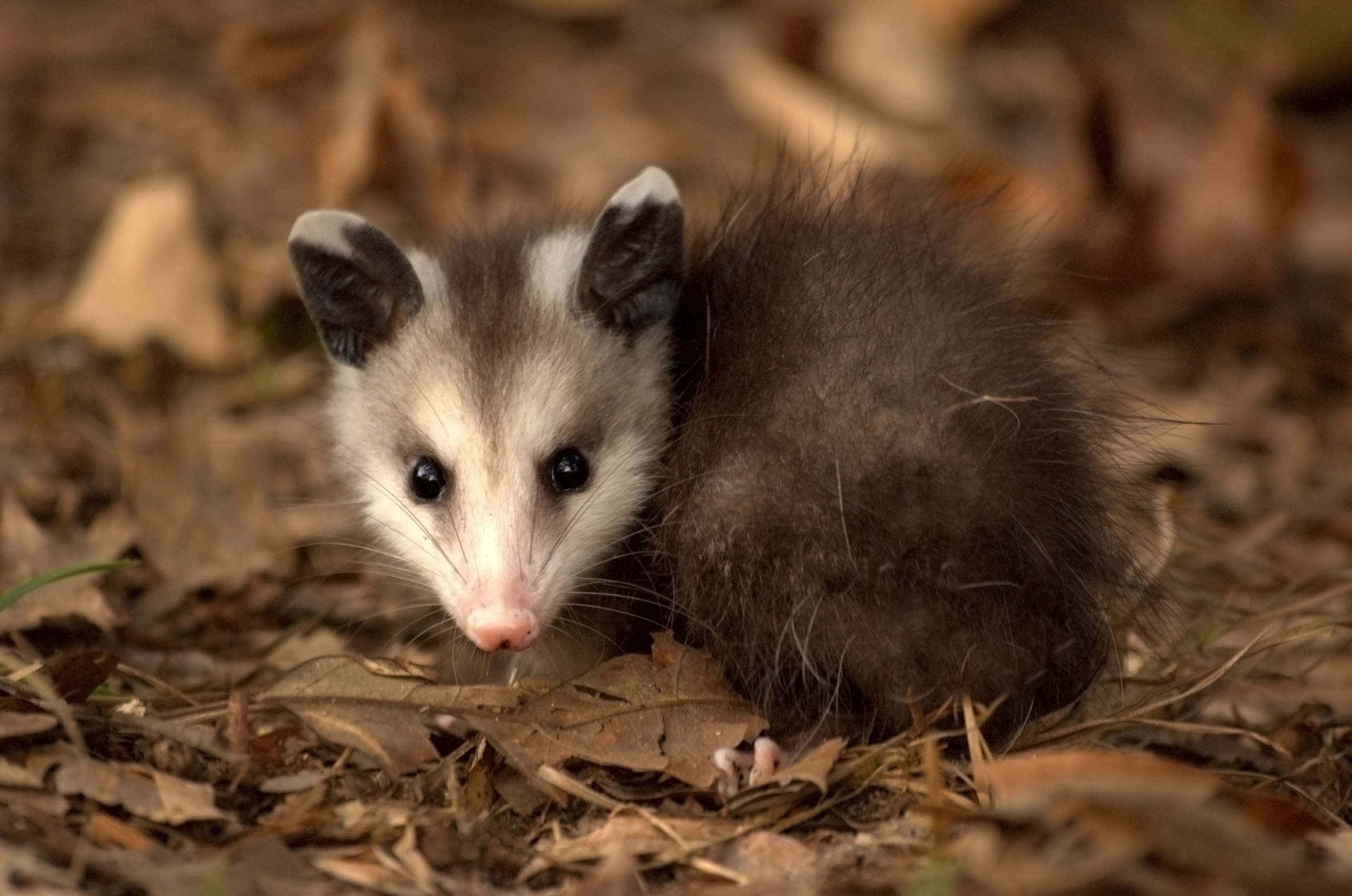
  • Young possum in oak leaves. Photo: Liam Wolff. Free Art License. (Probably not as thoughtful as it looks.)

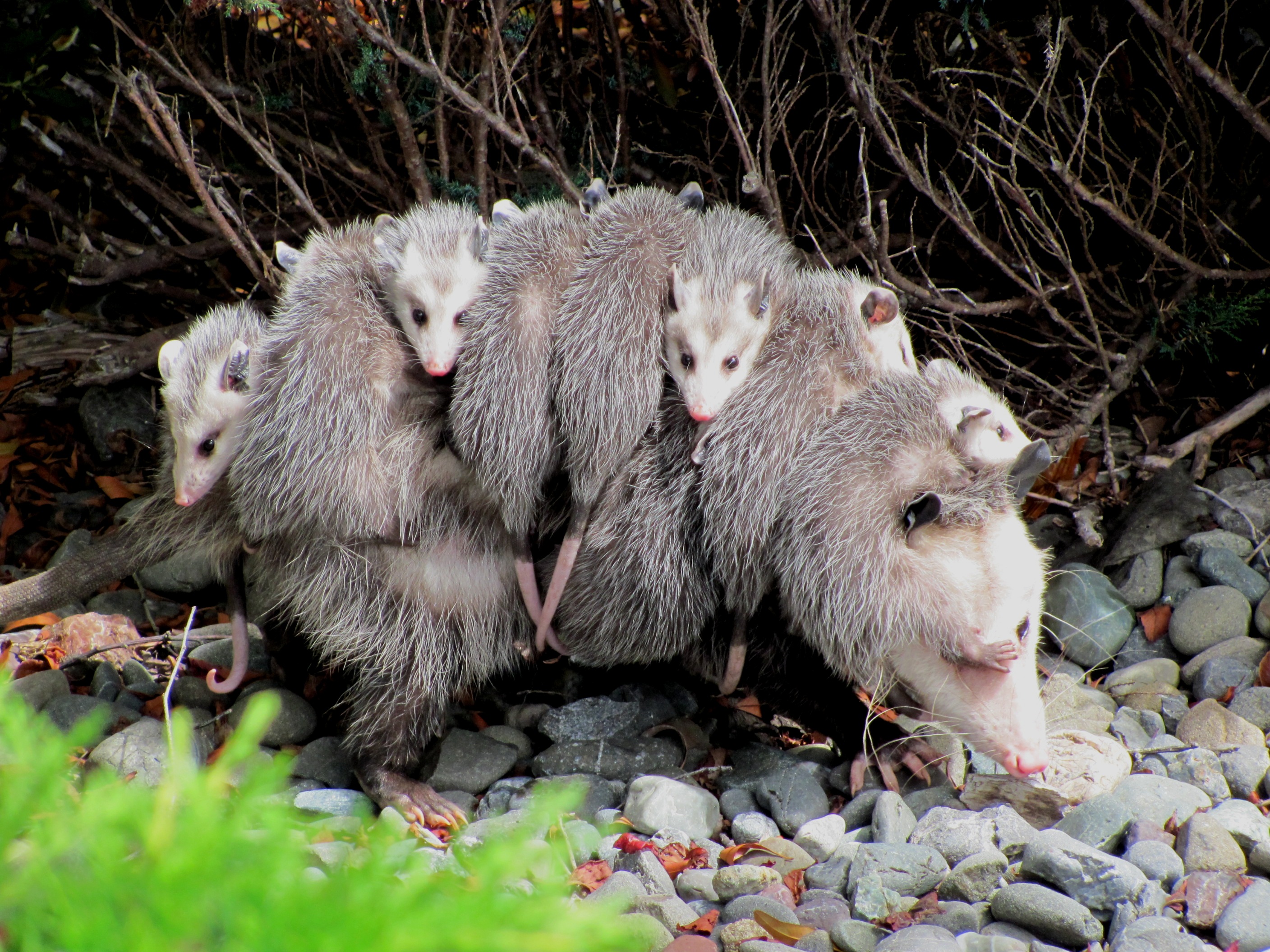
    Young and charming.


    A
    long time ago, I had some baby possums. Their mother had been killed
    by a car while crossing the road with her children on her back. A
    teacher who found them gave the survivors to me. (At the time there
    were no wildlife rescue centers in the area.) Fortunately, they were
    more or less weaned. I carried them around in my shirt pockets.

    They
    were lovely then. They had soft silver fur with black rings
    around their eyes. They had little white-furred hands, and if you
    gave them a slice of apple they would sit on their haunches, hold it
    in their hands, and eat it the way people in cartoons eat slices of
    watermelon. They had prehensile tails, with a little soft white fur
    on them, and if you forced them to, they would hang from your finger
    by their tails. They loved to clamber about on your body, checking
    out your pockets.


    Photo: Specialjake. Creative Commons Attribution-Share Alike 3.0 Unported license.

    Visibility: poor.


    Although
    they trusted me, they showed no signs of loving me or anyone. As they
    got bigger, their beautiful silver fur grew coarse, which is why you
    so seldom see possum-fur coats. Their tails coarsened, too, scaly and
    ratlike. Their 50 teeth became more worrisome to see, although they
    never bit a person.

    While
    under one of my relatives' care, one of them, Stong, escaped. He
    trashed a neighbor's cat which foolishly attacked him, and went on
    his merry way. The other one, Buckley, went to college with me. He
    learned but little.


    Male
    possums can raise and lower their (large) testicles at will, and it
    was amusing to watch Buckley waddling over rough terrain, raising his
    testicles over obstacles. He had a full suite of instincts and was
    astoundingly good at locating ancient rotten fruit, baby robins in
    the shrubbery, and other toothsome snacks. He would hiss when I took
    these things away from him, but not bite. Despite these skills, he
    feared the forest and would climb my leg in a panic if he thought I
    was leaving him. If I tried to stroke him, he would flatten his back
    to avoid my touch. (Thus if you tried to stroke him while he was
    crossing a testicle-snagging obstacle, he would become quite flat.) He
    didn't like to be scratched either. He didn't care for dogs and cats.
    He enjoyed eating, sleeping, and sniffing things.

     In
    addition to Buckley, I took my dog and cat to college (I lived
    off-campus). Then there was the chicken, whose name I have forgotten,
    let us say Dave. 


    Possum. Photo: Risssa. Public domain. (My grapes, mine.)

    An adult possum, stealing grapes, unrepentant.  


    My
    friend Laurel was taking embryology. In the lab there was an
    incubator full of fertilized chicken eggs developing into chickens,
    commercial Leghorn crosses. Periodically the class would dissect a
    few to see how the embryos developed. Some never got dissected and
    hatched into dear little fuzzy chicks. The professor jovially offered
    to put them down, but several students said no! they would adopt
    the fluffballs. Laurel, who lived in a triple, took one. Soon it
    was time to go home for the summer. Dave was no longer fuzzy – he
    was starting to get unattractive pinfeathers. Laurel was doubtful
    that border officials would let her take Dave to her family home in
    Mexico City, and certain that they would not allow him back across
    the border.


     So
    since I had a dog and a cat and a possum and lived in the US and was
    driving home, would I take Dave? Okay. Laurel delivered him to me,
    with his box, and his chicken feed, and his water dish.


    I
    took him home and all was well. Not that my father was pleased with
    this addition. At night, I covered Dave's box with a larger inverted
    box, so he would sleep in darkness serene.


    One
    morning I got up and began to tend the livestock. The dog and cat
    went out. I let Buckley out to trundle around the room sniffing
    things. Waddle, sniff, peer, sniff, waddle. I lifted up the top box
    so Dave would know the sun had risen. But unbeknownst to me, Dave had
    leapt out of his box and was in the space between the outside of his
    box and the covering box. When I lifted the covering box Dave dashed
    brainlessly across the floor and Buckley whirled at the speed of
    light CLOMP and sank his teeth into Dave's neck, killing him
    instantly. He hissed when I took Dave away from him.


    I
    felt awful. I let my possum kill Laurel's beloved Dave! (At least I
    didn't let him eat Dave.) How would I tell her? I didn't have her
    number in Mexico, so I put it off.


    In
    the fall I was dreading having to tell Laurel. I didn't go looking
    for her. Finally I saw her coming toward me in the quad. I had to
    face her. She was bubbling with information about her summer, her new
    dorm, classes. I listened and said little, racked with misery.
    Finally I said, "You know your chicken you gave me to — "

    "Do
    you still have him?"

    "No,
    I'm really really sorry — "

    "Oh
    thank God! I was dreading having to tell my roommate I had a
    chicken!"

    I
    did tell her what happened, but she didn't really care, for the love
    of Dave had receded in his absence. Well damn. I could have let
    Buckley eat his catch.


  • In The Nature of the Beast I describe and interpret aspects of animal behavior that interest me. Sometimes that includes human behavior.

    I usually try to be funny. Not that you can tell by this page. For some reason I’m in a grave mood. When I find out who’s to blame, action will be taken, and levity will resume.

    I’m the author of Becoming A Tiger: How Baby Animals Learn to Live in the Wild, and co-author with Jeffrey Moussaieff Masson of When Elephants Weep: The Emotional Lives of Animals. Those are good books with great references.

    On another subject, I’m co-author with Marjorie Ingall of SorryWatch, a blog that describes and analyzes apologies. That’s funny too. You can see it at http://www.sorrywatch.com or follow it at McCarthyBeast on Twitter.


  • On the whale-watching trip in Monterey Bay we were lucky enough to see not only humpback whales but also blue whales – the largest animal that has ever lived. The humpbacks and the blues both had calves with them. We had the happiness of seeing that these species were reproducing, and of glimpsing (barely) their maternal behavior. Photo: Mike Baird. Creative Commons Attribution 2.0 Generic. http://www.flickr.com/photos/72825507@N00/2838719126 (Very very cool to see. Yet not an intimate encounter.)


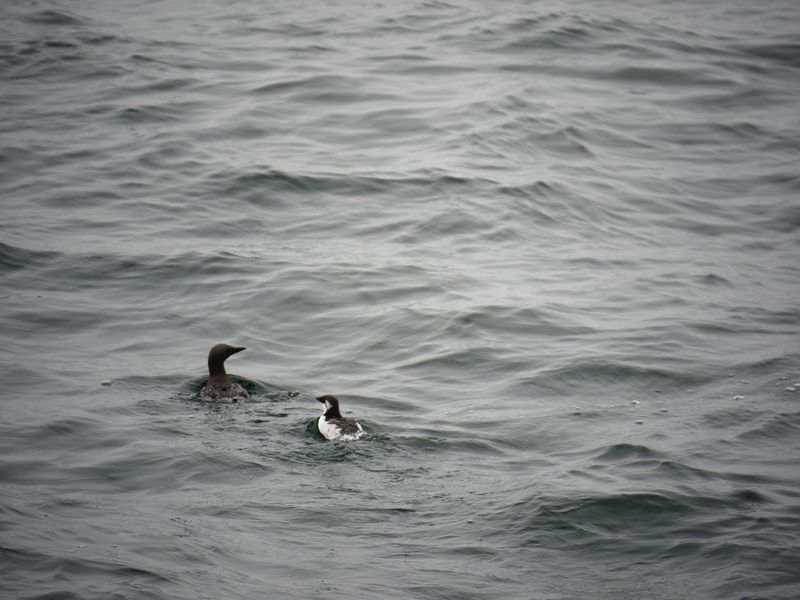
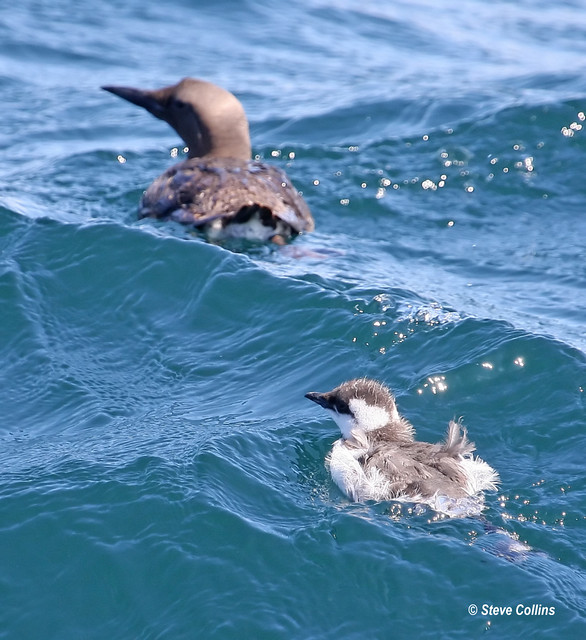
    A less glamorous species – small, dowdy, unremarked – was also displaying parental behavior. Here and there on the waves (oog, waves, where is that dramamine?) were twosomes of the Common Murre. (They're Uria aalge, and murre rhymes with purr. No y-sound.) Photo: http://www.flickr.com/photos/40723658@N05/7778186192/in/photostream -- Used with kind permission. (HERE COMES BABY!!!)


    Murres live by catching fish. They dive beneath the surface and use their wings to fly underwater. Maybe it's something you have to practice doing to be good enough to make a living.


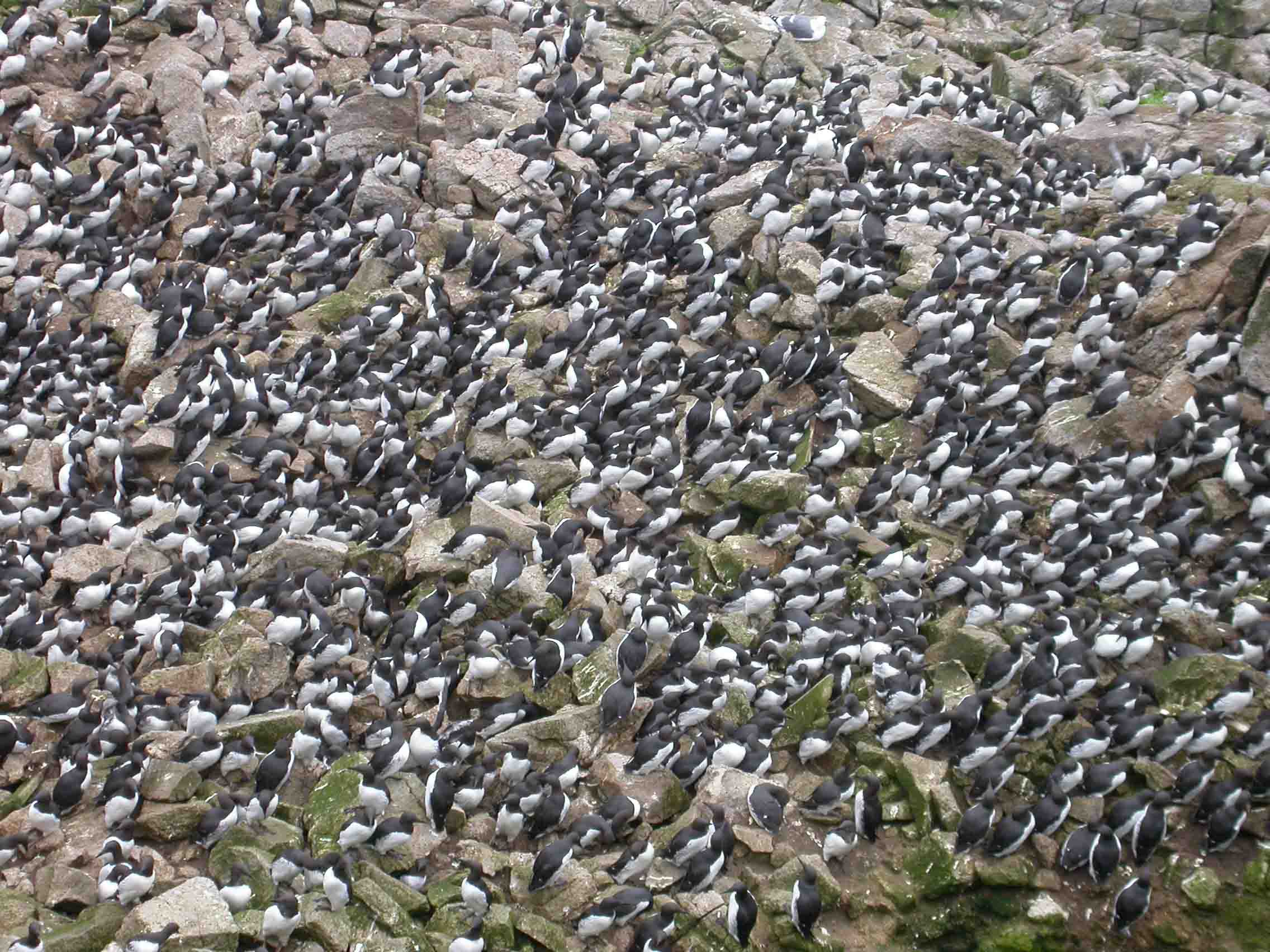
    They're superbly formed for the life aquatic, but they must resort to land to raise a family. Murres nest in crowded colonies on rocky islets or coastal cliffs. A pair of murres raises a single chick a year, if they are lucky and things go well. Father and mother go to sea and bring fish back to the crowded screaming rookery. Photo: Duncan Wright. GNU Free Documentation license 1.2. (BABY'S WHERE?)


    Each chick shrieks at the top of its lungs, a piercing cry I translate as BABY'S HERE!!! BABY'S HERE!!! with maybe a touch of BABY'S HUNGRY!!! The adults recognize their child's scream, and bring fish to their own darling, and nobody else's.


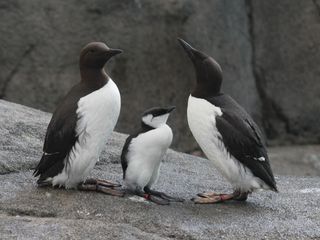
    When the chick is old enough it jumps off the rock. It can't fly yet, so it falls into the sea. And screams BABY'S HERE!!! The chick's father finds it there, attracted by his child's voice. The chick's mother does not appear. She's done her bit. She laid the damned egg, remember?

    Photo: Dean Kildaw, USFWS. Creative Commons Attribution 2.0 Generic. (We did the baby's room in a guano theme.) 

    Father and child swim away, and travel together for a few weeks. It seems likely that the chick is learning how to make a living in the exacting murre profession, although it is also possible that it's simply under its father's protection while it matures. The two are good at staying together, aided by the cry that can be heard over crashing seas: DON'T FORGET BABY!!!


    Occasionally a juvenile bird comes into a wildlife rehab center and it's desirable to put it in an outdoor pool as soon as possible, so it can be in its favored medium, practice swimming and diving, and so its earsplitting cries of BABY'S HERE!!! will have a less painful deafening effect.


    Whale children are tended by their mothers for all their childhoods. Murre children get time with both parents when they live on land, and with their fathers after they bravely leap into the ocean.  Photo: DickDaniels (http:// carolinabirds.org) Creative Commons Attribution-Share Alike 3.0 Unported. ("Your family keeps saying 'Well, there's nothing wrong with her lungs.' I don't think that's funny.")


    Those saintly men. I am sure father murres love their chicks, take pleasure in their company, perhaps enjoy seeing them become more skilled. But there must be times, there must be, when they are tempted to scream back BABY SHUT UP!!!
    Common Murre chick


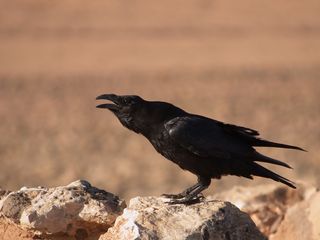
  • Long ago, starter birdwatchers in an Arizona desert spotted a huge black bird. Perched commandingly, unimpressed by puny humans.

     Could it be – a raven? In the desert? Weren't they forest wilderness birds? A handy bird guide said the raven was “Common only in the Far North and in the West, especially near heavy timber.” No timber in the Chihuahuan Desert.

    A more authoritative bird book said, “Resident of wild regions.” This desert was fairly wild…. A western bird guide Photo: National Park Service. Public domain. "I call this song 'Evermore.'"said, “Habitat: Mts., deserts, canyons, coastal cliffs, boreal forests.” Okay! Deserts! Common Raven, Corvus corax! World's largest songbird! Yay!

    The resident of wild regions has become increasingly common in urban regions. In the last 25 years, there's been a population explosion of ravens and crows in cities. If you can find a wild region, you can still find ravens residing there. But other ravens have decided to join us for dinner.

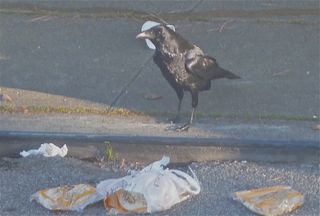
     My San Francisco neighborhood is full of them. They swoop Photo: Frank Vassen. Creative Commons Attribution 2.0. "This one goes out to food -- you know who you are." over City College, bursting out of the pines. They holler from roofs. They strut in the gutter, disemboweling that helpless urban victim, the fast-food bag. Ravens evolved as carrion eaters. In a forest, ravens track wolves. If wolves kill a moose, ravens wade in, grabbing bites. In my neighborhood, ravens keep an eye on people, especially the ones walking away from Beep's Burgers.

    What changed to make residents of wild regions feel so comfortable in the city? Lots of garbage around, but that's not new. Probably what changed is raven culture. Young ravens stay with their parents for months learning what's safe, what's dangerous, and where food is. 

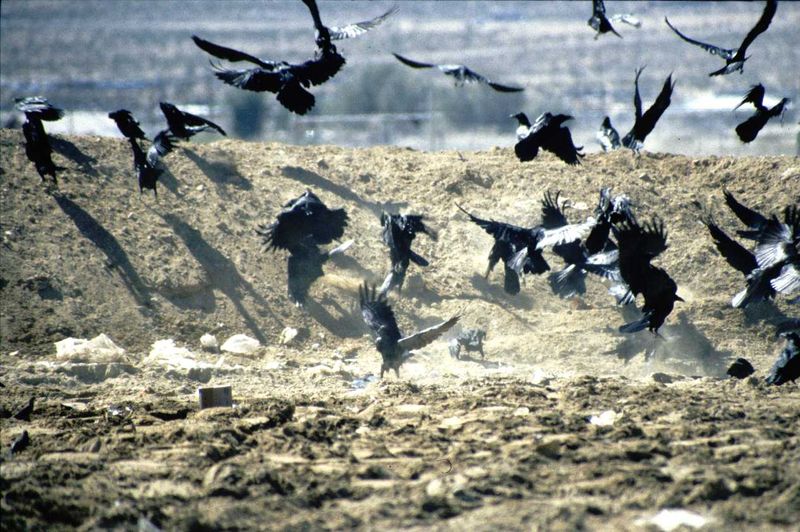
    Photo: United States Geological Survey. Public Domain. Mmm, landfill.
    There are several hundred ravens in San Francisco, and not nearly enough places for all those giant birds to nest. So most birds around town are non-breeders, hip young consumers with spare time and a burning curiosity about the world and which parts of it can be eaten. They know the best dumpsters, the most spacious dumps, and the most generous handouts. Public domain. Raven in San Francisco.

     Many people feed ravens. People love the contact with wild animals, and ravens are cool. They are huge and hilarious as they high-step toward your offerings. Sometimes feeding them lets you observe their intelligence. I met a woman who feeds ravens at Fort Funston. When she arrives, ravens gather even before she parks – they recognize her car. She scatters peanuts across the iceplant, and dozens of ravens search for them.

     Another time I met a man sitting on a bench overlooking the sea. A raven stood on the seat next to him. Another perched on the back of the bench. He doled out snacks. He said these ravens knew him well, and described their family structure. (He said they were father and child.)

      Image: Astrid Andreasen. Public domain. Raven is "ravnur" in Faroese. The black and white pied ravens of the Faeroes were shot out and no longer exist.I love ravens. Feeding animals is fun, and it feels like a win-win. Certainly the ravens would vote for it. But I don't feed them, and I think no one should.


    The problem is that ravens are clever wild animals who find their food in many ways. One way is robbing nests of other birds and eating eggs and nestlings. The ravens of wild regions have always done this, and city ravens have kept up the skill. Stuffed with garbage and treats, urban ravens have plenty of leisure time to look for nests of little birds. It would be nice if well-fed ravens didn't feel like robbing nests, but no. They still enjoy the hunt.

     Nature's way, even if it's kind of depressing, right? Are we supposed to try to convert wild animals into kind vegetarians?

     No. It's nature's way for ravens to rob nests, but it's not nature's way for there to be so many ravens. We've created surplus predators, whose numbers aren't controlled by prey supply. Nature's way includes predators starving if they destroy prey populations. City ravens don't starve, because they have garbage and handouts. Many ravens means many sharp black eyes looking for nests. A project to bring California Quail back to Fort Funston failed, apparently because ravens got all the quail chicks. But they didn't starve, because there are still plenty of french fries scampering around the parking lots.

    Photo: Aconcagua. GNU Free Documentation License. I don't know what kind of bird it's eating.Rangers in state and national parks are trying to discourage visitors from feeding ravens. (I know, they discourage you from feeding everything, and why can't a chickadee have a damn crumb, but they're particularly worried about ravens.) In 1989, in Big Basin State Park, near Santa Cruz, biologists discovered only the second known Marbled Murrelet nest. Thrilled, they began observing the nest, which produced one silent thoughtful chick. Just as the chick was almost old enough to fly, ravens killed and ate it. They'd been observing too. The Big Basin ranger campaign to make sure no garbage gets left around for ravens to eat is called “crumb management.”

     To speak of surplus predators is also to speak of outdoor cats. Same deal – we support them in high numbers, which have nothing to do with prey supply. They behave naturally, but not in a natural context. Both cats and ravens are clever, fascinating creatures. Interacting with them puts us in touch with a fragment of wildness. We shouldn't do that in a way that lays waste other fragments of wildness.

     I dislike telling people they shouldn't do fun things (feeding animals) and I dislike depriving animals of fun things (free food). So here's a loophole for city dwellers. Next time you have a moose carcass, I think it's okay to leave it out for the ravens.

      Moose. Photo: Delphine Ménard (notafish }<';> ). Creative Commons Attribution-Share Alike France. “Wait, what?”


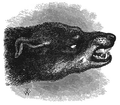
  • If Doctor Doolittle offered online courses in animal languages, I would take them all. He'd have many customers. Actually, all of us already know a few phrases Image: PNG file of a wood engraving from a drawing by T.W. Wood, illustrating The Expression of the Emotions in Man and Animals, by Charles Darwin. (Another possible translation: “I've been told I should get braces – what do you think?”)in animal languages. We don't need Intro Dog to know that this dog is saying “I might bite! Check out these teeth!”

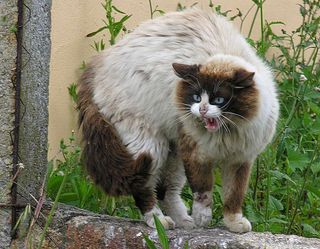
    We don't need Conversational Cat to guess that this cat is saying “I'm prepared to fight, and while you're thinking about that, notice that I AM HUGE.” Photo: Luis Miguel Bugallo Sánchez. Creative Commons Attribution 2.0 Generic. (Or: “We learned to walk like this in Runway Model Class. The expression is super important.”)

    We understand these bits of body language and so do they. Neither dog nor cat would think the other wanted to be friends. But these are generic phrases meant to be understood by many species. Normally canids and felids don't hang out together, and they don't Photo: Yuval Y. Creative Commons Attribution 2.5 Generic license. (“What's going on in that furry head?”)understand most of each others' body language. What about households where dogs and cats live together?

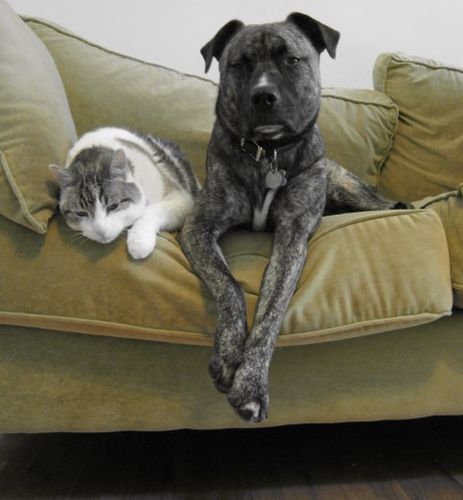
    You've probably seen households where cat and dogs get along. Sometimes they agree to ignore each other, sometimes they're civil, and sometimes they're friends.

    So we knew this, but now there's a study that backs us up. (Look it up in Applied Animal Behaviour Science if you don't believe me.) Zoologists at Tel Aviv University observed households Photo: Ohnoitsjamie. GNU Free Documentation License, Version 1.2. (“Just chilling, hanging out, working on our screenplay.”) with both dogs and cats. They scored the relationships between the pets as amicable (friendly), indifferent, or aggressive. Many pets had friendly relationships, in which they played together, licked each other, or slept snuggled up. Neta-li Feuerstein and Joseph Terkel found that pets are most likely to become friends if they are under six months old when they start hanging out with the other species. It also helps if the cat was there first.

    These dogs and cats learn to understand each other's body language better. Dogs and cats have some signals in common – like growling – but some signals have the opposite meaning in the two species. For example, bilingual pets know that rapidly moving your tail from side to side means different things coming from a dog or from a cat. When a dog wags its tail, that's a happy friendly signal. When a cat lashes its tail, the mood is very different, and the bilingual dog steps back.

    The study found that cats were about as good at understanding Dog as dogs were at understanding Cat. When a dog rolls on its back, that's a submissive or deferential gesture, often a prelude to a friendly encounter. Cats living with dogs can learn to comprehend this, even though they use the same movement aggressively. When a cat rolls on its back, that's often preparation for grabbing you with their front legs and clawing the living daylights out of you with their hind feet. Which can also be a game.

    The dogs and cats learn to understand each other's body language, not to use it. A dog may understand that the cat lashing its tail is saying "I'm outraged! I may pounce!" but the dog won't begin wagging its tail to show outrage.

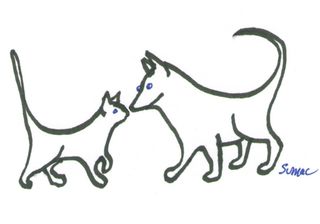
    Drawing: Susan McCarthy. All rights reserved.

    The closest thing to an exception to this rule that Feuerstein and Terkel found is nose-to-nose sniffing. This is a friendly greeting gesture among cats. Dogs usually prefer a mutual start-at-the-tail sniffing procedure. But dogs who are friends with cats learn to do the nose-to-nose with them.

    However, I would draw Feuerstein and Terkel's attention to the cat in this video, who appears to switch between languages, using Dog to threaten what I assume is a trespassing dog outside, then switching to Cat to greet a household member.


     Feuerstein and Terkel are the kind of researchers who worry about animals in shelters not finding homes. They conclude their scientific report by assuring us that it's possible to adopt both a dog and a cat. They think dog-cat friendships are particularly rewarding for the cats. Dogs are better able to relate to humans in their household as their pack, whereas a cat “seems to gain something from the presence of an additional animal,” showing more friendly behaviors. They particularly urge people with one cat to get it a dog friend to improve the cat's quality of life. If you do, I urge you to send me pictures.

    Photo: Rufus Sarsaparilla. Public domain. (“What are you staring at? Never seen twins before?”)