•  

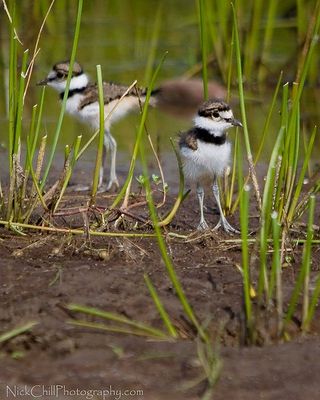
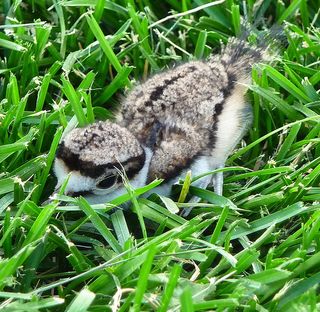
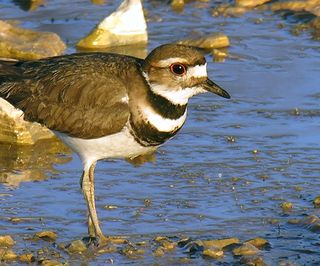
    Photo: Nick Chill Photography. Creative-Commons Non-Commercial Share-alike license. http://www.flickr.com/photos/nchill4x4/4463287839/ (So this is the world.)I had been trusted with the task of feeding the killdeer  chicks at the wildlife center. I put trays of food in the shorebird pen. Elaborate trays of shorebird dainties: freshly-thawed tiny invertebrates, insects, duckweed. I was careful to make sure no killdeer got out. It didn't Photo: Drew Avery. Creative Commons Attribution 2.0 Generic license. http://www.flickr.com/photos/33590535@N06/3779045044/ (I'm invisible. You don't see me, right?) seem hard, since the appalling sight of a human made them run, crouch, and freeze.  


    But as I was walking back toward the main building, I heard a killdeer overhead. Nowhere near the shorebird pen. Now I was the one who froze.


    Did I let one out? Oh no, did I forget to latch the door? Did they all get out? Oh no no no.


    …sounds more like an adult killdeer – it's loud. And close.


    Oh. 


    *#^&+$%.


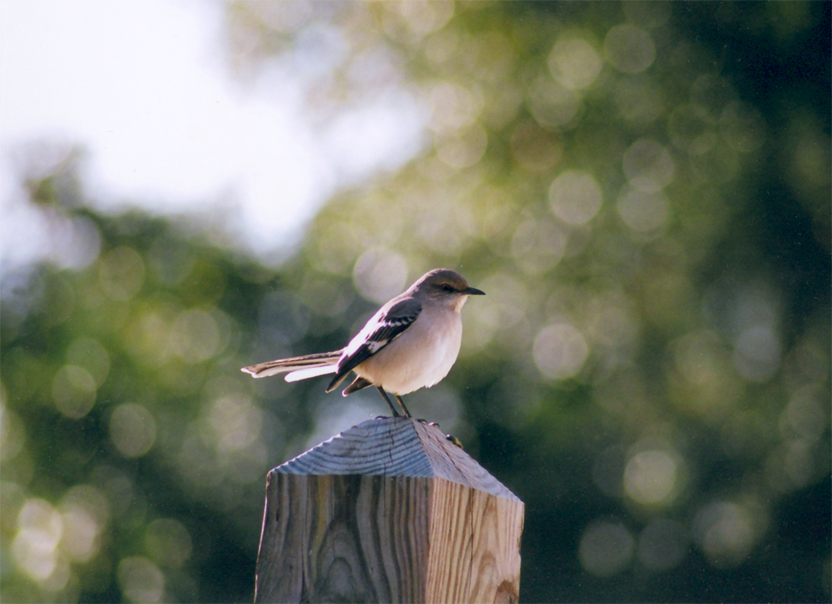
    A mockingbird was atop a high pole, running through his imitations. Starting with some killdeer calls.

    Photo: Clinton and Charles Robertson. Creative Commons Attribution-Share Alike 2.0 Generic license. http://www.flickr.com/photos/dad_and_clint/99078065/ (Fear? I can tell you about fear. This one time, I thought I was invisible? And there were these humans with a camera? And the next thing, I'M ALL OVER FLICKR.)

    Giving me a pang of guilty fear. As if I need any more of those.


    If he'd noticed, I'm sure he would have thought it was funny. He would do it again. Which is why it's important to stay stone-faced around mockers. Which you probably know. Because you went to grade school too. Photo: Geogre. Public Domain. (Did I just hear a strangled gasp?)

  • Photo: Fanny Schertzer. GNU Free Documentation Licence, 1.2. I seek fish.

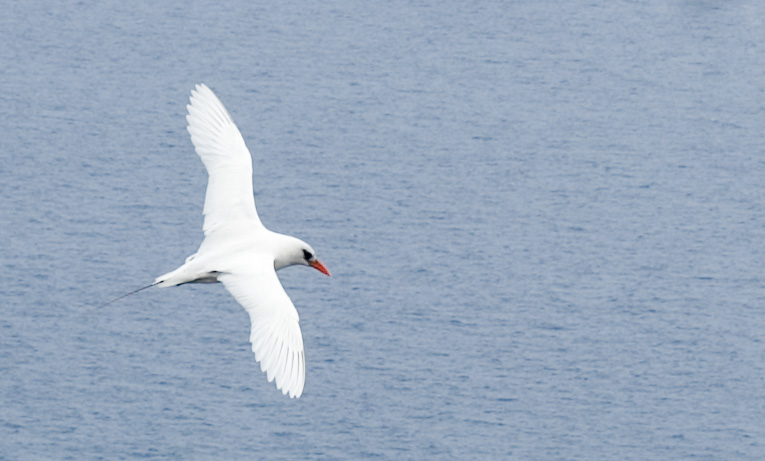
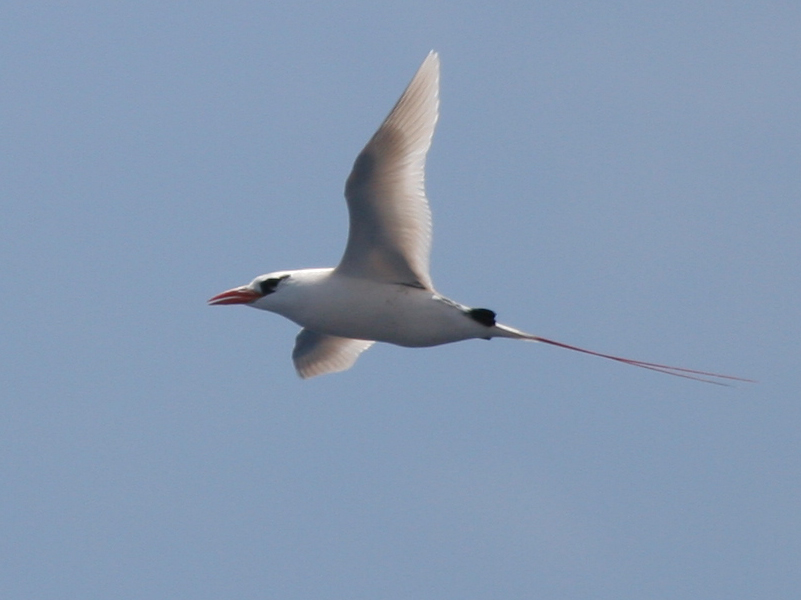
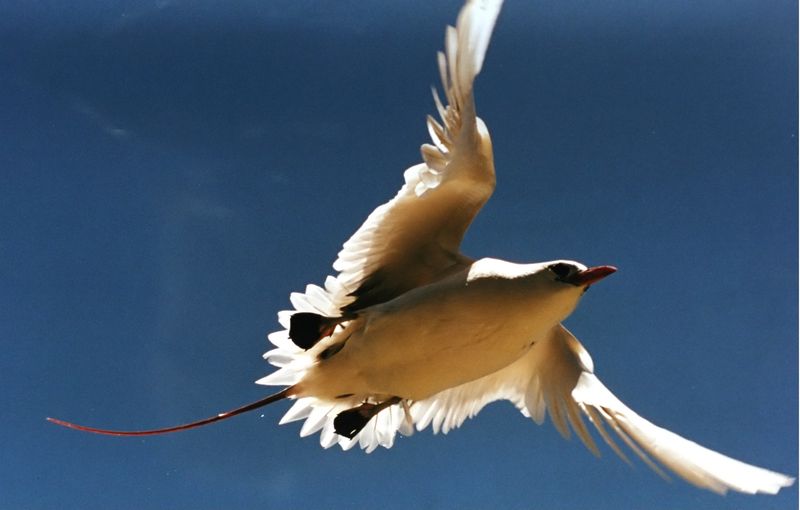
    Red-tailed tropicbirds are aces of tropical Pacific skies. They're big white birds with striking black eye markings. Each has two ridiculously long red tail feathers in the midst of its normal white tail feathers (thus Phaethon rubricauda). They catch fish by plunging into the sea from a height and grabbing them. Also squid.

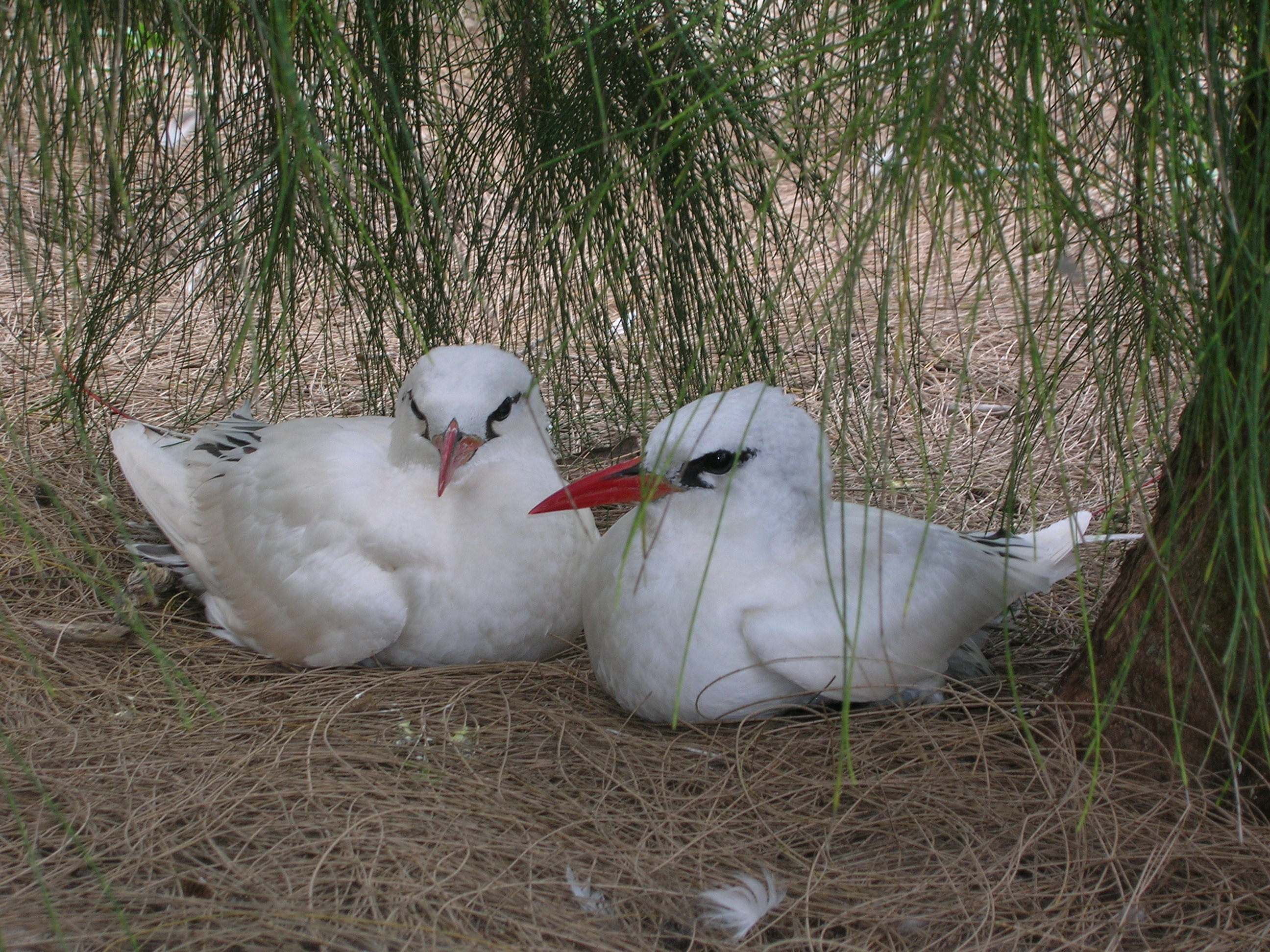
    The tropicbird is one of those seabirds that usually doesn't bother with land. They fly or rest on the water. But that doesn't work when a bird is in that awkward egg stage, so they breed on islands. They like to nest Photo: Forest & Kim Starr. Creative Commons Attribution 3.0 Unported. This is nice.colonially, let's say on a nice coral atoll, tucked under a bush, or in a niche between hunks of coral.

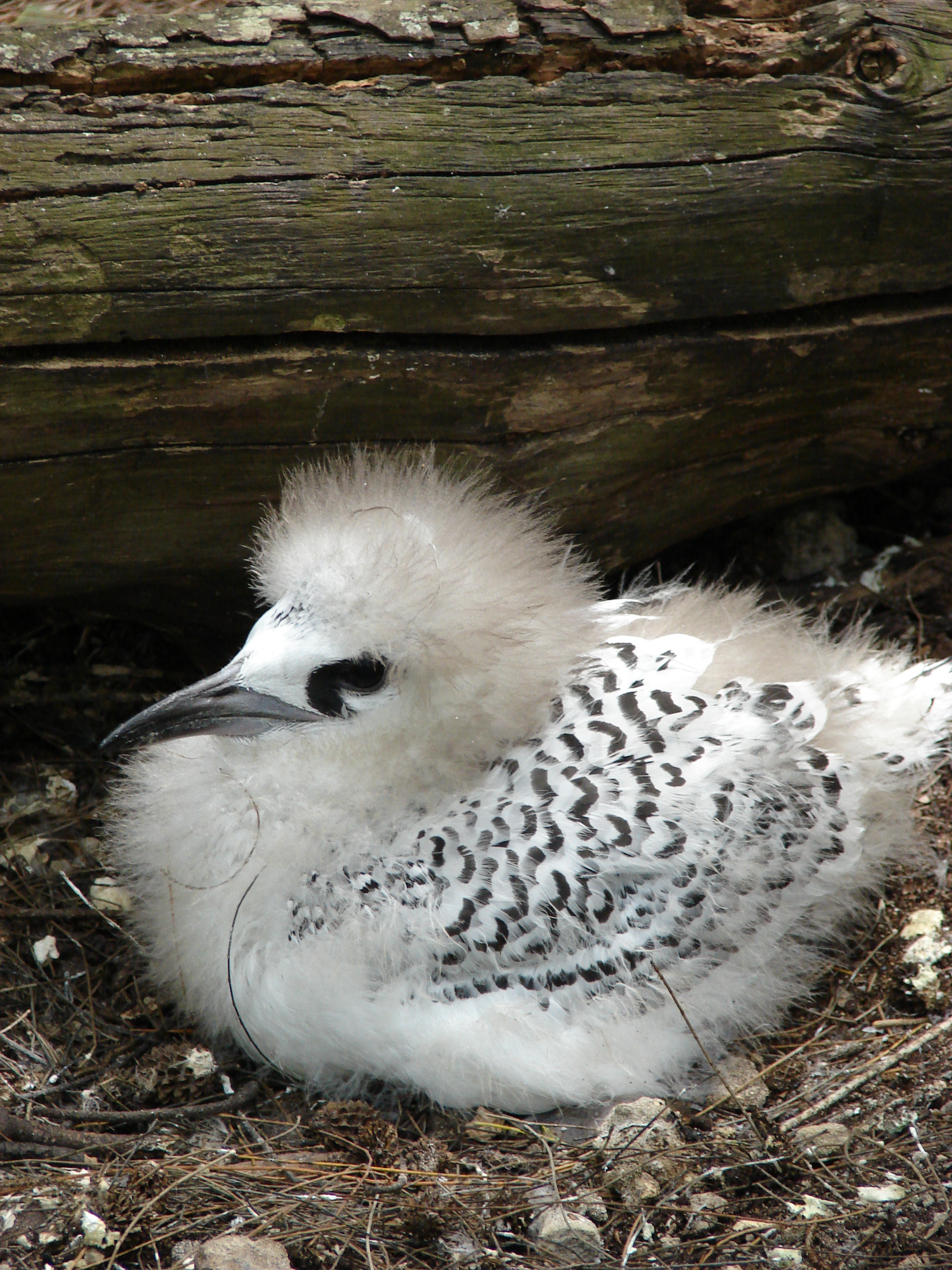
    Sometimes, apparently, a bird looking for a nice flat atoll lands on the nice flat deck of a ship, and tucks itself into a niche between cargo containers, and sits Photo: Forest & Kim Starr. Creative Commons Attribution 3.0 Unported. My parents say this is just an awkward age. They're out getting fish. And squid. I like squid. there peaceably waiting for the rest of the gang to show up, unfussed that the island it has selected is moving, like Spidermonkey Island in The Voyages of Doctor Dolittle.

    Recently a tropicbird was found sitting zazen on a Korean cargo ship. When the ship arrived in southern California, the bird was brought to International Bird Rescue's San Pedro center, where she was found to be in good health. On a recent visit, I saw her there, resting on a mesh haul-out in a small private pool. She looked at us cheerfully. It seems that tropicbirds are among the island birds that have no fear of land animals such as humans.

    Her pool was too small for plunge-feeding. IBR's blog has video of the tropicbird being fed fish. “Ah, they are grabbing my head. Yes, they are prying open my bill and inserting a fish. Ooh, there's a fish in my bill. Sweet.” The tropicbird swallows, sometimes with a little throat massage to urge the fish along, and sits placidly. It does not occur to her to reach a few inches forward and take another fish. That's not how she rolls.

    Photo: Duncan Wright, USFWS. Public domain. I seek fish. And squid.Tropicbirds are aerialists but not distance fliers, so after tests came up negative for contagious diseases, and USFWS permission was received, the bird was put on a plane to Hawaii and then on another to Midway Island. There they put her in the water and off she flew. Photo: Neil Gray. Public domain. Squid? I can get squid.

    Red-tailed tropicbirds breed on Midway, so with any luck she'll find a mate, and a nest site that doesn't shift coordinates, and will not depend on the kindness of Korean sailors, bird rescuers, and government agencies. Island tameness can be a disastrous feature for wild animals, but in this bird's case it worked out nicely.

    Photo: Mila Zinkova. GNU Free Documentation License, 1.2. Watch out, fish. Watch out, squid.

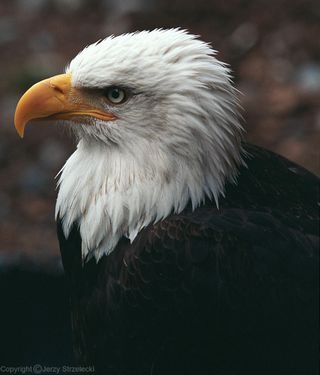
  • Bald Eagles are the specialty of the Alaska Raptor Center, in Sitka. It's an animal hospital in a forest. They treat 100-200 eagles a year, as well as other species. Many are treated and set free. Others have problems that mean they can't make it as wild birds any more. These generally go to zoos or become Ed Birds – used in educational programs of various kinds. Photo: Jerzy Strzelecki. GNU Free Documentation License 1.2. Volta, who can't help looking as if he's cross about something. Like the encounter with the power line.


    Some of the Ed Birds are in outdoor aviaries. When I visited this summer, one of the Ed Eagles, Volta, on a perch outdoors, became agitated when we passed by. My guide speculated that Volta remembered me unkindly from a previous visit.  (Although I am a friend to all animals, on that visit I was taking a course in eagle rehab, which involves doing a number of things that might displease a bird – captures, pedicures, beakicures, etc.) But it turned out that Volta was agitated about a wild eagle flying around the aviaries.


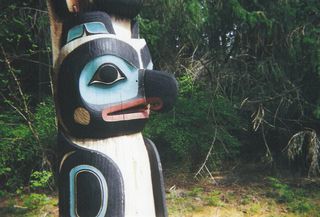
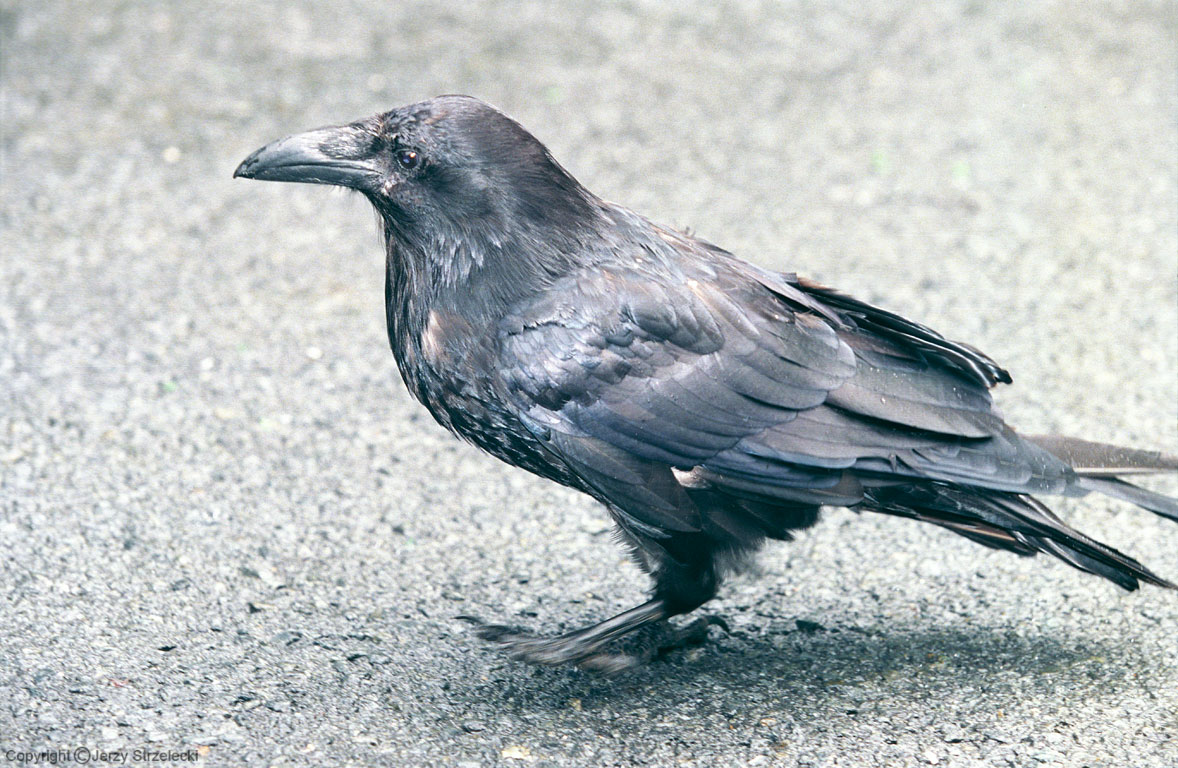
    We moved on to view Gilly, an Ed Raven. Gilly came to the center in 1997, as Gilbert, a youth of three months with an elbow so shattered by a gunshot as to rule out wild life. Gilbert became an Ed Bird and at some point, I suppose, was revealed to be female. Gilly was in an outdoor aviary and gave us a haughty uninterested glance. She has a more complex life than one might guess an Ed Raven would have. She was once housed with two other ravens, but they are a couple, who Photo: Beeblebrox. Creative Commons Attribution-Share Alike 3.0 Generic Unported. Raven totem, also in Sitka. demonstrated loyalty to each other by harassing Gilly, so she was given her own space.


    Gilly has a wild friend, Romeo. He visits her frequently, so the Raptor Center thoughtfully put an extra-long perch in her aviary, which projects out through the wiring. Romeo can perch on the outside, and Gilly can perch on the inside, and they can sidle up to each other.


    I do not know if Romeo and Gilly are romantically interested in each other. Ravens are fond of shiny things, and Romeo brings Gilly shiny things, and passes them to her through the wire. Gilly accepts them and passes Romeo bits of her food. She's no fool – she doesn't give him her salmon or her meat. She gives him vegetables and popcorn. Maybe she's concerned about his weight.


    They won't do this if you're standing right there. But if you're a few aviaries away, you can look through several wire walls and see Romeo arrive and the subsequent exchanges. I long for the Raptor Center to set up a RavenSwapCam.  


    It may be love, it may be commerce, or it may be a happy mix of the two. In any case it shows the complexity of ravens.

    Photo: Jerzy Strzelecki. GNU Free Documentation License 1.2. Gilly, an original thinker who does not say “Where art thou, Romeo?” perhaps knowing that the correct line is “Wherefore art thou Romeo?” meaning not “Where are you?” but “Why do you have to be Romeo, a person from a family hated by my family?” Nevertheless, she would like Romeo to show up.


  • It was afternoon, not the best time for wildlife spotting. We were on a forest trail by the Wynn Nature Center outside Homer, Alaska. The first of us walked briskly around a bend, spotted a rabbit in a clearing, and froze.

    The rabbit didn't flee. Perhaps it hadn't noticed him. Two more of us came tramping along, and Person One gestured for stealth. Obediently we froze, then sneaked forward to behold the rabbit noshing on a bush. Photo: Forest service of the USDA. Public domain. I am perfectly camouflaged, yet I feel a little uneasy.

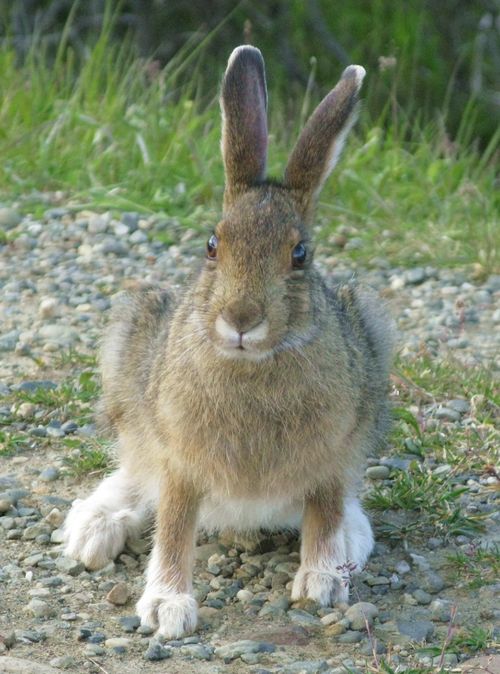
    It was a young snowshoe hare (Lepus americanus). Since it was  summer, instead of the amazing white camouflage of winter, it  had brown fur.

    Except for its giant feet. Those were white, and huge. Pearly clodhoppers. The puny lagomorph had feet so big as to appear burdensome. How is a young animal supposed to survive and elude predators if it has to tote such feet?

    Photo: Dave Bezaire & Susi Havens-Bezaire.  Creative Commons Attribution-Share Alike 2.0 Generic. http://www.flickr.com/photos/75988799@N00/3680552948 Supposedly I'll grow into them.
    Its feet were ready for winter, when their hugeness will enable it to race across snow like a lightning bolt. Then the giant feet make snow- shoes look like a brilliant  idea instead of a terrible mistake.

    It will need to race because it is so tasty and conveniently-sized, and lynxes  Suzuki Bokushi. Public domain. I am perfectly outfitted, and it's a great feeling. and owls and hawks and wolves and coyotes and simply  everybody will want to eat it. I assume it will know then that it needs to run away.

    For this rabbit didn't seem concerned about eluding predators. It turned from the bush and looked at us with mild interest. It hopped awkwardly toward us and stared. “Oh, it's tame,” we thought. “It's probably wondering if we brought trail mix.” The rabbit hopped a little closer, surveyed us casually, and turned back to bite more leaves off the bush. Then it disappeared into a mass of bushes.

    Back at the nature center we asked about the tame rabbit. They have no tame rabbit.

    Photo from Deutsches Bundesarchiv (German Federal Archive). Public domain. Snowshoes and greasepaint, a natural pairing.

    They said some young hares are properly alarmed by the sight of humans, and some just aren't. They also said hares are abundant now, on an upswing in their famously cyclical population curve. (In areas with lynx, hare population booms and busts are closely followed by lynx booms and busts.) That alleviated any worry that the bunny cluelessness we had witnessed portended an end to all bunnies, but didn't explain why some are so casual about people.

    On YouTube, among many the hunting videos, you can find quite a few videos of such “eh, whatever” hares, often hopping through wilderness campsites, clad in brown fur with tremendous white feet.


    What is it with these fools? People are notorious rabbit killers. We are monsters – fear us!

    After we get a good look.

  • The story about the smelly babies isn't true. Birds don't reject their nestlings if people have handled them and gotten human scent all over them. Most birds can't smell much, anyway. (But don't say this around a vulture. Or a kiwi. Or a fulmar.)

     I don't know how this story got started, but I certainly heard it  when I was a kid. Somehow it had an appalling plausibility –  our very touch turns innocent babies to pariahs.

    Photo: Lenscv. Public domain. (Really, the smell would be the least of it.)
    (Not the actual baby robins I'm talking about.)

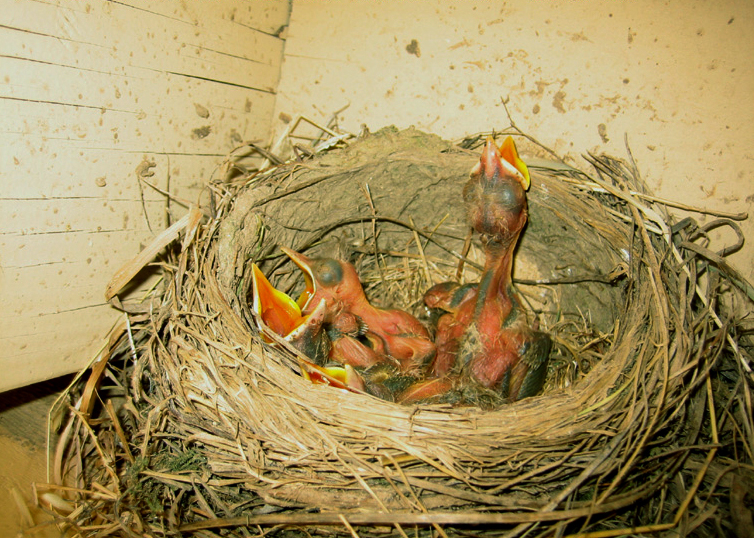
    Fortunately for three small birds I met recently, it's nonsense. These robin nestlings fell out of their nest on a windy morning. They hit the sidewalk uninjured, and a kind passer-by picked them up (intelligently noting the address) and took them to the nearest animal shelter. The shelter had the expertise, and the feeding formula, to take care of the young birds. But they knew the best upbringing for robins comes from robins. They had eight million things to do besides feeding screaming baby robins every 20 minutes. A wildlife rescue organization would try to get the robins back to their parents.

     I'd been told that the best thing to do for uninjured baby birds is to get them back up in their nest, or near their nest, or at least up in the branches of their tree out of cat-reach, and let their parents take care of them. I believed it. But I had never done it. (What if it were as false as the human-stink story?)

    We inspected the site. With the address, we could identify the home tree, but it was leafy and no nest could be seen. Besides, that nest was clearly a slipshod dealio that baby robins fell out of in a high wind, a flimsy sieve, a deathtrap. We'd have to rig up a substitute. The worrying part was that there didn't seem to be any robins there. The parents were supposed to be hanging Photo: Ltshears. Creative Commons Attribution-Share Alike 3.0 Unported. You don't know what you're talking about. That nest was brilliantly constructed, and incredibly well hidden. around calling for their children. But no. No one was around but blackbirds. By this time the babies had been away most of the day. Had the parents given up? 

     We thought we'd try anyway, so we went to get the chicks. They were past the naked blob stage, into the partially-feathered lump stage. They were starting to have robin faces. Maybe a week from fledging, they were correctly-behaved bird children. They alternated between gaping and screeching, twittering softly, and squatting silent and motionless like little lumps of ugly. The shelter gave them a feeding, which would last them in Photo: Susan McCarthy. (The actual robins described.) case their parents never returned and we had to bring them back.

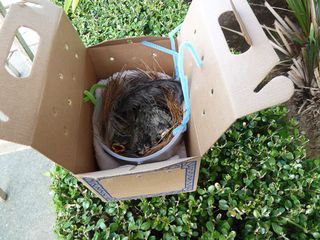
    Back at the tree, we scanned for robins. Nothing. Using a ladder, we wired a plastic tub into the branches, making sure it wouldn't tip in the wind like certain shoddy constructions. We'd made drainage holes so liquid couldn't collect in it. That was the nest. The shelter staff had made a nice lining with pine needles and bits of Photo: Susan McCarthy. (The world is a strange place.) a feather duster. While the wiring took place, the nestlings hunkered low inside, pretending not to exist.  

     We took the ladder away and looked around. No robins. We peered around with binoculars. Nothing but blackbirds. We crossed the street and sat on a bench and looked. No robins. So we got in the car and drove away, but then came back, and parked across the street, taking advantage of robins' inability to read license plates or tell a Delorean from a Hupmobile. We stayed in the car. Blackbirds flew over the tree, perched on a wire above the tree, and squeaked at other Photo: Ltshears. Creative Commons Attribution-Share Alike 3.0 Unported. You call that a nest? blackbirds, but there were no robins.  

     Until suddenly there was a silent robin in the tree next to the nest tree. With something in its bill. It silently dived into the nest tree. It had been 16 minutes since we walked away from the tree.

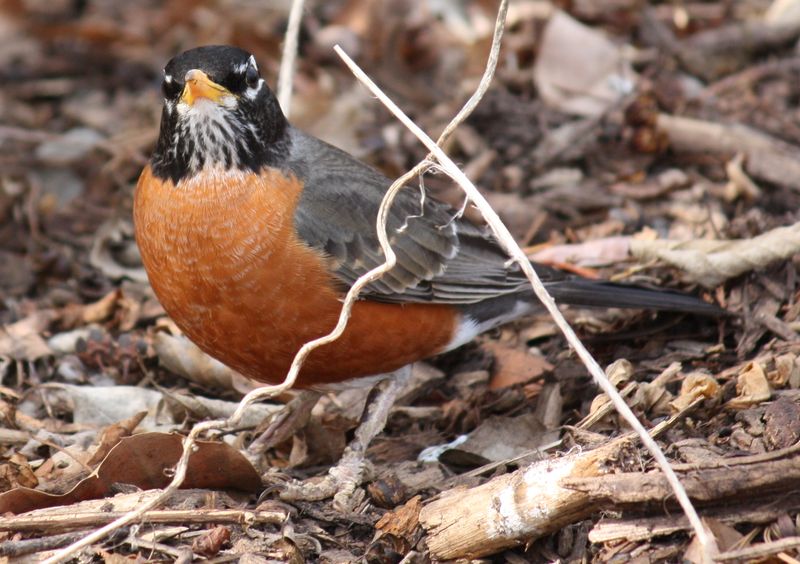
    Photo: Ciar. Creative Commons Attribution-Share Alike 3.0 Unported. (Not the actual robin we saw, but a better picture than the one we took.) What are you looking at? To be sure it was true, we walked down the other side of the street, crossed, and casually walked under the tree, glancing up for just a second as we did. An adult robin was perched – silently – two feet from the nest tub.

     It makes sense that parent birds would approach the nest without making giveaway sounds, but I'm still amazed that they so quickly detected that their kids were back (in a nearby location, with a new pre-fab house) and resumed food deliveries.

     Mostly, I'm delighted that they overlooked the fact that the kids must have reeked of rescuer stink.

    Photo: Ltshears. Creative Commons Attribution-Share Alike 3.0 Unported. YOU CAN GO NOW.


    Follow-up:

    I went by the nest tree about two weeks after we put it up. Since the young robins had been about a week from fledging, I wasn't worried about disturbing things. Everything was the same. The nest was still up there, if you looked, and no robins were in sight. I was relieved that the plastic nest hadn't been distubed.

    Going back later to remove the nest, I saw that the tree had been heavily pruned since the last visit. It was no longer a thickly-leaved place where you could hide a nest. Whoever had pruned the tree had carefully left the plastic nest. It was a touching gesture, although the nest was now too exposed to be safe. I was very glad that the pruning had happened after the babies had fledged. I took the nest down and examined the lining. It appeared well used.

    Babies are often brought into rescue centers when trees being pruned or felled turn out to have nests — baby birds, squirrel pups, dragonets.* It's better to prune out of nesting season.

    Early this morning, I went back to look for young robins, and saw this squirt in the little park across the street. The spots on Photo: Susan McCarthy. Public domain. Oh hai. Yes, I haz grown. the feathers show that this bird fledged this year and hasn't gone through the preformative molt yet — that it's just a child.

    It could be some other robins' child, but it's the right age and the right place to be one of the three rescued fledglings.


    (*Okay, probably not dragonets.)


  •  

    I haven't been bitten by a rattlesnake, except in nightmares. Once in southeast Arizona it was close. For some reason I was about to clamber up a small rock face. It was hot, and insects were buzzing, and it suddenly struck my companion that one insect buzzing on the rock face might actually be a snake. Indeed, a very small rattlesnake on a very small ledge was issuing a warning so small that I had taken it for a bug's advertisement.

     I have been threatened by other rattlesnakes, but never at biting distance. Several times I have been part of a team making a rattler get off a nice warm back-country road where it was planning to bake for a while. Those snakes tended to rattle savagely when chased into the chilly brush, not realizing that we were trying to save their lives.

    Photo: Breadbutt. Creative Commons Attribution 3.0 Unported. Most pictures of rattlesnakes seem to show a snake in a defensive coil, shrieking “No pictures!” This one's just tending to business.  

    But rattlesnakes appear in my nightmares sometimes, and they are ferocious then, biting repeatedly, biting multiple persons, biting the worst possible body parts.


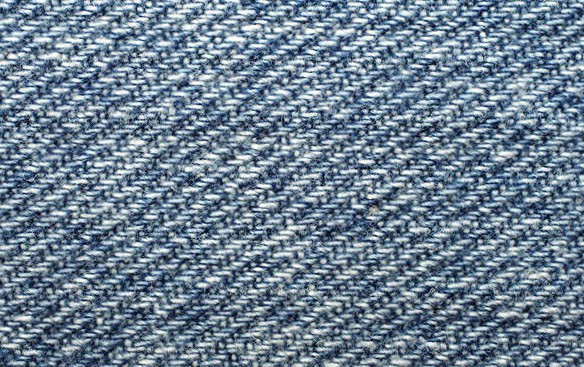
    Since when I am mooching around rattlesnake country, I am usually wearing jeans, and subject to the derision of shorts-wearers, I was interested to learn that jeans provide partial protection against snakebite. Shelton Herbert and William Hayes, of Loma Linda University, writing in the Annals of Emergency Medicine, describe an experiment in which they induced rattlesnakes to bite “model human limbs” and measured the amount of venom injected if the limb was bare or covered with denim.

    Photo: Ryj. Creative Commons Attribution-Share Alike 3.0 Unported. My hero.

    The model human limbs were latex household gloves filled with warm water and dangled from a snake hook. There were 15 rattlesnakes, large and small. Each session began with 5 seconds of “noncontact harassment,” type unspecified. (Waving the snake hook? Stamping on the ground? Taunting?) Then the model limb was thrust near the snake. They did this until the snake bit the model once, or until fifteen minutes had passed.

    Snakes are all different. Two snakes couldn't be bothered to bite at all. Five times a snake managed to get in two bites before they whipped away the glove. (Auditioning to be in my nightmares.)

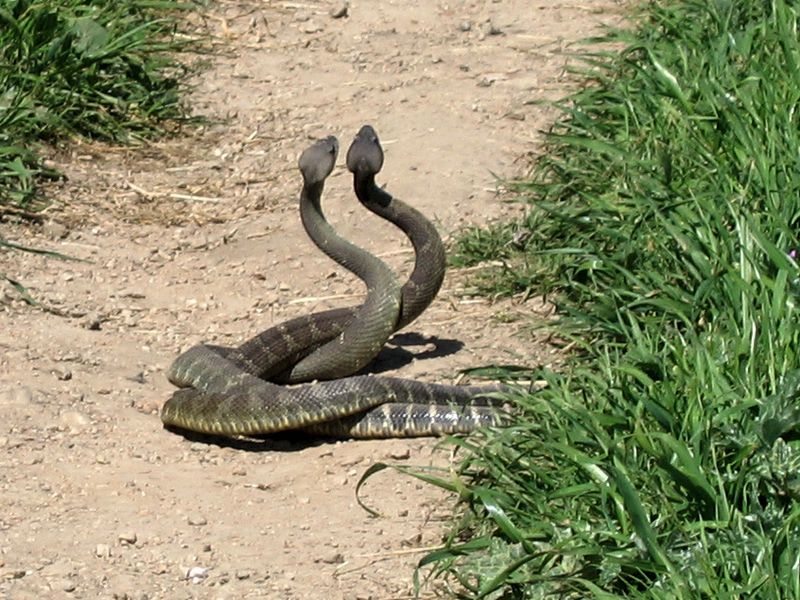
       Photo: Dawn Endico. Creative Commons Attribution-Share Alike 2.0 Generic. http://www.flickr.com/photos/51035743246@N01/139896364 This apparently shows two male snakes wrangling. “Nightmares? I'll give you nightmares.”

    Anyway, it turns out that denim makes it harder for rattlers to inject venom. About two-thirds harder. They still bit, but less venom got in. It sounds like their fangs got stuck. A lot of venom just came out on the denim. And the small snakes often didn't manage to inject venom at all. Perhaps there were “kinematic difficulties associated with venom delivery.”

     “Wearing long denim pants as an alternative to shorts may provide a simple, low-cost means of reducing the severity of snakebites,” say Herbert & Hayes.

    Yay! (Although there are so many details missing in this paper. What kind of denim? Brand new? Stone washed? Acid washed? We're not talking jeggings, are we?)

     Herbert & Hayes speculate that the “protective effect might be even greater for the comparatively short-fanged elapid and venomous colubrid snakes, which warrants further study.” I am too busy to take up the torch and do that study, so let's just hope jeans thwart them too.

     Let no one tell you that jeans are not appropriate attire for every event. It is unlikely that you will encounter a bitter, frightened, or unhappy rattlesnake in most places, but it is still nice to know that you are prepared if you do.

     I intend to wear jeans in my dreams from now on.


  • Deer, bears, and chipmunks were excellent aspects of my summer camp experience. Then there was the frog relocation scheme. Sometimes – often – and I now realize that at these times we were probably supposed to be in the crafts A-frame or playing volleyball by the lake or rehearsing for the talent show – we would prowl the creek that flowed from Mosquito Lake, catching frogs. Catching frogs is hugely fun. Unless you are frogs.

    We meant them no harm, and always released them. We just enjoyed the hunt, and pitting our amphibian-capture capabilities against their mammal-eluding capabilities. Sometimes amphibians won, sometimes mammals won.

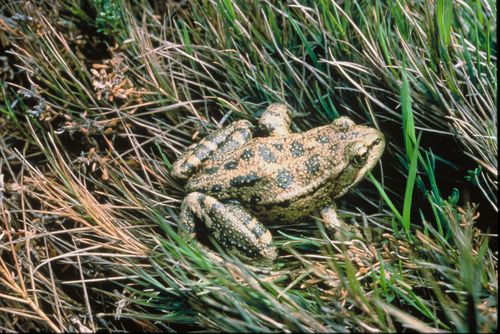
     Frogs have a tactic in which they leap off a bank (often with a charming croak or yelp), dart to mud at the bottom of the creek, and freeze in place, holding their breath. This can work well to prevent detection, especially if there is enough mud to bury the frog. In Mosquito Creek, there was often insufficient mud, and we would crouch on the banks, only a few feet from the frog, staring at it as it hunkered in plain view on the creek bottom. The frog would regard us from lovely gold-laced eyes, perhaps thinking itself triumphantly hidden.  Rana boylii, yellow-legged frog. Photo: Pierre Fidenci. Creative Commons Attribution-Share Alike 2.5. http://calphotos.berkeley.edu Frog fallacy: If you are perfectly still, you are invisible. Actually, it's surprising how often that's true.

     Slowly, slowly, the frog hunter would lower a hand into the water, slowly so as not to alarm the frog, not to trigger its motion-detecting neurons, though still visible to it, and slowly slowly maneuver to be close enough to snatch it. Ha!

     Then you have a frog, and after you have admired its beauty, what to do?

     A pool in a stream is made more beautiful by a frog on its banks. Some pools had two or three frogs, riches indeed. It seemed to us that if a pool with one frog was good, and a pool with two or three frogs was great, a pool with, say, twelve frogs would be completely fabulous.*

     We found the finest frog pool on the stream, and rearranged it to be even better, and then went up and down the stream capturing frogs and relocating them to the perfect pool. They would swim to the bottom and hide themselves and we would go off in search of more frogs.

     We'd return, expecting to find the pool thickly jeweled with frogs all around its gorgeous banks. But no. Maybe they were still hiding. We would release our latest prisoners and try again.

     But to our chagrin, all frogs immediately repatriated themselves, so we were never able to achieve our dream of a heavily befrogged pool. (I know. We were ten.)

     Fortunately frogs weren't involved when we invented a new game, Army Corps of Engineers.


    (*Or, as we eloquently phrased it, really neat.)

       
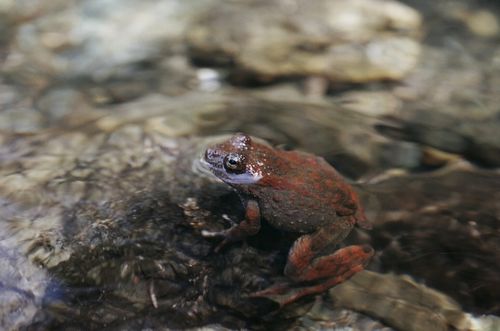
    Rana draytonii, red-legged frog. Photo: Mark R. Jennings. U.S. Fish & Wildlife Service, hence public domain. Frog fantasy: “They're gone, right?”


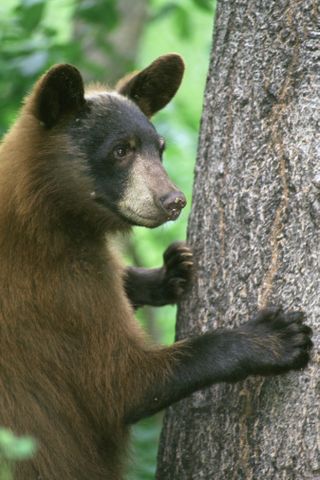
  • Trying to get close to deer is one thing. There were some animals in that forest that it was wiser not to get close to, and others who thought it might be good to get close to us. Bears were in the first category – we were afraid of them – and luckily not in the second category.

     One camper went off by himself, and just about bumped into a bear. Terrified, he ran away. Terrified, the bear ran the other way. When the kid stopped running he was seriously lost. When the camp noticed he was gone, there was a huge search. There was even a helicopter. He was located and rescued the next day. (How this played out for the bear we never knew. But definitely no helicopter.) Photo: Steve Maslowski. U.S. Fish and Wildlife Service, hence public domain.

     I didn't see bears there myself, but sometimes we saw bear signs. Once when we went on an overnight hike, a bear dropped by, removed a locked cabinet from a tree where it had been hung, tore it open, and ate our cornflakes. I was astonished, since I had a low opinion of cornflakes. Why bother?

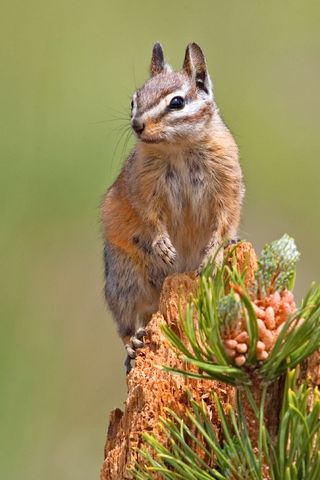
    Other animals were more willing to get close to campers. A certain chipmunk commandeered a camper's sleeping bag, probably because the camper was storing quasi-illicit candy and snacks in there. The stuffing also pulled out well and quickly made up into a splendid chipmunk bed.

    Chipmunk_2006  When the camper got in her bag and discovered the chipmunk, the chipmunk did not flee. It was willing to share. But when the camper attempted to evict the chipmunk, the chipmunk was annoyed, and bit, and we all found out about the whole sordid story, and rabies shots were insisted on. 

    Have I mentioned what a great camp this was? There were wild animals, and there was drama.


  • I figured out how to get close to deer at summer camp. It was a great camp, where we slept outside and cooked our own meals. A wilderness camp, except not the kind where they force you to belay off things.

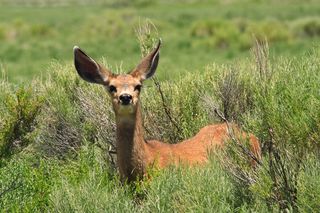
     The forest was full of black-tailed deer (Odocoileus columbianus), including does with fawns. I had never seen so many, never so close. In the fall, there was hunting in this forest. As we campers blundered along, deer would fling up their heads, stare, and take off running and bounding. Photo. U.S. Fish & Wildlife Service, no author. Okay, these are actually white-tailed deer.

    I ached to get closer. I tried freezing when a deer spotted me. I would freeze, they would freeze – and then they'd run. One day, instead of freezing, I looked away, leaned over and examined a manzanita bush, tugged at a leaf, pretended to eat it. I glanced around and the deer were still there. After a while they put their heads down and started eating again. They'd look around from time to time, but stayed calm. Photo: Walter Siegmund. GNU Free Documentation license 1.2. Also a white-tail.


    This casual attitude turned out to be the way to allay their fears. Don't stare like a predator, don't go out of sight (like a lurking predator), just act like a fellow grazer. I may have hammed it up unnecessarily, assessing and rejecting leaves, snorting daintily, looking around wide-eyed for mountain lions, shaking off hypothetical flies, but if the deer thought I was emoting too much, they didn't say.

     Herbivores often hang out with other species of herbivores. There's safety in numbers. The deer didn't think I was a deer, but they did seem to think I was a creature behaving in a way they understood, a non-dangerous way.

     I tried moving closer, browsing as I went. That worked too. It was shocking how close they'd let me get. But then I'd get too close, and my un-deerlike nature would become too obtrusive, and they'd sail away.

    Photo: Calibas. Creative Commons Attribution-Share Alike 3.0 Unported. Yup, a white-tail. (All I wanted to do was get close. But if I had gotten closer, I would have wanted to pet them and scratch them at the base of their ears. And if they had let me do that, I would probably have tried to pick ticks off them, and move their ears around like antennae picking up station KDOE, and the next thing they knew I would have been trying to get them to chase sticks. I do see that they had to draw the line somewhere.)

     People have been trying to get close to deer for predatory purposes for a long time. Before guns came to North America, getting within bowshot of deer was something people schemed to do far more often than they do today.

     Apparently just acting innocent wasn't enough, because Indians across the country had developed this to a high art. They had deer outfits. Made of deerskin.

     Thomas Jefferson Mayfield, (previously blogged about) described how the Choinumne who partly raised him did this. “[T]hey prepared the horns and hide of the deer and placed them over themselves. The head of the deer was hollowed out and was fitted over the head of the hunter. The skin covered the back of the hunter.”

     Then they went into their vegetarian act. “A short stick was carried in the right hand and was used to imitate the forelegs of a deer when the hunter bent forward. The bow and arrows were carried in the left hand. He would imitate a deer feeding and rubbing his horns on the brush, and many other actions of the deer, until he approached quite close to the game. Sometimes the hunter would work an hour to get just ten feet closer to the deer.

     Here's an illustration of how the Timucua, of what's now Florida and Georgia, did this. Jacques Le Moyne, Florida Photographic Collection. Those deer have a funny feeling something's not right. But what could it be?

     In The Way We Lived: California Indian Reminiscences, Stories and Songs, a Pomo woman talking about the hunting exploits of her grandfather, says “My grandfather said he put the deer head on when he want to go out hunting. He used to go out among the deer.”

     Apparently the deer let him get close, but they couldn't quite figure him out. “The deer wanted to smell his behind.”

     Yes, yes, a hazard all spies and double agents face. What to do, Mr. Bond? “He always just turn around and sit down.”

     There are modern bowhunters who also wish to get close to deer. While I am only slightly informed on this subject, I gather they generally have high-tech bows. They dress in camouflage, not in deer suits. And like me, they don't get so close that they have to sit down.


  • I was reading Indian Summer, by Thomas Jefferson Mayfield, an account of the years Mayfield was raised among the Choinumne Indians of California.

     It's an interesting account, which includes a description of an ingenious traditional method of pigeon hunting. This involved building a blind from which one could snare pigeons with thin nooses. It had to be built in the right place, where pigeons would come to drink at dawn. “They liked to water at a spring or water hole near tall trees, especially pines. They… all tried to water at the same hole,” Mayfield wrote. “They would light in such numbers that sometimes they would strip the limbs from the trees. It would take these large flights from one to three hours to water. When they left a water hole, it was as badly drained and trampled as though a thousand sheep had watered there.

    That sounded oddly familiar. Huge destructive flocks of pigeons breaking branches off trees with the weight of their numbers? I'd heard that before – but it was always about passenger pigeons (Ectopistes migratorius).

    “When they alighted on the trees their weight was so heavy that not only big limbs and branches of the size of a Print: Louis Agassiz Fuertes. man's thigh were broken straight off, but less firmly rooted trees broke down completely under the load,” wrote Pehr Kalm, in 1759, of the “marvelous multitudes” of passenger pigeons.
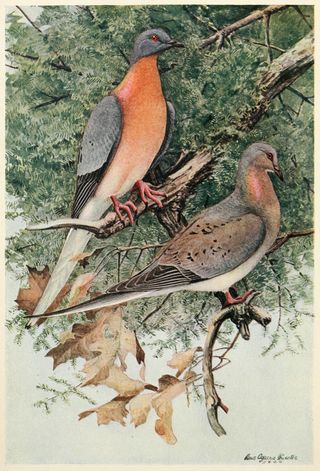
    I had learned this in a 1911 issue of The Auk, the journal of the American Ornithologist's Union. (Which I was reading at the exceedingly cool Prelinger library, where they have amazing old journals as well as books.) This sad issue was dedicated to the passenger pigeon, describing a bird that seemed to be extinct in the wild (and would soon be extinct in captivity) – but holding out the hope that there might be a few left.

    The AOU had offered rewards for passenger pigeon nests – and been deluged with mourning dove nests. “It now Another unfortunate species looks as if the worst fears of the American naturalists… [are] confirmed, and that we are 'in at the death' of the finest race of pigeons the world has produced,” wrote C. F. Hodge.

    Wallace Craig described the calls of passenger pigeons as he remembered them, in hopes that this might help people find survivors. “[I]f you tell a boy to look for a bird of the same general appearance as the Mourning Dove but larger, he will be sure to mistake some large-appearing Mourning Dove for the Passenger Pigeon. But tell him to look for a pigeon that shrieks and chatters and clucks instead of cooing, and the boy will be less likely to make a mistake.” Among other calls, Craig describes the keck, the Martha, wanting her head tickled.
    kah-of-excitement, and the keeho. He provides musical notation for pigeons he observed in an aviary, including  the notes given by the male “when just about to tickle female's head.” The last passenger pigeon died in 1914 at the Cincinnati Zoo. Martha, she was called.

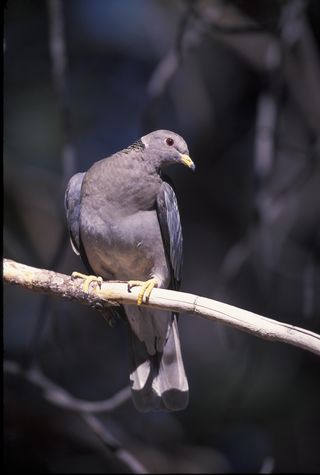
    Wait, so what did Mayfield see? Passenger pigeons ranged North American forests east of the Rockies. They were never in California. Mayfield just called the birds the Choinumne hunted “pigeons.” I think these were band-tailed pigeons (Patagioenas fasciata), birds which are Band-tailed pigeon. Photo: Gary Kramer, for USF&WS. Public domain. hunted in California to this day. They live in forests west of the Rockies. 
    Mourning doves also occur in California – and across the continent – and are also hunted. But they prefer open and semi-open country. I've never heard of their flocks breaking branches.

    I wondered if band-tailed pigeons were a west-of-the-Rockies version of that east-of-the-rockies bird, the passenger pigeon. Putting the names of both pigeons into a search engine, I saw that a brand-new study of pigeon and dove DNA had been published in Molecular Phylogenetics and Evolution. Contrary to the previous belief that the passenger pigeon's closest relative is the mourning dove (pointy-tailed, both of them), the study Mourning dove. Photo: Dori. GNU Free Documentation License 1.2. See how pointy-tailed. found that the band-tailed pigeon is the closest relative.

    Kevin Johnson, one of the authors of the study, makes the point that a band-tail is not super-closely related to a passenger pigeon. "This bird is pretty diverged from its nearest relatives, meaning it had a unique place in the world. It represented a unique lineage that's now gone," he told Science Daily.

    Well, obviously. A band-tail doesn't even have a pointy tail. Nevertheless, this is the closest thing we have left to a passenger pigeon and I plan to cherish the species on that basis.

    It seems I am not the only one who find band-tails a workable substitute for passenger pigeons. Passenger pigeons were afflicted with a species of bird louse. Because the species was described only in 1937 (by  Band-tailed pigeon. Print: A Brooks. Malcomson – I shall call it Malcomson's bird louse) and because it was believed these lice had lost their last home when Martha died in 1914, they were called Columbicola extinctus. But guess who else suffers from Malcomson's very same bird louse? Yes! Band-tails do.

    It so happens that I had a band-tailed pigeon once, long ago. I found him on a lawn under some trees, too young to fly. I had no idea what to do to help him except take him home and feed him and name him Bertrand Russell.

    (I now know that the best thing I could have done was to put him back up in the trees, even if I had to tie a shoebox to a branch for him to squat in, and then leave him alone. That way he would be out of the reach of ground predators, like dogs and cats. His parents would have come and fed him and said encouraging things to him as soon as I left. I wish I had known to do that. I still feel okay about naming him.)

    I took good care of Bertrand Russell. He was old enough to know that he was a pigeon and I was not. Though he accepted food from my hand, he didn't like being around humans and that included me. He resented the whole deal. He perched on a high shelf on top of Walker's Mammals of the World (the binding still shows the traces) and thought bitter thoughts.


    Photo: John McCarthy. All rights reserved. Bertrand Russell is leaning forward, thinking about flying up to the rafters. He's not sure it's a good idea (it's not), but he would probably do it if I would just get my hand out of the way. He is not enjoying having his picture taken. I raised Bertrand Russell until he was feathered out and could fly. I released him in good band-tailed pigeon habitat, a forested area where birders regularly saw band-tails, but it was an abrupt transition for him, what they call a “hard release.” I still feel bad that it was the best I could do.

    In 1834, the traveller Thomas L. McKenney was crossing Lake Superior in a storm when a desperate storm-tossed passenger pigeon landed on his boat. He prevented the boatmen from killing it, fed it water and crackers, put it in a mocock (a birchbark basket), and took it home. “[T]hough only a pigeon, it came to me in distress, and if it be its pleasure, we will never part.” He named it Me-me. “It knows its name, and will come when called.” Boy, that doesn't sound like Bertrand.

    I never saw bird lice on Bertrand Russell, missing a chance to meet a species back from extinction. But I saw Bertrand himself, a grim bird intent on survival, even if he had to put up with the attentions of a teenaged human. It's the closest I'll ever get to a passenger pigeon, and in retrospect, I'm thrilled about it.