• Photo: NASA Earth Observatory, MODIS Rapid Response Team, public domain. Oil spill oil takes different forms. It can manifest as an iridescent sheen, a viscous stinking black layer, tarballs, an orangeish mousse.

    Oil spill regulars can weigh the effects of different oils on smirched animals. Bunker C Crude versus diesel? Diesel is worse. 
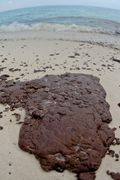
    Photo: Gatrfan, www.drewbuchanan.com, public domain. Tar on Okaloosa Island, FL.

    Spilled oil changes. Last week I visited the Deepwater Horizon wildlife rescue center in Fort Jackson, Louisiana (since moved to Hammond, Louisiana, to be out of the hurricane evacuation zone). Among the birds were many young birds. Not nestling babies, not reckless teenagers out on their own, more like bird children. Old enough to walk around, go down to the shores of nesting islands, play in the water, and get oiled by the sheen on that water.
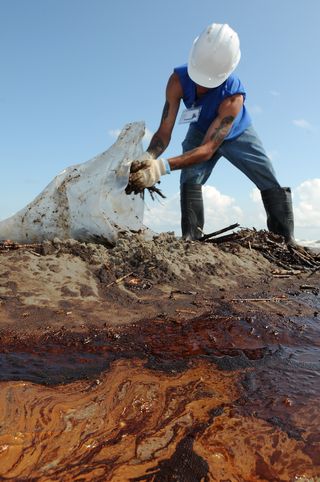
    Photo: Petty Officer 3rd Class Patrick Kelley. Creative Commons Attribution 2.0 Generic. "A worker cleans up oily waste on Elmer's Island, just west of Grand Isle, La., May 21, 2010."
    Good news was that rescuers aren't seeing oil burns on these birds. Oil often contains volatile chemicals like toluene and xylene (the ones you smell when you walk past the nail salon), benzenes, sulphates, things that can burn skin, eyes, and lungs.

    Jay Holcomb, the director of IBRRC (the International Bird Rescue Research Center, which along with Tri-State Bird Rescue is running four oiled-wildlife centers in the Gulf states), compared this to a previous spill in Louisiana. That also happened in nesting season. “We had 1,000 baby pelicans. Only 250 lived – they did really well. The rest died because they were sunburned from the oil,” he says. “We learned a lot about how to raise baby pelicans.”

    The Deepwater Horizon oil had a long way to drift before it hit the nesting islands. Apparently a lot of volatile compounds evaporated on the way. So, no burns.

    “It's a different kind of oil. It's actually easier to get off than the Cosco Busan,” an IBRRC worker tells me. (In that San Francisco Bay spill, the container  ship Cosco Busan hit a pier of the Golden Gate Bridge, spilling 50-55,000 gallons of bunker fuel oil.)
     

    Photo: IBRRC. Creative Commons Attribution 2.0 Generic.

    Any kind of oil that gets on birds' plumage can kill them. We used to hear that birds were kept waterproof by natural oils in their feathers, but that's not exactly right. It's the feathers themselves. Feather by feather, vane by vane, and barb by barb, plumage slides in place to make a perfectly waterproof shell over a bird's skin. Down feathers next to the skin hold warmth. Natural oils from a bird's preen gland condition the feathers. But feather structure, correctly aligned by preening, is what waterproofs an aquatic bird.
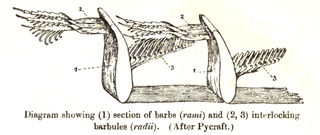
     

    Drawing: W R Ogilvie Grant. Public domain.

    Other kinds of oil disrupt feather alignment. Feathers clump and pull away from each other. Water can get in next to the bird's skin. Birds, who run at a higher body temperature than people, get chilled fast.

    A single non-waterproof spot in a bird's plumage where water leaks in will gradually soak the whole bird. One spot of oil can do this. If you have the bird in a pool, you will see it ride lower and lower as the water soaks in and makes it heavier. A wild bird may head for land when it finds itself sinking.

    Bird rescue facilities like to have warm-water pools so they can test the birds' waterproofing without getting them chilled. That's one advantage to an oil spill in the South in the summer. I visited the bird rescue center in Theodore, Alabama. “The nice thing about this heat, this oppressive heat, is that the animals don't get cold,” said Californian Michelle Bellizzi. “The birds are way more used to this than I am.”

    Petroleum oils aren't the only ones that can kill water birds. A few years ago there was an outbreak of desperate oiled birds stranding on the California coast. Forensic analysis of the oil was done to figure out its source. It turned out to be fish oil, dumped by some fishing boat, just as deadly to seabirds as anything pumped from under desert sands. You could kill birds with extra-virgin olive oil.

    The name of a 1991 incident tells the story: the Wisconsin Fire and Butter Spill. (Hard to believe, but melted butter is not always a good thing.)

    For that matter, if you don't completely rinse the detergent solution off the birds after you wash them, that disrupts their waterproofing too, and can kill them just as quickly as the oil it washed off.

    But thorough washing and complete rinsing, followed by the bird's intensive preening, can do the trick.
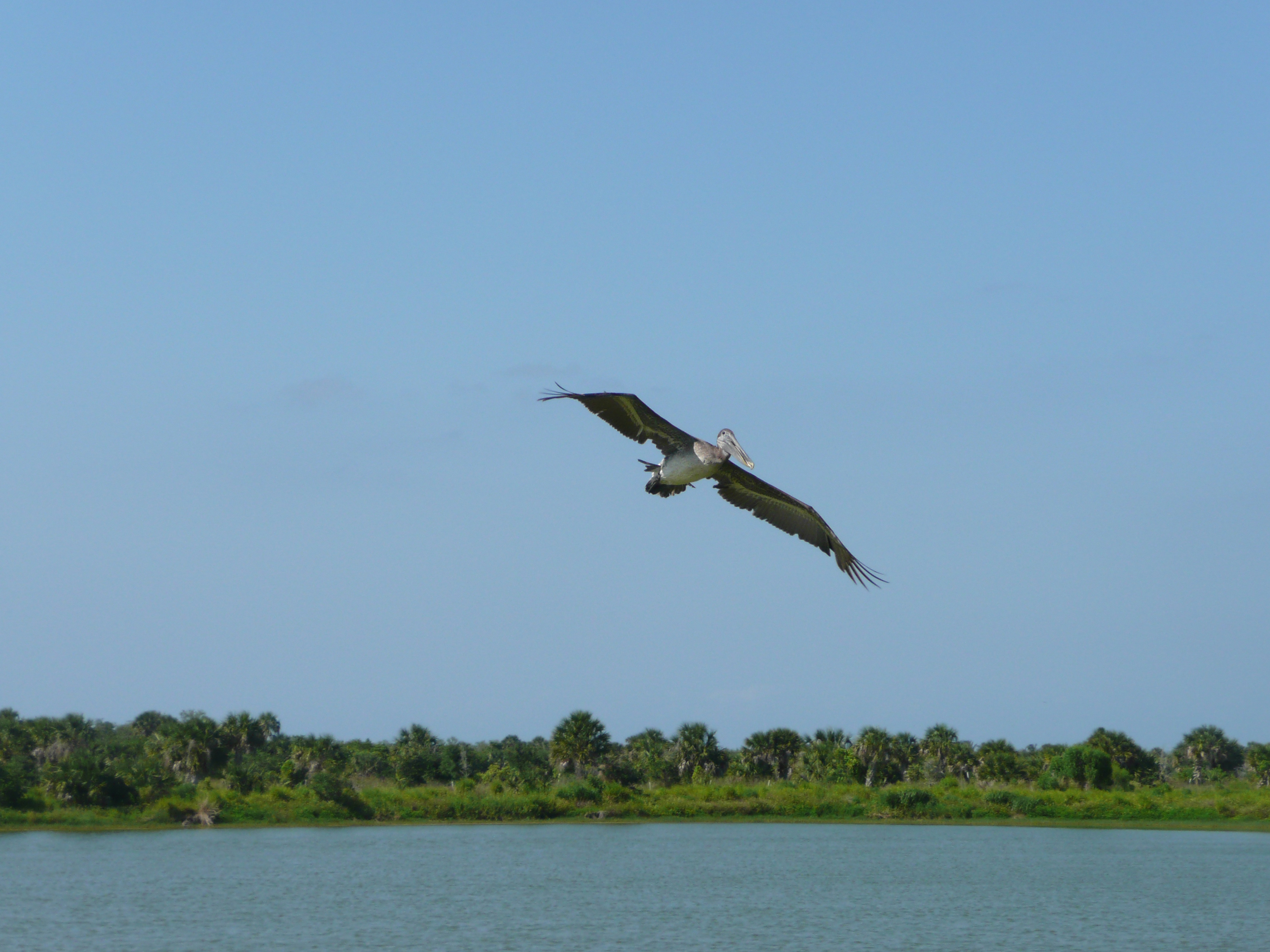
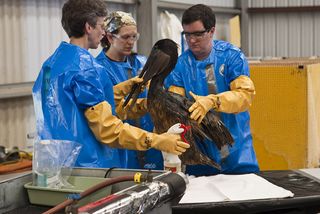
    Photo: U.S. Fish & Wildlife Service, Northeast Region. Public domain. Washed pelican flying.

  • Wildlife rescue professionals responding to the Deepwater Horizon spill have been working very hard for months now. Oddly, they're kind of touchy when you mention people who've recently been saying that it shouldn't be done at all. They're mostly polite, but they talk faster and start peer reviewing right on the spot.
    Photo: International Bird Rescue Research Center. Creative Commons Attribution 2.0 Generic. (This might be a posed image. Birds are usually treated bit by bit, with their eyes covered as much as possible, so they don't have to see the demons into whose hands they have fallen.)

    The
    contrarians say oiled birds almost all die, even when they've been
    washed. They cite some studies with sad results. They say that washing
    them isn't in their best interest. That they will suffer painful deaths
    after they're released. That euthanasia is the humane course. That there
    are better ways to spend money to help birds than on doomed victims.
    That it's not worth it.

    It's worth it to those saved.

    Oiled birds don't know rescuers are trying to save them, so they don't cooperate, yet they share a goal with the rescuers. They're struggling to live.

    Animals don't want to suffer, but they'd rather suffer than die.

    Sometimes it's worth it to animal species and populations. Sometimes it's not. (But since when have people cared only about species and populations? We're obsessed with individuals.)

    As for those studies? People who say that most washed birds die anyway are picking the grimmest studies they can find. If they picked other studies, they could find much happier results. In some studies, many birds survive.

    Unfortunately, studies are hard to compare. The rate of survivorship depends on a lot of things. What kind of birds were oiled, what kind of oil it was, how quickly they were brought for washing, how cold they got beforehand. Different rescue groups have different standards for triage and for release, which makes their results hard to compare.

    It would also be relevant to know what survivorship was of birds that were never oiled and washed. In some species, most birds – especially first-year birds – don't make it from one year to the next even when life is great.

    Brown pelicans (Pelecanus occidentalis) are one of the species being washed in large numbers in the Gulf, and they're tough types.

    Another tough customer that's suffered from oil spills is the African penguin (Spheniscus demersus) also called the Black-footed penguin for its dark feet, or the jackass penguin for its poignant brays.

    The 2000 sinking of the MV Treasure drenched their nesting islands in oil. 19,500 penguins were washed and released. They've survived well and gone on to breed almost as successfully as non-oiled birds. (There had been a previous big spill there in 1994, when the Apollo Sea went down in the same area.)

    One great thing about penguins is that they can wear flipper bands you can read at a distance, and they stand around while you get the binoculars on them. So it's relatively easy to get penguin data.

    While the birds are tough, the species was officially Vulnerable in 2000, and is now Endangered. This is probably because they can't get enough fish to eat, probably because commercial fisheries near the islands are catching so many.

    Here's the thing: using that good penguin data, it's been calculated that this imperiled population is 19% bigger than it would have been if oiled penguins hadn't been washed and released.

    Worth it.
     

    Photo from Wikimedia Commons. Public domain.

    Another story.

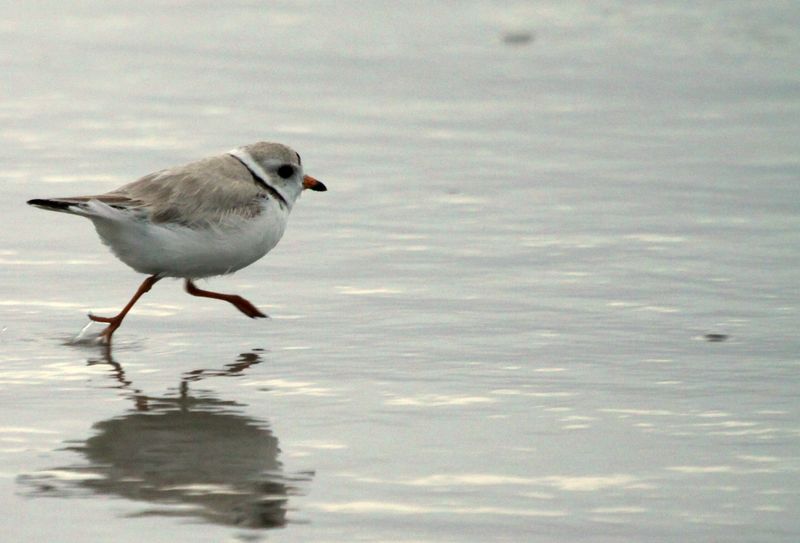
    In 1996, after the Anitra oil spill in Delaware, some endangered piping plovers (Charadrius melodus) were among the oiled birds.
    Photo: auburnxc/Bear Golden Retriever. Creative Commons Attribution 2.0 Generic.

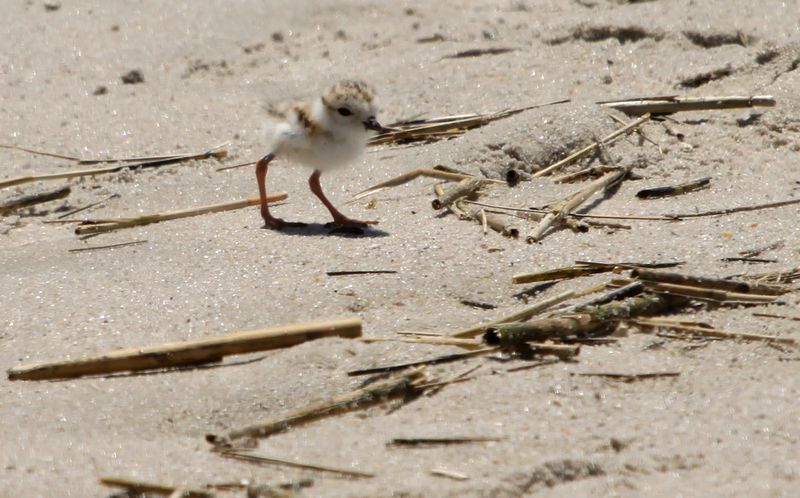
    Rescuers from Tri-State Bird Rescue & Research trapped and washed the oily plovers. Because it was nesting season, they released them earlier than they ordinarily would. One of the birds was a female, whose mate hadn't been oiled. He sat tight on the eggs while she was missing.

    When she reappeared, skinny, clean, and ready to take her *&^%$& turn, he jumped up and raced off for his first decent meal in two days. They settled back into their nesting routine, but some *&*^*$# came along and ate their eggs. She laid some more. Some #$%&^* came along and ate those. She laid some more. A late storm buried the nest in sand. The next morning the plovers dug up the eggs and resumed sitting on them. One egg hatched. Plover chick!

    Worth it.


    Charadrius_melodus_-Cape_May,_New_Jersey,_USA_-chick-8

  • Once upon a time there was a giant diving ocean goose – wait, no, maybe a giant diving ocean duck – so specialized for diving after fish it couldn't fly. It was as big as a Canada goose – anyway, a small Canada goose – okay, probably as big as nine pounds.

    Maybe it was tasty, too, because its bones are found abundantly in old kitchen middens on the California Channel Islands and along the coast. Although with all that diving it must have been tough. Tough and fishy. (Plenty of tough fishy meat for the whole gang!)
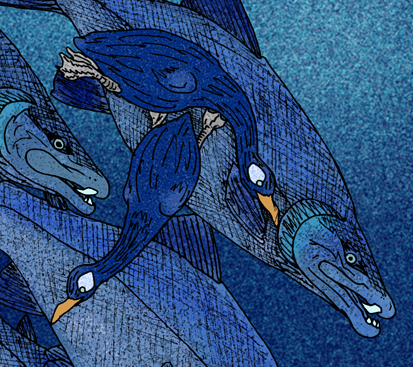
    Chendytes lawii image: Stanton F. Fink. Creative Commons Attribution 2.5 Generic licence. (Tough? Yes. We're tough on mackerel.)

    This extinct diver is called Chendytes lawii. (I'm saying chen DIE teez.)  Here's a picture made by Stanton F. Fink, who likes to portray extinct creatures.
     

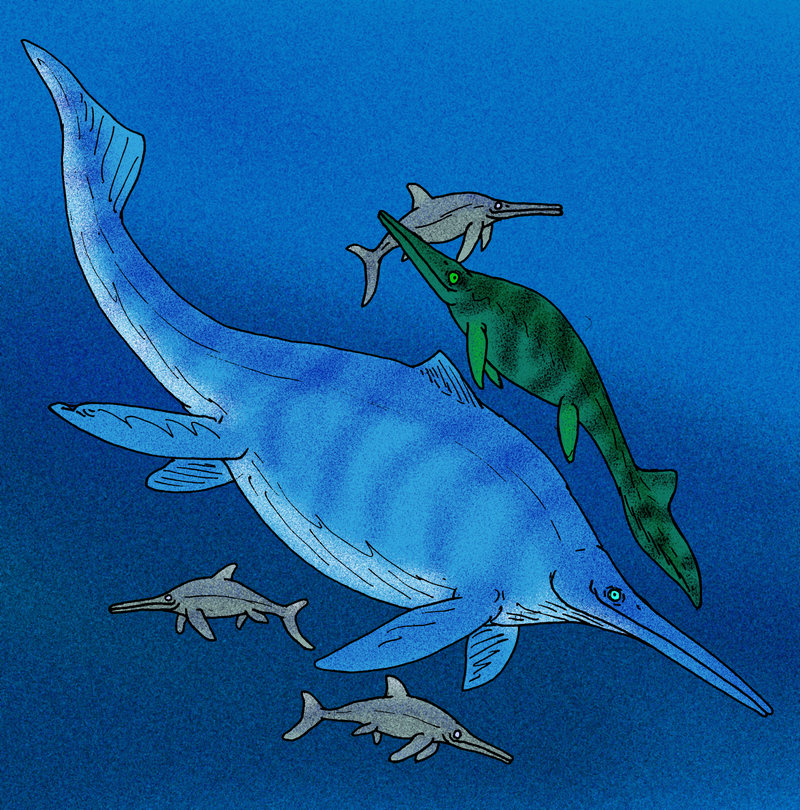
    I wouldn't have expected it to be so blue, but who knows? (I also like Fink's shastasaurs.)
    Shastasauridae image: Stanton F. Fink. (Late Triassic! Shout it out!)
    Chendytes only went extinct around 2,500-3,000 years ago. We just missed it.

    A Chendytes bone 10,000 years old was found in a cave on San Miguel Island. Maybe a duck-eating person left it there, or maybe it was some other duck-eating animal. Yeah, yeah, or maybe it tottered in there to be alone.

    Chendytes is material for arguments about human-caused extinction. This charming big duck (imagine if you were hungry and this enormous creature popped up to the water surface within easy clubbing distance – you'd be totally charmed) became extinct before the arrival of Europeans, so we can't blame so-called Western civilization. (Actually, I bet netting was a more likely technique than clubbing, but clubbing sounds cartoonier.)

    It's generally thought that an earlier Western civilization, that of the coastal Indians of California, drove or helped drive Chendytes to extinction. Climate changes may have contributed. But there is debate about whether it can be considered a late, outlying part of a hypothesized Pleistocene Overkill in North America, or whether its demise is actually evidence against an overkill “blitzkrieg.”

    Here's the deal. A whole bunch of very large North American mammals went extinct right about the time humans (from the Clovis culture) showed up, about 11,000-13,000 years ago. Mammoths, mastodons, ground sloths, 8-foot long beavers, the stag-moose, a large camel – there must have been thundering herds everywhere you turned. As these species vanished, other species that preyed upon them or scavenged their carcasses, like saber-toothed cats (gone) or like condors (barely hanging on) were affected too.
     
    Photo: Chuck Szmurlo. GNU Free Documentation License 1.2. (I don't mind tough. I don't mind fishy.)
    Did they vanish because we killed them off, or because of climate change or other factors, or some of each? And if we killed them off, did it happen so fast because we indulged in “overkill”? The idea is that people killed far more than they could eat. The classic – and often repeated – example of this is the buffalo jump, in which a big herd of buffalo is chased off a cliff. (It doesn't seem like it's so easy to stage a buffalo jump, but I admit I've never tried.)

    There's fierce debate about this. Some people would include Chendytes as an example of big animals wiped out. (See Tim Flannery, The Eternal Frontier: An Ecological History of North America and Its Peoples.) Others cite Chendytes as a counter-example – the species co-existed with people for thousands of years before it went extinct. Some say that's because they were relatively safe on the islands.

    But Jones, et al. (T. L. Jones, J. F. Porcasi, J. M. Erlandson, H. Dallas, Jr., T. A. Wake, and R. Schwaderer) say that people seem to have been in the Channel Islands for about 11,500 years, so it took about 8,000 years to eat the last Chendytes. In “The protracted Holocene extinction of California’s flightless sea duck (Chendytes lawi) and its implications for the Pleistocene overkill hypothesis” Jones et al. argue that if it took so long for humans to hunt out Chendytes, it should have taken them a comparable time to eliminate other species. So maybe it was something else that happened to the megafauna.

    Opinions differ on when Native Californians had boats that enabled them to get to the nesting islands that were probably Chendytes's last stronghold. (I say: right away. People always turn out to have been boating longer than we thought.)

    Thus some say we co-existed with Chendytes for millennia. Others say we wiped Chendytes out practically the minute we got the seafaring equipment to get out to the nesting places and gorge ourselves (on tough fishy meat).

    Occasionally I think about a Pleistocene Revival event, in which a little DNA cut-and-paste work would bring back cool megafauna. I'd love to see mastodons and mammoths and those giant beavers. (Did they make huge dams?) But if you didn't bring back giant predators the giant herbivores would multiply crazily. I'm not ready for dire wolves and saber-toothed cats. I'm not even sure how we would
    Image: ДиБгд. Public domain. Megatherium, the ground sloth, thinking about your peonies. manage with the herbivores. Mastodons in the arboretum would not be popular. If you don't like gophers in your garden, you're gonna hate ground sloths. People skipping to the fruit stand for the beginning of cherry season would be upset to learn that giant camels had beaten them to it.


    I was thinking that Chendytes might be easier to get along with. What if we could re-create them and let them hang out on the Channel Islands again? With our effete modern eating habits, most of us would readily agree not to eat those tough fishy types. Huge diving ducks! What could be bad?

    Oh no. Unless they went after our shellfish.

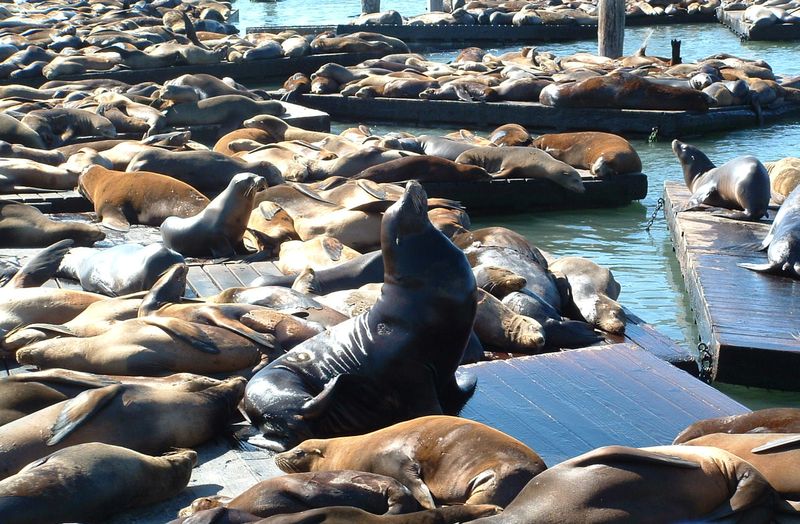
  • Pier 39 on the San Francisco waterfront is an open mall, with music, performers, a merry-go-round, people who will do a caricature of you-with-an-enormous-head, and stores for the left-handed or sock-mad. There's an aquarium and a marina. You can catch a ferry.

    The pier was originally for commercial shipping. Then it was redeveloped as a tourist attraction. There was an opening ceremony in 1978, at which then-mayor Dianne Feinstein wore a “discreet but attractive swimsuit because of a bet with the developer,” according to the New York Times of that era. (Sadly, I can't find a photo.)

    In 1989, some small boat docks on the north side of the pier were vacant during repair work. Unexpectedly, sea lions started hauling out on these docks. They napped. They grunted. They barked.
     
    Photo: Reywas92. GNU Free Documentation License. (Sometimes grunting seems like the appropriate thing to do.)

    Business owners and boat owners complained. Noisy! Stinky! Unsanitary! Bad for business. A permit was requested to scare them away by detonating explosive charges. Others objected to the request. The controversy made it into the newspapers. This alerted residents who didn't ordinarily go to Pier 39 about the easy-to-view sea lions. We rushed to the spot to view the pinnipeds (Zalophus californianus). It was a great angle, and the sea lions were very close, and delightfully blasé about being viewed.
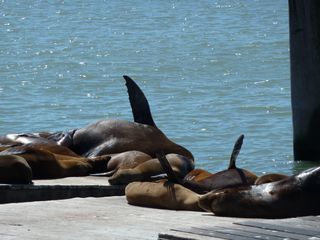
    Photo: Susan McCarthy. Public domain. (If you're a sea lion, and you get too hot, stick your flipper in the air. If you're a person, try sticking your foot out of the covers.)
    Since we were there, we drank lemonade, bought left-handed scissors and gala hosiery, and were manifestly good for business. We made plans to bring our out-of-town visitors.

    The permit request was hastily dropped. Pier 39 began promoting the sea lions.

    Most of the sea lions leave in the summer, to catch breeding season in the Channel Islands, and return in the fall.

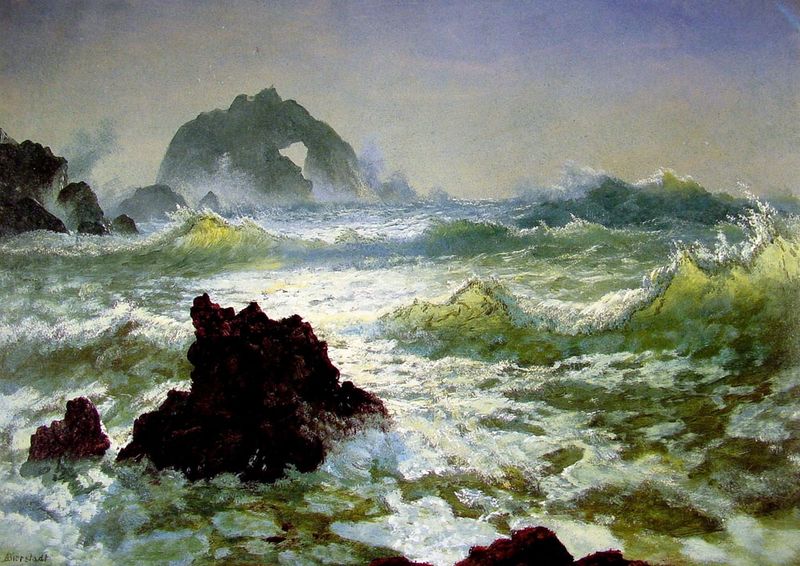
    What are the sea lions doing here? Resting. It is said that the sea lions who hang out at Pier 39 used to hang out at Seal Rock, but moved for some reason. How mysterious. Why on earth would they do that? Why wouldn't a wild animal prefer to hang out in a wild place? Look how great Seal Rock is:
    Painting of Seal Rock: Albert Bierstadt. Public domain. (What a scenic place to nap.)

    The two places aren't that far apart, but Seal Rock is outside the Bay, and Pier 39 is inside. It's  speculated that there are fewer predators inside the Bay. Fewer predators makes it easier for scrumptious types to relax.

    San Franciscans pay close attention to the doings of the sea lions. Earlier this year, almost all of them vanished from Pier 39 and there was much worry and much press coverage. Were they starving? Had a shark or a killer whale scared them away? Was that them up in Oregon?

    Then they came back. There was much rejoicing, especially among the merchants.

    Things don't seem normal among the sea lions this year. Mothers are giving birth to pups early, and in unusual places. Five were actually born at Pier 39.

    El Nino may have something to do with it, or domoic acid, or declining fish stocks. The species isn't endangered, but it's not having a good year. If there's anything I can do to help, just say the word. And I know I speak for the small-business community when I say so.
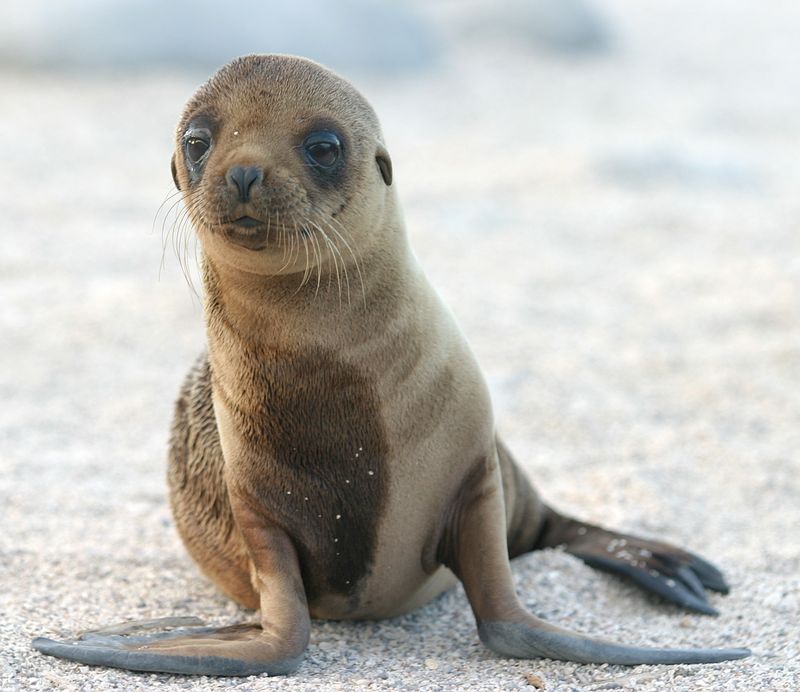
    Photo: refractor/dagpeak. Creative Commons Attribution 2.0 Generic. (This is actually a Galápagos Sea Lion pup (Zalophus wollebaeki), but I reject typecasting.) (Oh, all right, you made me say it: I CAN HAZ FISHWICH?)


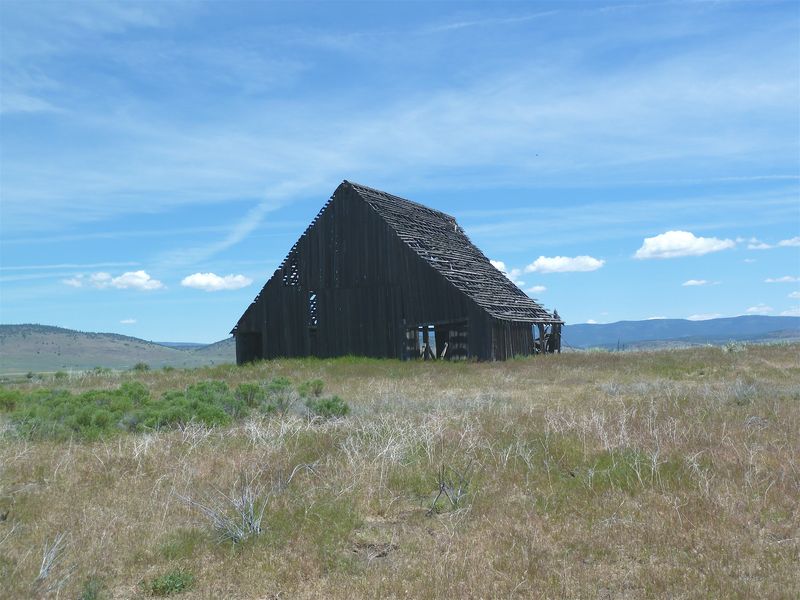
  • Photo: Susan McCarthy. In Modoc County.
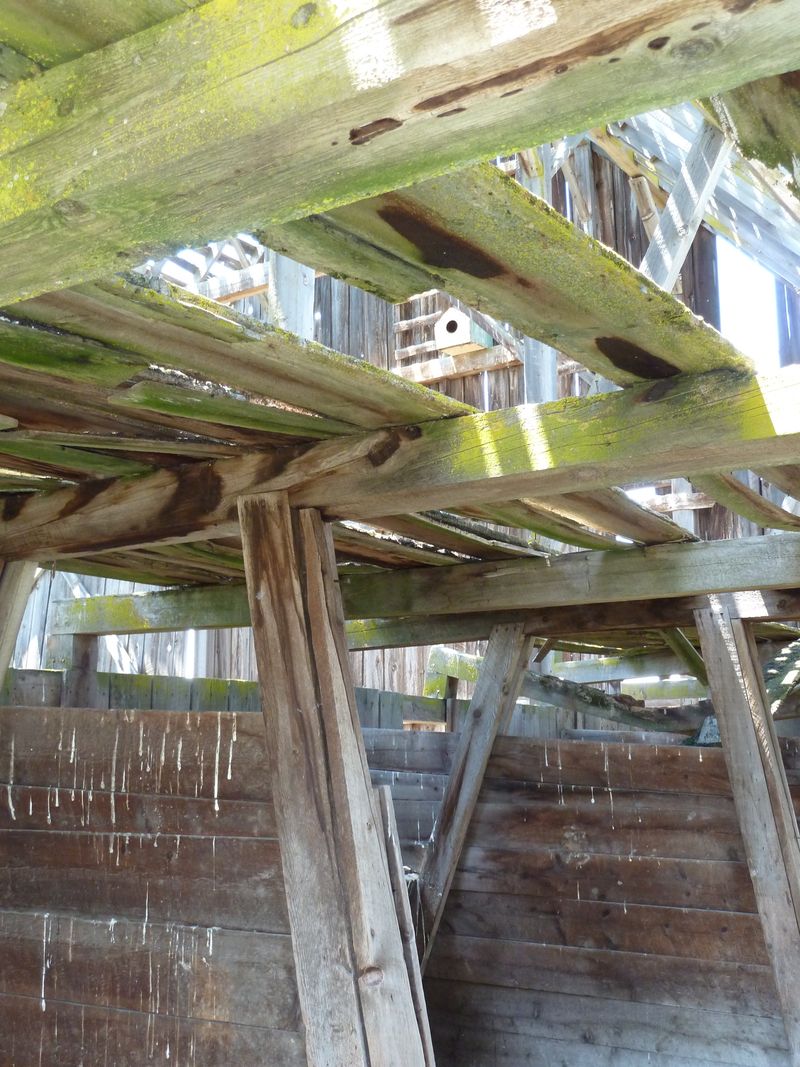
    Sometimes you see a barn and you know it has owls.
     

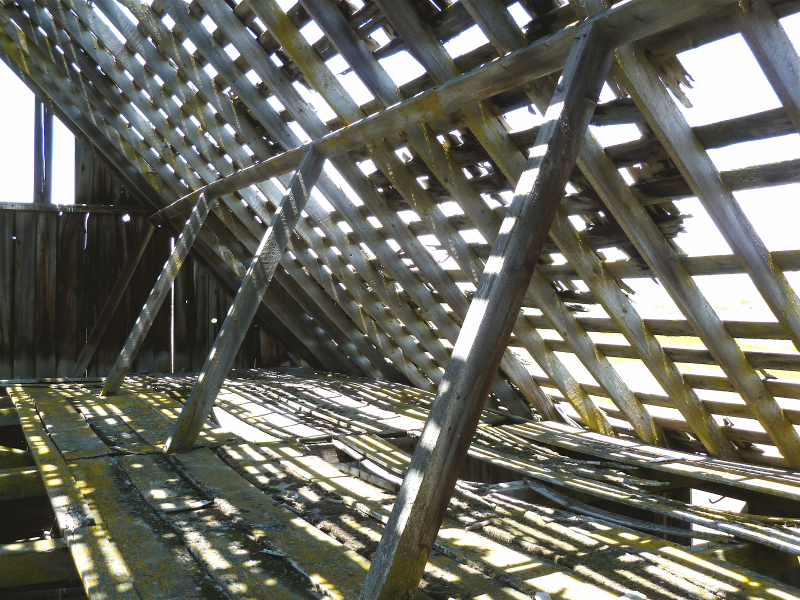
    This one is airy, with many escape  routes. As we walked to the door, a barn owl (Tyto alba) silently flew out.
    Photo: Susan McCarthy. You kept your hay up here.

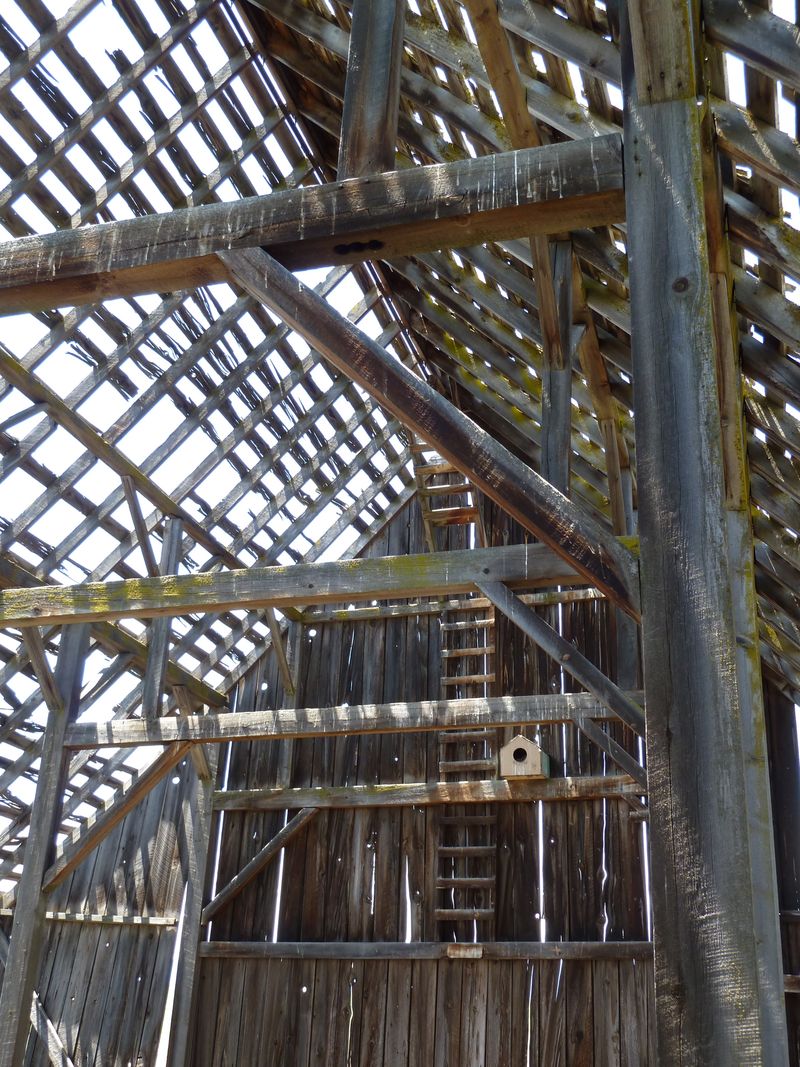
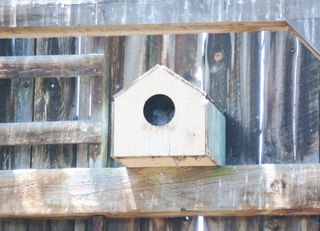
    A helpful person had put up an owl box. Owls had accepted it. Not recently, judging by the size of the charnel scatter of debris below, full of fragile white bones of rodents.


    Photo: Susan McCarthy. Box of owls.

    An owlet looked out. I think it was worried, maybe horrified. But it wasn't too frightened to stare.


    Photo: Susan McCarthy. Surveillance by brave owlet.
    Not all barns are suitable for owl nesting. When a barn is otherwise good but has no owl box, owls may nest on a corner between rafters.

    This old barn is so great that I think it would have an owl nest even without the box. It's made of solid beams and planks, strongly joined.

    Before there were barns, these owls nested in natural places like holes in trees. Humans have reduced the number of trees (and many humans object to trees with holes in them, with the notion that such trees are diseased, unsound, and liable to drop heavy limbs onto humans including small beloved children running through the park to raise awareness for kidney disease).
     

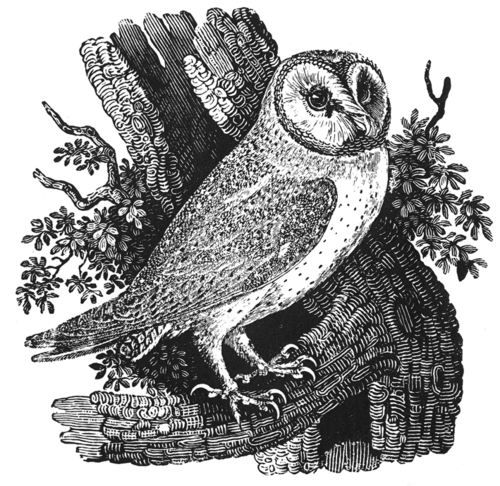
    Print: Thomas Bewick. That tree is a deathtrap.

    However, we have put up barns which can be nested in. Barns attract rodents, useful to barn owls, since an owl family may eat more than a thousand in a year.

    Barn owls evolved hunting in meadows and along forest edges and nesting in trees. Some still do so, but others hunt on agricultural land and nest in agricultural buildings. We're not completely useless to owls.
      
    Photo: Susan McCarthy. You kept your hoofstock in these stalls.

    Photo: Susan McCarthy. Are they still there? Gross!

    Even if we give them the creeps. 


  • I was lucky enough to write this story for Parade about detecting cancer by the sense of smell. It starts with dogs and moves on to technological nose equivalents. Check it out — there's video.

    The electronic and chemical noses researchers in this story are working on will do only a fraction of what a dog does — they will look for a few biomarkers for a given disease.

    While working on this story I talked to Jim Walker, a psychobiologist whose specialty is measuring the sense of smell. He's optimistic about the specialized devices researchers are working on, but overall, he says, "for many years the best we're going to be able to do is a dog."

    "The dog is the best at chemometrics, taking a complicated chemical picture and making sense of it. That's why a dog can trail someone through the woods. Nobody thinks we have come close to a machine that can do that."


    Photo: great_sea, Creative Commons Attribution Share-Alike 2.0 Generic

    He's not just speaking anecdotally, since he's conducted careful laboratory research to learn just how small a wisp of amyl acetate a dog can smell. (The hard part of this research isn't getting dogs to show what they can do. It's precisely controlling the airborne concentrations of the chemical.) How small? One part per trillion.

    That's why "the president doesn't get on the plane till the dog says it's okay."


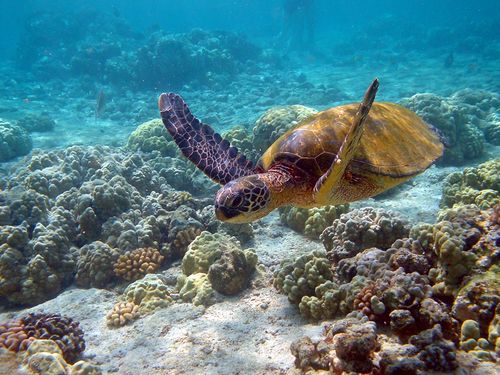
  • One day I saw a giant sea turtle bite my sister. We were snorkeling in Hawaii and were suddenly in the midst of a number of turtles. They were feeding on seaweed. I looked over at my sister, and saw her beaming at a turtle from a respectful distance. Unnoticed by her, another turtle had appeared behind her, much closer. All was well
     Photo: Mila Zinkova. GNU Free Documentation License 1.2 until the swells pushed them together, causing her to bump gently against the turtle. Annoyed, the turtle extended its beak and bit my sister.

    Right on the wetsuit.

    She didn't notice the nip. When I told her about it later, she was chagrined to have missed this wildlife experience.
     

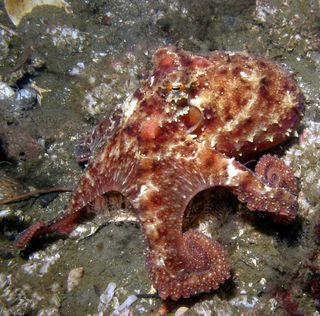
    Another day I was visiting tidepools on the California coast with a friend. We found a small, sullen, pink octopus lurking in some eelgrass. I scooped it out to look at it. It tried to slide away, but I moved my hands so that it just kept oozing into the next hand. Then I arranged for it to ooze into George's hands. After he had admired it, he eased it back into the tidepool where we had found it.


    Just as he had lowered it into the water and was taking his hands
    Octopus rubescens. Photo: Kirt L. Onthank. Creative Commons Attribution-Share Alike 3.0 Unported away he exclaimed, “It bit me!” There was a small red dot near the base of a finger. Instantly a stranger materialized at our backs. “Their bite is venomous,” he remarked and strolled away.

    That was a horrid moment. (Meanwhile the octopus had emitted a gratuitous cloud of ink and departed.) I am happy to report that this  species of octopus (which must have been either Octopus rubescens or Octopus bimaculoides) is not very venomous. “Like a bee sting,” George said afterward. He survived to brag of being bitten by an octopus, which is more than I can do.

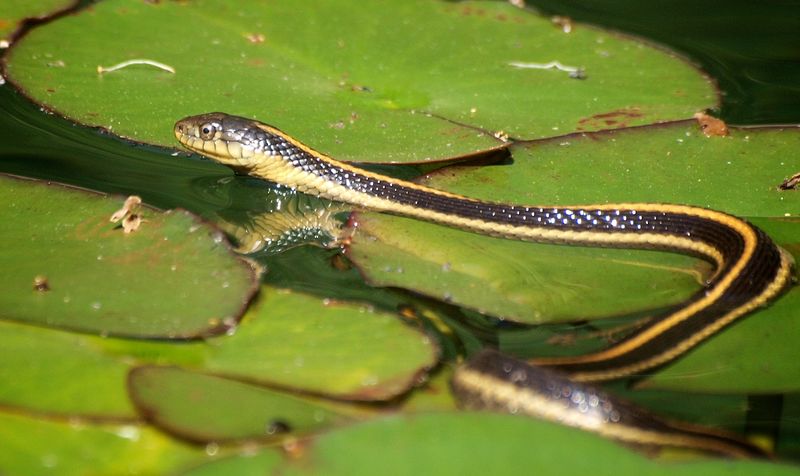
    However, I was once bitten by a snake. It made two little holes in my finger.

    This was a long time ago when I was a nature-struck youth. It was a garter snake, and I can't imagine why it bit me unless it was because I had been chasing it across a empty lakebed, and had grabbed it when it took refuge in the bottom of a mud puddle, and was in the process of thrusting it into a bag.

    I feel remorseful about this. However, the snake was not too traumatized to eat several small toads that were also in the bag. This while the bag was dangling from the handlebars of a bicycle as I madly pedaled for home. Nor was the snake too weakened to force its way out of the charming fish tank I had furnished for it to live in, the one with a heavy slab of glass on top, which the snake elbowed aside when it departed before a day had passed.

    Tough snake.

     
    Thamnophis atratus. Photo: Ingrid Taylar. Creative Commons Attribution 2.0 Generic.


  • The experimenters were trying to enliven the lives of zoo animals while simultaneously gathering data. As often happens, not all the data they gathered was in the categories expected.

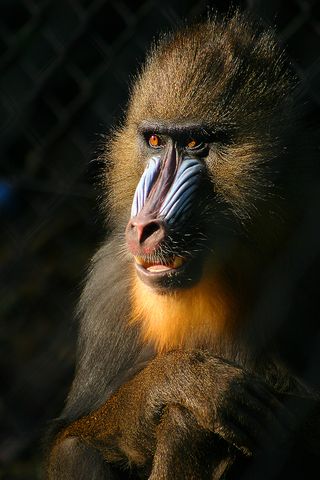
    As Hal Markowitz recounts in Behavioral Enrichment in the Zoo, date (1981), he was trying to set up a game for mandrills (Papio sphinx) in a Hawaiian zoo. It was a button-pushing game. Fast reflexes won. The goal for the mandrill was to push a lighted button on a console before a zoo visitor could push the button on a matching Photo: Malene Thyssen. GNU Free Documentation License. console on the other side of the barrier. This game had been a big success with Blue, a mandrill in another zoo. Blue was fast, he knew it, and he enjoyed proving it.

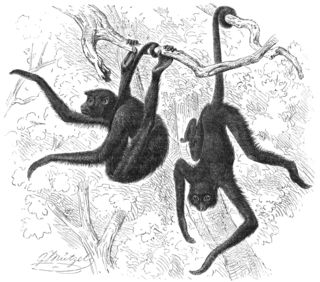
    But the arrival of mandrills at the zoo was delayed, and Markowitz was asked to adapt the equipment for spider monkeys (Ateles ater). Spider monkeys spend most of their lives up in trees. Their hands are less well suited to pushing buttons. (That’s why your spider monkey friends never text you.)

    Markowitz’s team hung a rope next to the apparatus, so a spider monkey climbing on the rope could reach a hand over to push the button. Only one spider monkey Image: Gustav Mützel. was interested, and her technique was to dangle, and push the button with her nose. She was fast enough to beat lots of hand-using humans.
      
    At the Portland Zoo, another experimenter decided to study “ratio strain” in camels. Since camels have no hands, it was thought in this case that the nose was the appropriate thing for the animals to use. When a panel lit up, camels were to push it with their nose to get a delicious pellet. (No competition with visitors was involved.)

    The idea was to see how seldom you could reward the camel before you reached “ratio strain,” the point at which the animal stops responding so often or at all, and perhaps shows “an increase in emotional behavior.” If an animal will push a button if it’s rewarded every other time, what if it’s only rewarded one time in ten? One time in a hundred? In other words, unseen powers move the goal posts, and the players get visibly peeved. 

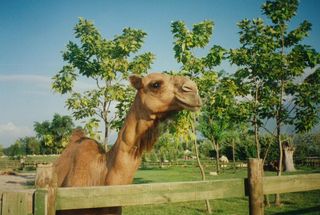
    The camel Adolph monopolized the equipment. As the ratio became less favorable, Adolph devised a new tactic. He’d stick out his chin   Photo: Sabri76. and vibrate it rapidly, pushing the button with great frequency. With this fast fighting technique he was willing to play even when he got a pellet only once for every 150 chin wiggles.

    Markowitz wanted to make an apparatus that could be used by all kinds of animals. All they had to do was touch one of two steel plates situated below two lights. “I envisioned that snakes could sidle up alongside the detector and trigger it off, that elephants might choose to touch it with their trunk or rub against it with one of their legs, and so forth.”

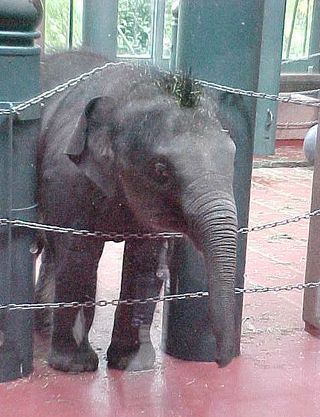
    The first player was to be Gabriel, a charming young elephant living in the children’s zoo. Perhaps my predictable narrative method has tipped you off that things did not go as expected. Gabriel solved the  Photo: Bev Sykes. Creative Commons Attribution 2.0 Generic. problem by squirting water from his trunk between the response panels. This shorted them out electrically, “so that a response on either side paid off.”
     
    They tried to prevent this by emptying Gabriel’s water trough before the experimental session. Then long before the session. Then long, long before the session. But crafty Gabriel stored water in his trunk. No matter how long they kept the trough dry, he was always ready to tamper with the equipment.

    So much for the Universal Device.


    ST-bakerelephant

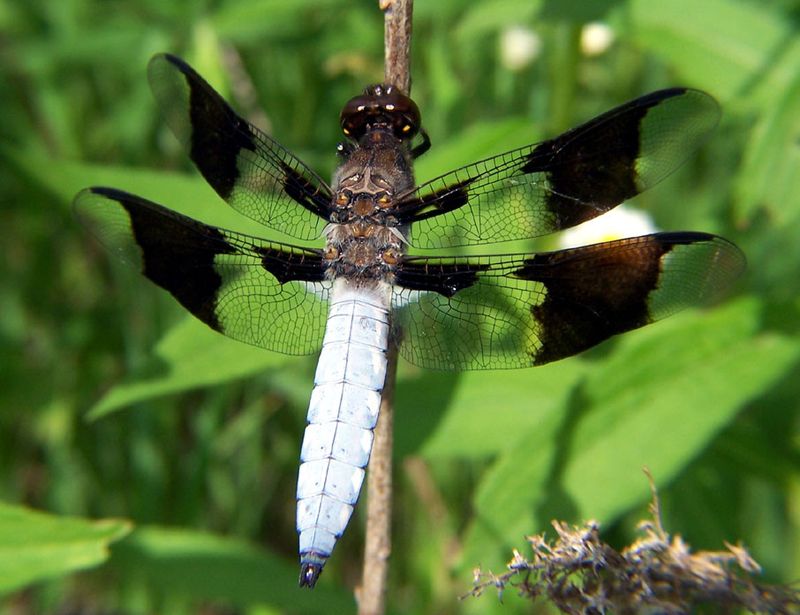
  • The first dragonflies of the season were glinting over the pond. I noticed some weird ones. They had short dark wings and wide pale blue bodies. Looking closer, it turned out they don't have short wings – they have broad dark stripes in the middle of their wings that give that effect from a distance.


    Photo: Bruce Marlin. Creative Commons Attribution-Share Alike 2.5 Generic license.
    Keying them out later revealed that they were common whitetails (Libellula lydia  — or maybe Plathemis lydia). They really are common and widespread, so I'm embarassed that I never noticed them before. I can see the argument for calling that color 'white,' but based on the ones I saw I would still vote for 'pale blue.' The color, which is only on the male adults, is created by 'pruinescence.' Had to look that up too. Pruinosity. The quality of being pruinose. Looking hoary, having a bloom of powder on the surface. Argh, click, click click, click, okay, so 'pruina' apparently means hoarfrost, or rime.

    So much for my instant theory that it comes from prunes and the bloom that one often sees on the skins of fresh prunes and other
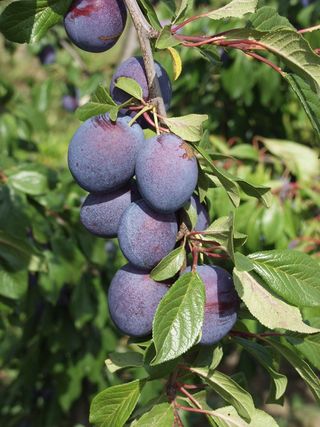
    Photo: Glysiak. GNU Free Documentation License. Prunes – see how pruinescent? plums. Now I'm embarassed that I don't know more Latin.

    Back at the pond I was trying to take pictures of the mystery dragonflies, which kept settling on the banks of the ponds, then zipping off just as I was getting them in camera range. Each one seemed to be patrolling a certain stretch of bank. In each stretch there was only one dragonfly. Once you observed one briefly, you could tell which way it would fly when you disturbed it, since it was determined to stay in its territory. (And still I never succeeded in getting close enough. Embarassing.)

    Sure enough, when I looked them up, the territoriality of the males was described. But it turns out that they divide their territories not only spatially but also chronologically. They do shifts of a few hours at a time. In a study in Monterey they found that a territory could be subject to seven different males in succession.

    “This is my land and here I am king! All eggs laid by beautiful ladies will be fertilized by me! No one dares rival my dominion! If any usurper tries to intrude, I will attack! Until 3:30, then I'm outta here.”

  • San Francisco's wild parrots, subjects of a very nice book and movie, are famously “of Telegraph Hill.” But sometimes a few appear over my obscure Ingleside neighborhood where they land in the trees,
    Photo, "Who's a pretty parrot?" by Jef Poskanzer. Creative Commons Attribution 2.0 Generic. shrieking. I have seen a flock of eight, and family groups of four. They are cherry-headed conures (Aratinga erythrogenys), native to Ecuador and Peru.
     

    One evening I came up the side porch steps from the basement and startled a parrot into a desperate squawking getaway.

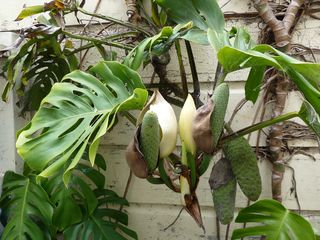
    It had to have been in my ridiculous philodendron, in which I have never before or since seen any bird.

    This is a cast-off house plant my mother forced me to take when she moved out of town. I really didn't want it. It was scrawny, with two
    I got a camera for my birthday! Thank you, Barb! or three leaves. I put it on the side porch to die. I didn't plan for it to die, but I was sure it would. This side porch is a space mashed between our house and the next, enclosed on four sides, open to the sky, rather mossy. It's a sort of glorified air shaft containing stairs from the kitchen down to the basement. Apparently this protects the *#!*%^$& philodendron, which is now six feet tall and fruits. It  subsists mostly on fog drip, though I occasionally feed it cooled-off  water from steaming vegetables.

     
    So apparently the tropical parrot found the tropical plant and the two
    Dendrobates pumilio were drawn together in what I now realize is a tiny tropical enclave. It  would be a shame to neglect this excellent microclimate. There's not
    Blue poison dart frog, photo: Arpingstone enough space to install tapirs but maybe some arrow-poison frogs could enjoy themselves there.

    Cool.  I thought that was just squawking, but apparently it was a message of wacky possibility. Dare to dream, earthbound human!

    Photo with kind permission of Art Siegel (artolog).