•  

    La Dolce Vita di Lampo

    Lampo slept in the station at Campiglia Marittima, a busy railway junction. In the morning he'd jump on the train to Piombino and walk Mirna Barlettani to school. Then he'd take the train back to Campiglia.

    When the Turin or Rome Express stopped in Campiglia, Lampo would gaze meaningfully at the kitchen window of the dining car, barking if necessary. The cook would toss bones and meat out.

    In the afternoon, Lampo took the train to Piombino and walked Mirna home from school. Then he returned to Campiglia.

    From Campiglia, Lampo might catch a train anywhere. He'd hop onto any passenger train (never a freight) and ride calmly until he heard the conductor coming, when he'd hide under a seat. Lampo visited every station within 200 miles of Campiglia, becoming a well-known personality.

    He was back in Campiglia by 9:00 pm, to catch the train to Piombino with assistant stationmaster Elvio Barlettani, Mirna's father. He'd spend the evening with the family. He was grossly favored over their dog Tiger – Tiger got bread and macaroni, but Lampo got meat, because that was the standard he was accustomed to. Then Lampo caught the last train back to Campiglia.

    If it was very hot, Lampo might stoop to the bus. Having gone to a beach on the Tyrrhenian coast with the Barlettanis, Lampo knew the way. He'd go to the bus terminal and mingle with beach-goers getting on the bus so he could spend the day there.
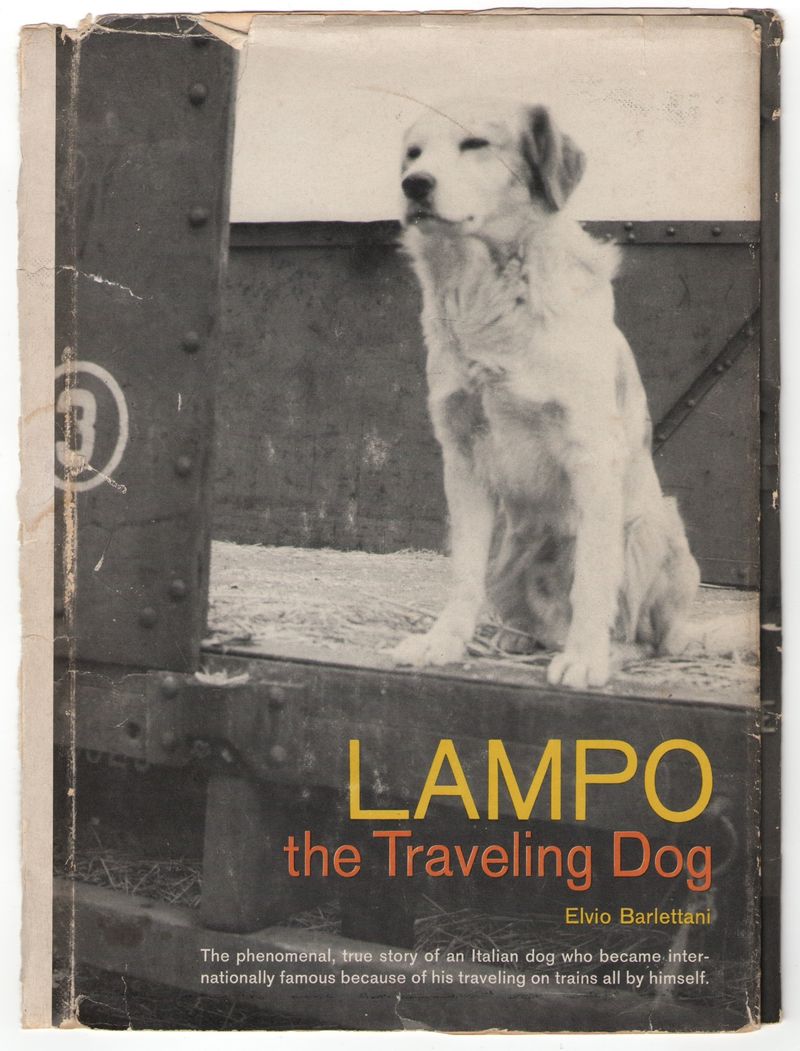
      Lampo -- front cover of 1963 English translation by Alan Houghton Broderick. Pantheon/Random House.

    Storia di Lampo

    When Lampo jumped off a freight train in August 1953, and started living at Campiglia station, he already seemed used to solo train travel.

    Talking with other railroaders, Barlettani concluded this was the same dog who had been mooching around the Livorno (aka “Leghorn”) station. When the Livorno stationmaster called the dogcatcher, railway workers shouted to warn the dog, and flung him into a freight car pulling out.

    When the dog made Campiglia his base, the staff named him Lampo (Lightning). At first he traveled locally, but then he got ambitious, traveling for miles wherever trains went.

    Lampo became famous among railroaders, who recognized him and exchanged stories of his travels. Then journalists, scum that they are, wrote about him and his fame spread.

    Naturally there were authorities who thought poorly of this. Barlettani was told to make Lampo play it cool for a while. He took Lampo home to Piombino (a small spur station), and enlisted station staff there to keep him from getting on the train. Lampo busied himself defending the Barlettani home from deliveries, and from their friends and relations. He kept trying to catch a train. Every night, when the whistling and clatter of the outbound train could be heard, he'd fling himself at the door.

    They let him ride the trains again, but one day he got caught in a door. The train was stopped so the doors would open and release him. This irregularity was witnessed by an inspector. Higher-ups ordered that the dog must go.

    Barlettani conferred with station staff. They decided to put Lampo on a freight, not let him off till it was far to the south, and eject him in open country far from a station.

    Of course he came back. When Lampo stepped off the Rome train five months later, he looked terrible. He had been tied with wire and string before getting free. He was gaunt and sick. A vet said he would die in hours. However, after a night's sleep in Campiglia station (his choice), Lampo felt much better.

    He was far more famous now. “The station echoed with cries of joy.” The authorities relented; conductors pretended not to notice any dog; crowds came to see him. Lampo resumed traveling. Journalists, jackals that they are, filmed him for TV (alas, none of this seems to be on YouTube). He was known all over Italy, and in France. Word even got to San Francisco where Barlettani's aunt lived.

    Lampo carried on his career for eight years. In 1961, age unknown, he was killed by a train in Campiglia station. Elvio Barlettani wrote a book, the 1963 Lampo: the Traveling Dog.

    Perché viaggiate, Lampo?

    When Lampo first appeared, no one was startled. In Italy in those days, when people had excess dogs or cats – which was often, for neutering and spaying was not commonly done – they frequently put the animals on freight trains to take their chances elsewhere.

    None of the others took up regular train travel. However, Barlettani's macaroni-fed dog Tiger, an unambitious German Shepherd, was terrified of thunderstorms. One evening a storm hit just as Lampo was catching the train back to Campiglia, and panicky Tiger hopped on after him. Another day, in  another storm, Tiger took the train by himself, having apparently learned to escape the horror this way. But the dimwit had not learned discretion, and passengers were terrified to see this huge Alsatian.

    Barlettani writes that Lampo “wished to travel, not only to get to know a little about the great world, but also to learn about the life and reactions of men.”

    Very philosophical, and in my opinion not wrong, but not the whole story. The book does not touch on canine sexuality. But Lampo was male, and apparently not neutered. Dogs usually weren't. One photograph in the informative book seems to show an intact male. And a blog post mentions that at Campiglia station today there is a statue of Lampo and some newspaper clippings, one of which says Lampo's daughter will play him in an Italian TV movie. Either it's a very old clipping or “daughter” means some more distant descendant — but if he had descendants he wasn't neutered.

    Male dogs often like to range large territories. Part of the incentive is the chance to meet as many interested females as possible. Using the Italian rails, Lampo had the biggest territory of any dog in Italy. Maybe in the world. Unlike dogs belonging to most travelers, Lampo set his own agenda. If he met a ravishing bitch in Siena, no one would rush him away to Pisa.

    He surely had many daughters and sons. They don't seem to have inherited his methods, since I see no indication that Italy teems with independent rail-riding dogs.
    Lampo - back cover.

    Update: I have now learned of an Australian dog who traveled about by bus in the 1970s in the Pilbara region. Variously called Bluey, Dog of the Northwest, The Pilbara Wanderer, Red Dog, and Tally Ho, he had a transport workers union card and a bank account. In the film about him, he was played by Koko. If only he and Lampo could have met….
  • A certain member of the minor Scottish nobility has accused me of being “a bird person.”

    I deny it. Just as I refuse to choose between being “a cat person” or “a dog person,” I refuse to limit my interest in animals to, say, Class Aves (birds), Class Mammalia, or Class Actinopterygii (ray-finned fishes).
    Photo: Sebastian Cruz. (What's so wrong with birds?)

    I do mention birds more often than, say, primates. But that's because my circumstances are so sadly limited that I wake to bird song, not chimpanzee pant-hooting. The creature atop the nearest power pole may be a raven or a starling (or twice, a merlin), but so far hasn't been a colobus. And when something hurtles across my path it might be a squirrel or a lizard, but it is more likely to be a bird. Never a gibbon. Damn it.

    I gladly mention apes and monkeys when I have an excuse.

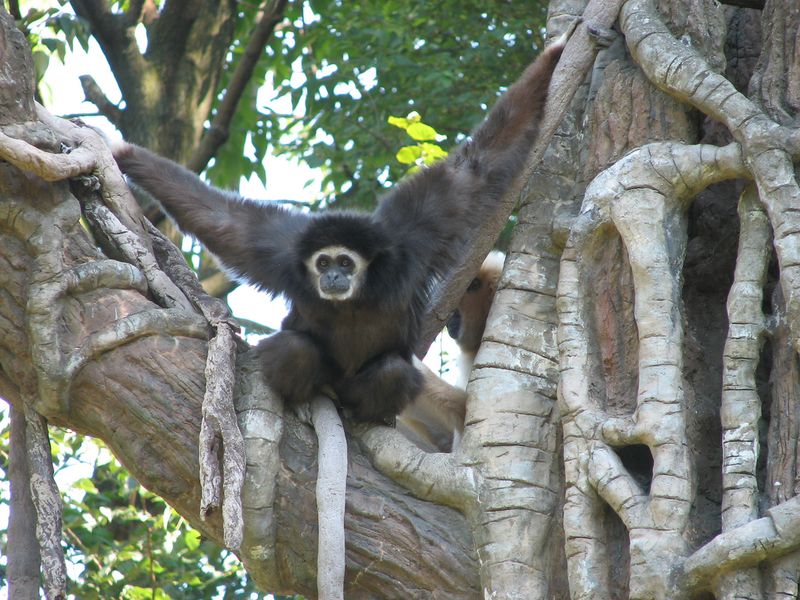
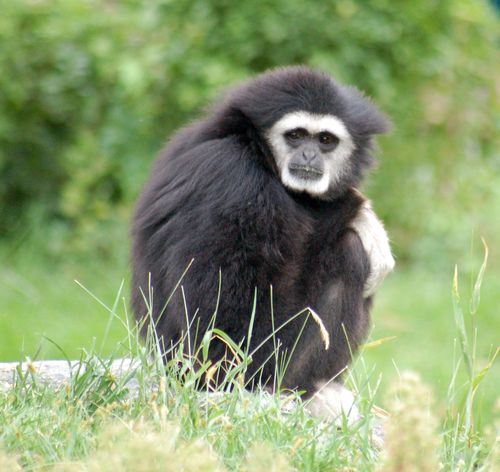
    Right here I have a passage from Ludwig Koch-Isenburg's 1963 work, Through the Jungle Very Softly, about Koko, a white-handed gibbon (Hylobates lar) he raised in his Frankfurt home. Koch-Isenburg had tons of exotic pets, toward whom Koko took a lordly attitude. Koko liked to release the African skink from the terrarium, but would drag it out if it tried to sneak under a cupboard.

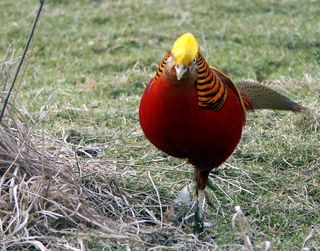
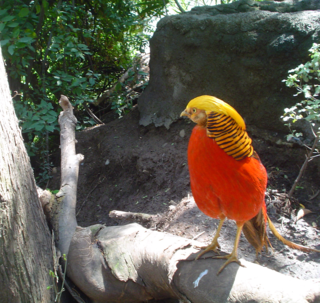
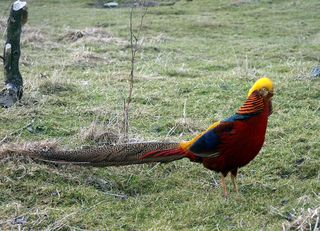
    One of Koko's favorite companions was a male golden pheasant (Chrysolophus pictus). Koko found the pheasant fascinating and often 
    Photo: David Castor. (It's a tail, not a handle.) grabbed its tail and dragged it along with him. The pheasant, reluctant to quarrel with his childhood playmate, permitted this, “and resisted only feebly when Koko tried to carry him up a tree.”


    The pheasant “would scurry away…, but Koko would catch up with him and clutch him by the tail,” Koch-Isenburg writes.
    Photo: Trisha Shears. Creative Commons Attribution-Share Alike 2.0 Generic. (It's really great up here, you'll love it.)

    The pheasant tried to be nice. One day Koko went too far and the pheasant gouged him with the spurs on its legs. Koko screamed in outrage, but never bullied the bird again.
    Photo: David Castor. (I trust I make my point.)
    It can be difficult, even painful, when the interests of childhood friends diverge. One individual is increasingly involved in active sports like swinging through branches, while the other enjoys finding food items scattered on the ground and meeting like-minded ladies. I think we've all seen this happen. That doesn't mean it hurts any less.

    I was hoping this effort might avert the “bird person” accusation, but now I'm afraid I've failed. I try to write about a primate, and the
    Photo by Derek Ramsay, used here with his permission. (It's awful to be so misunderstood.) primate himself drags in a bird. Och, what's the use? 

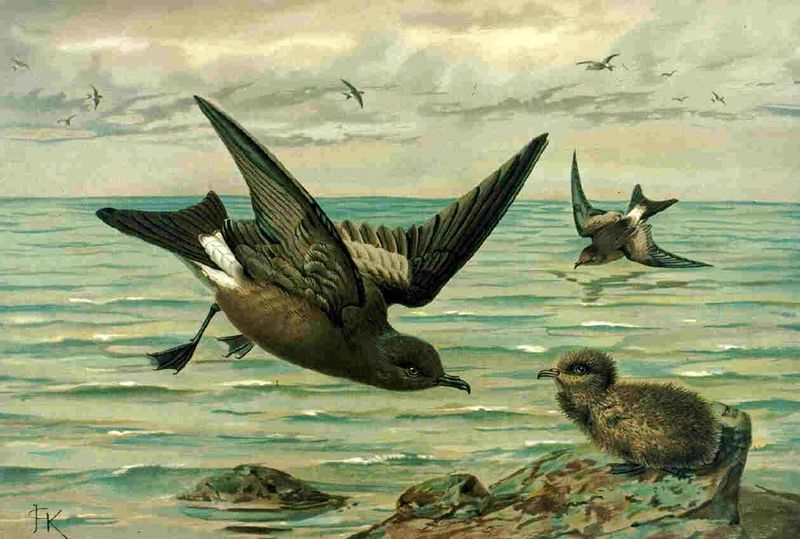
  • On remote islands where they breed, some small seabirds come and go at night. Thus they evade big daytime killers like skuas and gulls. Their secret nests are in burrows or under rocks.

    Leach's Storm-petrel (Oceanodroma leucorhoa) is one of these furtive little birds. They are smaller than robins, though with longer wings. It's said they don't even venture out if the moonlight is too bright.
    Photo C. Schlawe for USF&WS.

    Visiting Gull Island in Newfoundland, Franklin Russell, author of a moody 1965 book The Secret Islands: An Exploration ran across a petrel in trouble.

    She had gotten snared in tangled grass as she sneaked out before dawn with the other petrels. Russell picked her up. She screamed. He untangled her and tried to get her to go back down any burrow, but she darted away. She flew at top speed, away from the island – and instantly 50-odd gulls were after her with intent to catch and eat. These would have been big Herring Gulls or Black-backed Gulls.

    Photo by John Haslam, Dornoch, Scotland. Creative Commons Attribution 2.0 Generic. These gulls are trying to catch and eat a stale baguette.

    “The petrel was so well ringed by her enemies that to escape she would have had to run among at least ten gulls in any direction she tried to break out. This seemed impossible; but the petrel was not concerned with possibility or reason. Never for a moment was there any relaxation of the thrust and parry of the hunt. All the creatures were absorbed,” writes Russell.

    The chase hurtled through the air above a raft of thousands of puffins floating on the sea. Suddenly the puffins rose off the water. “…something alarmed them. Perhaps it was the intensity of the gull attacks; perhaps the petrel screamed her anguish.” Russell saw the petrel veer toward the cloud of flying puffins and vanish into their midst.
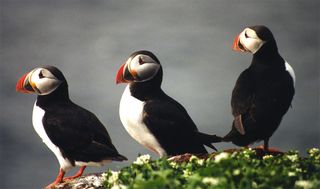
    Photo by Hanno. GNU Free Documentation License. These puffins are Fratercula arctica. Fratercula – little brothers – charming name.
    Huh? The gulls hung around where the puffin had been before giving up.

    Russell writes that he watched the departing flock of puffins with binoculars and “saw, finally, a tiny shape twist away from their mass.”

    A happy ending for the petrel. Russell says puffins (Fratercula arctica) aren't afraid of gulls. Puffins go to and from their nest burrows in daylight. But gulls are serious predators on puffins, though not when the puffins are going around in crowds thousands strong.

    Probably the puffins weren't deliberately rescuing the petrel. Probably some of the puffins were freaked out by the gulls pursuing the frantic out-of-place petrel, and decided to leave and go some place less creepy, right now. The other thousands of puffins didn't intend to be left behind if something was wrong, so they all took off, forming a screen into which the petrel shook her pursuers. Good deal.
    Naumann, Naturgeschichte der Vögel Mitteleuropas.

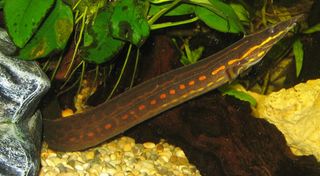
  • My sister had a fire eel (Mastacembelus erythrotaenia), Thomas, living in an aquarium near the refrigerator in which his food was kept. The food was tasty live tubifex worms.

    Thomas spent most of his time lurking under and behind rocks. Some predators like Thomas find this a useful default activity, since you
    Photo by Llandor. GNU Free Documentation License. might be thinking about nothing at all when, Oho! prey wanders by, and because you are under the rock, they suspect nothing.

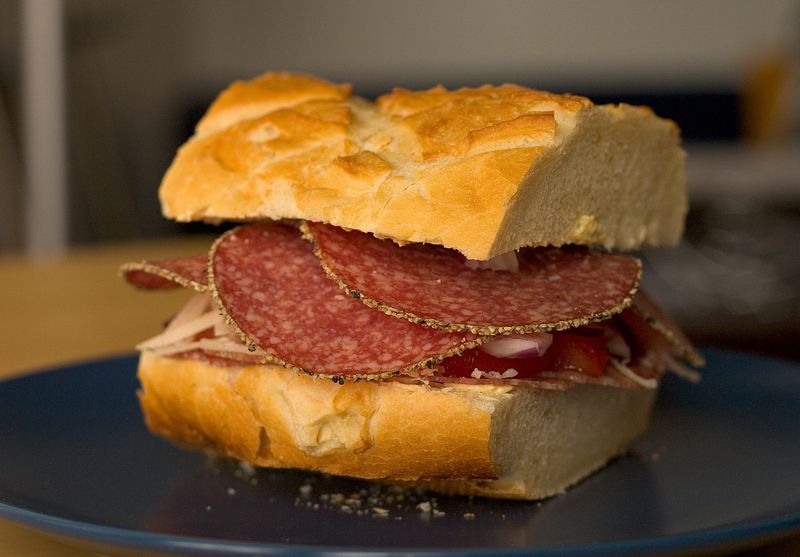
    When Thomas detected my sister heading for the refrigerator he truly shone as a wily predator. If she was going for “a glass of milk and a salami sandwich” Thomas took no action. But if her intent was to take out tubifex worms for the eel, Thomas was somehow able to tell. He swam out of the rocks and wriggled back and forth enthusiastically just below the surface. (It is not clear to me whether fire eels salivate, but if they do, Thomas may have been drooling.)

    We can't figure out how Thomas knew when my sister was after human food and when she was after fish food. This was not a matter of timing, since Thomas was fed irregularly, at any hour of the day, and not on all days. It will probably remain a mystery, since it is no longer possible to do experiments (on my sister, not on the fire eel) under the same conditions. (Was she walking differently? Was she wearing tubifex gloves? Was she glancing at the tank? She says not.)

    Perhaps you wonder why Thomas was not offered salami. Salami is fatty and salty, and probably not particularly good for little fire eels. Unlike many fire eels, Thomas was a good neighbor who did not eat the other denizens of the aquarium. On his salami-free regimen he waxed mighty, getting to be over a foot long before he perished in a reckless expedition to travel outside the aquarium. He was found in a desiccated condition on the keyboard of a nearby computer.

    Let that be a lesson to all of us.

    Photo by Alisdair McDiarmid, from Glasgow, United Kingdom. Creative Commons Attribution 2.0 Generic.

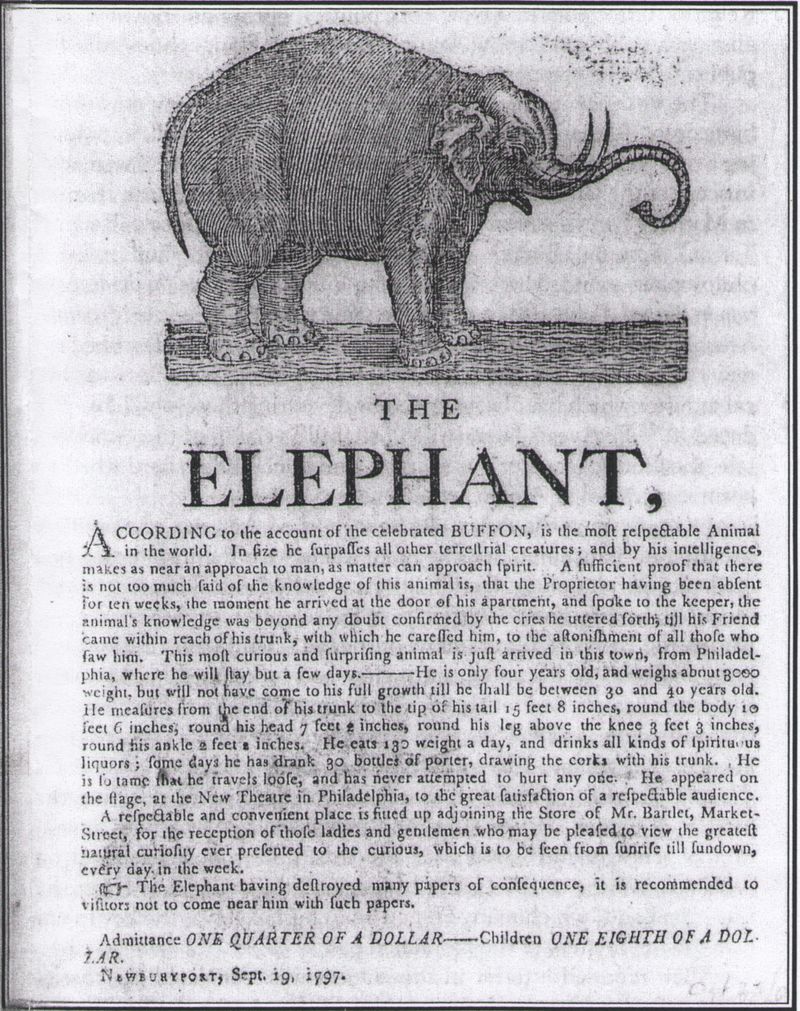
  • This broadside advertises the appearance of, probably, the first elephant brought to the U.S. The unfortunate elephant's child was bought in India and shipped on the vessel America. The captain planned to make money exhibiting it.


    With kind permission of the New-York Historical Society.
       With kind permission of the New-York Historical Society.

    The broadside is a nice mix of inaccuracy and loftiness. The Elephant is apparently the one known elsewhere and later as “Old Bet.” Female.

    “…[B]y his intelligence, [he] makes as near an approach to man, as matter can approach spirit.” Humans, that spiritual species, enjoyed offering alcohol to The Elephant.

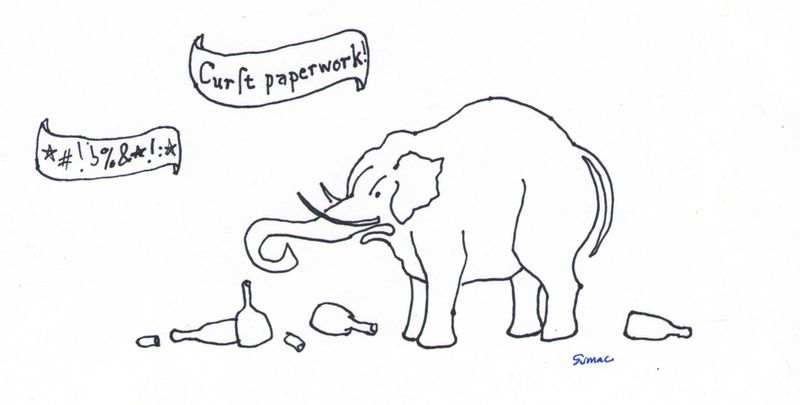
    “He… drinks all kinds of spirituous liquors; some days he has drank 30 bottles of porter, drawing the corks with his trunk.” Even when sloshed, the elephant “never attempted to hurt any one.” Yet beware. “The Elephant having destroyed many papers of consequence, it is recommended to visitors not to come near him with such papers.”

    Why did The Elephant destroy papers of consequence? (Why would a person going to see an elephant bring papers of consequence along?)

    My knowledge of animal behavior does not suggest an answer. My knowledge of cheesy fiction would suggest that the elephant associates papers of consequence with bills of sale and of lading, and its own unchosen journey from India and subsequent exile, and therefore responds with rage to the sight of documents – but that seems too pulpy to be true. A family member with knowledge of correct social behavior suggests that the elephant finds the flourishing of papers rude. That the elephant would react the same way to cell phone use.

    “Hi, guess what? I'm looking at The Elephant right now! Yes! It's awesome. Oh, it's huge. Totally respectable. It's uncorking bottles – ooh, now it's looking at me! It's coming over! The trunk is – WHOA–!” (Sound of phone being stepped on.)

    This makes sense to me. The respectable elephant knows what is polite and what is not – and, fueled by alcohol, starts enforcing the rules. I suppose that Miss Manners never goes on drunken etiquette rampages, or we would have heard about it.


    Drawing of Bet by Sumac.

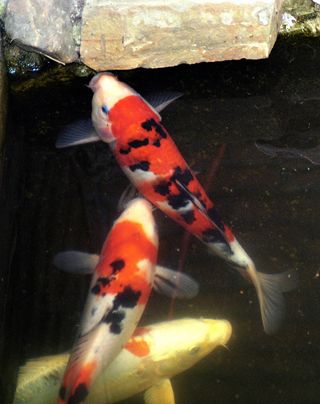
  • Researcher Ava Chase had three large koi (a.k.a carp) in her lab. She wondered if they could learn to divide music into categories. The categories she chose were classical music and blues.

    Chase rigged up a button and a fish-chow reward system in the tank.* First, Beauty, Oro, and Pepi learned to press the button when they heard 30-second excerpts from a John Lee Hooker tape, but not when
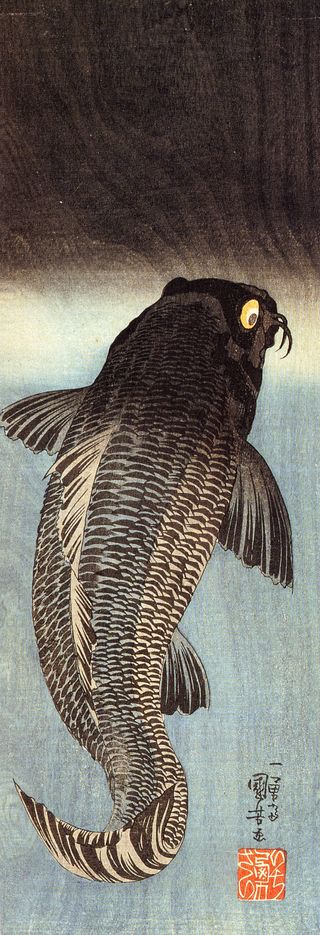
    Kuniyoshi Utagawa, Black carp 1.   they heard silence. This went well, although the “characteristically hyperactive Pepi” was slow to get with the program. Then they learned to press a button when they heard a bit of John Lee Hooker (“Blues Before Sunrise”), but not when they heard a bit from Bach’s oboe concertos. Then the rules were reversed, and they had to press the button for oboe concertos and not for John Lee Hooker. Beauty and Oro caught on quickly, but Pepi took longer, with “substandard” performances at first.

    The stimuli were broadened to see if the fish would lump other blues and classical recordings with the ones they’d already heard—would they treat Muddy Waters and Koko Taylor as being more like John Lee Hooker than Bach? Would they lump Handel and Mozart with Bach? Yes and yes.

    But there were Vivaldi problems. The koi took the view that Vivaldi’s guitar concertos were blues. They were adamant. So Chase used a 200-Hz high-pass filter to remove the lowest frequencies, in case they were picking these up through their lateral-line organs. This changed
    Caricature of Vivaldi, Pier Leone Ghezzi. their outlook on the nature of Vivaldi, even after Chase turned off the filters. Chase notes that “Vivaldi evidently can impress listeners in odd ways. Porter & Neuringer, 1984, reported that a Vivaldi violin concerto sounded more like Stravinsky than like Bach to their pigeons, as it did also to some humans.”

    (I pause to say that while I think this research is funny, I also think it is interesting. I reject the notion that all research must be no more than two obvious steps from curing Alzheimer's by giving urban youth jobs supplying unlimited clean energy.)

    Later, Chase tested the carp with synthesized versions of music they
    Photo Xlilx5, Creative Commons Attribution-Share Alike 3.0. had previously heard. First she refreshed their memories by exposing  them to a Bach oboe concerto and John Lee Hooker doing “One  

    Oboe. Encyclopedia Britannica, Kathleen Schlesinger
     Bourbon, One Scotch, and One Beer.” At this point Pepi “ceased  responding…and had to be dropped from the study.” (Chase doesn’t speculate as to what pushed Pepi too far, but we might guess. I have a collection of oboe jokes I think this fish might enjoy.)

    Chase tested Beauty and Oro to see if they could distinguish between two melodies with identical notes and timbres, by giving them a choice between two versions of a synthesized passage of the theme from Paganini’s 24th Caprice for violin—one of which was played in reverse. This too is something that carp can do, or at least something that Oro could do, since “Beauty’s performance inexplicably deteriorated to the point where he had to be dropped as a
    R. Wampus, Creative Commons Attribution-Share Alike 2.0 Belgium. subject.”

    A possibility raised by this research is that the fish had not simply learned to discriminate between two musical selections (“the louder one,” “the one with the high note,” “the fast one”) but to form and assign categories (“blues,” “classical,” “tadpolesque,” “that weirdo Vivaldi”) to music.

    That interests me, but I also wonder what was going on in with the koi. Were they bored? Were they losing their minds? Were they angry that they never got to hear the whole concerto? Were they anxious to find out why the guy is leaving home before sunrise? Were they frustrated that no one would produce a demo of Oro's composition, “Mean Mistreatin' Fish Teasin' Gal”? Were there quality control issues with the fish chow?

    I call for more research.

    *Chase,
    Ava R. 2001. “Music discriminations by carp (Cyprinus carpio).” Animal
    Learning and Behavior
    29: 336–353.

      
    "'Delta baroque,' that's what I should have said." Picture by Hokusai.

  • Here's another stellar dancer, a little corella or bare-eyed cockatoo, Cacatua sanguinea, dancing to Ray Charles's Shake Your Tailfeather. He does everything except shake his tailfeather and lift his feet.

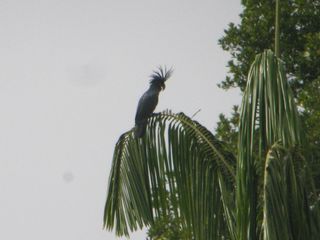
    Brilliant dancers that Frostie and Snowball are, their performances may not be the most we can expect from cockatoos. As discussed in Becoming A Tiger, wild palm cockatoos (Probosciger aterrimus) of Queensland, Australia, love to perform. Males perch on top of snags (making sure everyone gets a good view), spread their wings, scream, and pirouette. At the same time they drum on the tree with a stick
    In the greenroom, New Guinea. Photo: markaharper1, Creative Commons Attribution-Share Alike 2.0 Generic license they hold in one foot. It is believed by many humans that this impresses female cockatoos, so perhaps male cockatoos believe it too. It impresses me.

    Female palm cockatoos have also been known to do this. A journal article describes both parents in a cockatoo pair drumming like fiends on the day before their baby left the nest for the first time. (I believe this is the “Dance Party (Empty Nest) Mix.")

    These cockatoos craft their own drumsticks, snapping off branches and trimming them to a suitable size and shape.

    Some people collect abandoned cockatoo drumsticks. (This is the highest musical expertise I aspire to: creeping around under dead trees collecting bird discards. But I haven't been to Queensland, so even this ambition is thwarted.)


    Probosciger_aterrimus_-Leeds_Castle_-head-6a You can buy a palm cockatoo for a pet. Please don't.

    In light of what palm cockatoos can do, it is my view that Snowball should be offered a drum set. Those who live with Snowball should be offered really good ear protection.

    As for wild palm cockatoos, it is the usual dilemma with out-of-the-way cultures. One doesn't want to short-circuit their timeless artistic tradition by leaving corrupting tradegoods lying around the forests of Queensland. But shouldn't artists have their choice of tools? Shouldn't they be the ones to decide whether we offer them drum sets and xylophones? How about a simple tambourine? Would it be so bad to give a bird a tambourine?

    In addition to singing, dancing, and drumming (and crafting drumsticks), palm cockatoos also have a call that sounds kind of like “Hello.”

    If you get to go to Queensland, and you are walking through the forests of Cape York, and you hear a cockatoo calling “Hello…” do not think of it as being short for “Hello, wouldn't I make an adorable prisoner?” Think of it as being short for, “Hello, do you have a delivery for me from Percussion Mart?”

    Probosciger_aterrimus-20030511B

  • You, webwily blog reader, have probably seen video of Snowball, the dancing fool who happens to be a cockatoo (Cacatua galerita eleanora). It's gotten three and a half million hits, some of whom are not me.


    Snowball has been on many TV shows. (I especially like this one, where a panel of eminent scientists try to dance like a bird, at about 1:01.)

    Snowball's work has been studied by other scientists, who verify that he can keep a beat, and note that he dances better with a partner.(Patel et al., "Investigating the human-specificity of synchronization to music". Proc. 10th Intl. Conf. on Music Perception and Cognition.)

    This bird is a great dancer. In addition to his mastery of classic moves like kicks, he has a gripping repertoire of crest flings, not to mention hoarse cries. Like Fred Astaire, he conveys joy.

    In the initial video of this charismatic bird dancing to the Backstreet Boys, if you tear your eyes from Snowball's high-kicking luminous self, you may detect a parrot in a cage in the background. It is bobbing enthusiastically. Not all birds are equally talented.

    The late, famous, Alex was apparently a head-bobber. Many people have posted video of their birds dancing, and none seem likely to challenge Snowball's pre-eminence. I searched YouTube for examples so you don't have to. (No really, you don't have to, I know you have stuff to do.)

    That Alexandrine parakeet is not really breakdancing, for instance. Nor do I feel that the hyacinth macaw is committed to its interpretation of “The Sweet Escape. As for the cockatoo doing “Hula Girl,” that's straight out of vaudeville. Nice bird, doesn't have the hips for the job.

    But Babe, who seems to be a Black-capped Conure, dances fairly well and squawks with it.

    I like Jake the Black-headed Caique's “jumpstyle” moves.

    And the unnamed umbrella cockatoo who stars in “Death Metal Parrot” has got the passion.

    Apparently, if you have a bird of modest talent, the face-saving move is to claim it likes techno.

    You don't have to be a dancing bird aficionado to see that Snowball is remarkable. My friend zorca, urged by fans to watch the video, found his work surprisingly effective, and conceded, “Not bad for a white bird.”

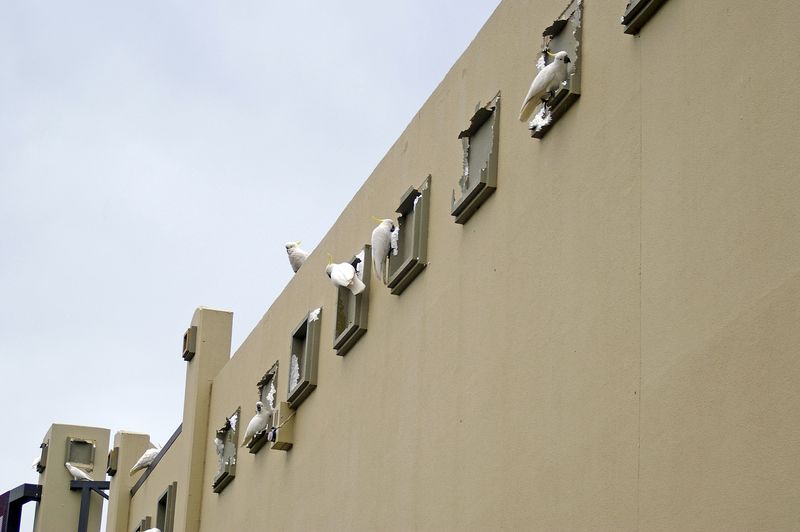
    Snowball resides at Bird Lovers Only, a rescue operation. Although parrots are highly-desired, costly creatures, they are difficult pets. From a selfish human point of view, their ability to scream at high volume for hours, inflict grievous flesh wounds, and efficiently destroy property are drawbacks.

    Cockatoos defacing a building. Photo: Bidgee, Creative Commons Attribution-Share Alike 3.0 Unported
     

    Their tendency to approve of one family member and dislike the others is often unwelcome. Their decorative aspects are lessened if, as regularly happens, they spend their idle time plucking out their own feathers.

    From a more unselfish standpoint, parrots are social to the bone, so to be alone all day is agonizingly sad for them. The ones who pull their feathers out are crazy with boredom (or were crazy with boredom in the past and now can't shake the habit). Parrots long for matrimony. When they're denied a suitable parrot spouse, a person in the household can take the place of That Special Somebird. Sadly, that person generally makes a rotten mate for a bird. Parrot couples are together 24 hours a day, and that's how they like it. Human love-objects seldom permit birds such devotion.

    Many captive birds don't get to fly. I don't know what to say about that.

    Vmenkov, GNU Free Documentation License

    Thus, many parrots end up in parrot rescue, crazed and maybe bald, leaving behind vistas of splintered wood and shredded fabric, ringed with angry neighbors.

    Snowball's is an inspiring story. I can't decide if it's a Happy Feet story, an Outsider Art story, or a Pygmalion story. (I hope the next scene doesn't find him battling addiction.)

    Snowball had at least three owners before going to parrot rescue. His sheer talent has won him international fame, the devotion of parrot rescuer Irena Shultz, and a permanent home at Bird Lovers Only.

    The greatest dancing bird the world has ever seen! Surely there is no poor country bird anywhere whose talents could ever rival his?

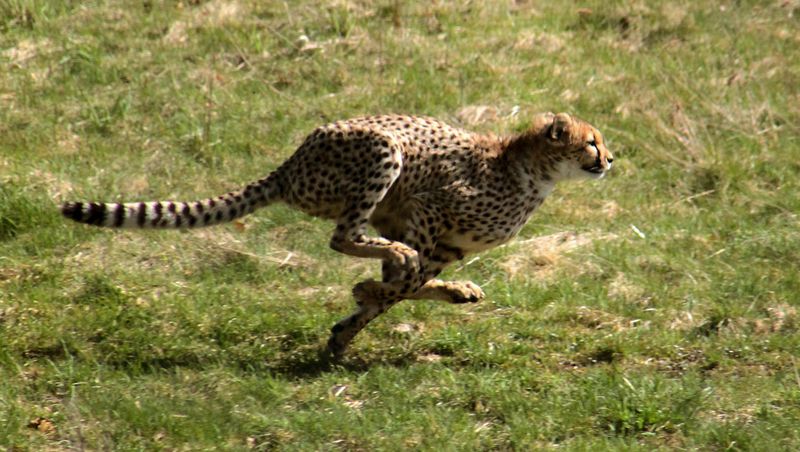
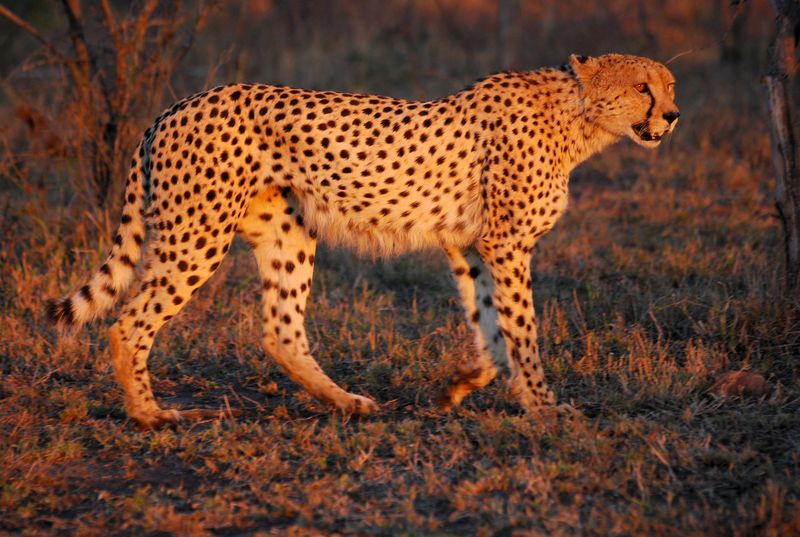
  • Researchers in the Serengeti were quantifying the hunting behavior of female cheetahs (Acinonyx jubatus). They measured the proportion of the day spent hunting, hunts started per hour, proportion of hunts which were successful, and time to complete a hunt. They recorded the age of the cheetahs' cubs if any, and how her hunting behavior changed with the age of the cubs.

    Malene Thyssen, GNU Free Documentation License

    Cheetahs with no cubs don't have to spend as much time hunting. Once they have cubs in the lair or just out of the lair, they have to spend more time hunting to feed those children.

    But there's another factor that goes into time spent hunting. I will remind you that cheetahs don't pair up, so these female cheetahs are single ladies with no babysitters and they can't even get their own mothers to help.

    The cheetahs whose behavior confounded the measurement of hunting time had young cubs, nursing but out of the lair. Fluffy, playful, delightful cubs full of nonstop energy, with exciting new teeth.
    Photo by Lukas Kaffer, GNU Free Documentation License
    When their mothers hunted these cubs either stayed behind or followed her for a short distance. Then they would sit and watch their mother advancing toward the prey, not coming forward unless she called them (to share the gazelle she'd just caught, say). Cubs know how to do this. They watch carefully as their mother stalks the prey.

    A cat stalking its prey often creeps forward, stops and crouches in place for a while, creeps forward some more when the prey isn't looking, stops again, and so forth. The researchers timed all this. To their surprise, the mother cheetahs were also taking naps. Creep, creep, crouch, snooze, creep, creep, crouch, snooze. Sometimes they'd sleep for ten minutes at a time in the middle of a stalk. Presumably, the cubs, lacking binoculars, just thought their mother was being extra sneaky.

    I think the researchers sympathized. “Freed of nursing attempts and being played upon, a mother had a chance to close her eyes,” wrote T. M. Caro in Cheetahs of the Serengeti. “Prey often wandered off as a consequence…”

    Any caretaker of youth can guess how those cheetahs feel. “I would kill for a nap. A nap and a glass of wine. A nap and a glass of wine without being chewed on and FIVE MINUTES CONVERSATION ABOUT SOMETHING BESIDES MR. IMPALAHEAD.”

    Wegmann, Creative Commons Attribution-Share Alike 3.0 Unported

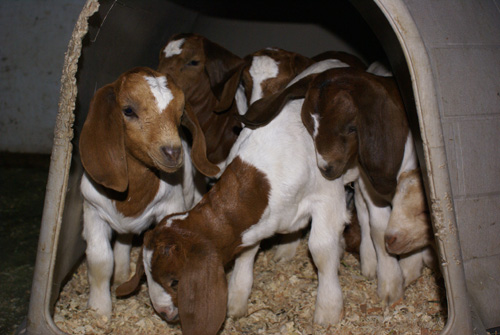
  • It's one of those igloo-shaped doghouses. The pioneer brand is Dogloo. (Naturally, it was an aerospace industry spinoff.)

    It's the time of year for baby goats – kids – at my sister's farm.  They popcorn all over the place, all day, and at night they like to sleep in a heap. In the igloo. My sister happened to have a second-hand igloo-shaped plastic dog lair standing about. The kids sleep there every night. Their idea.

    The mother goats are mildly concerned when their children vanish into the igloo. They peer and sniff, but they don't actually call the kids out.

    “That's bizarre,” I said, when my sister showed me this.

    “It's a den,” she said.

    “Goats don't have dens,” I said.

    “They do if they find one!” she said.

    Apparently.


    10 Boer goat kids in a plastic igloo. Photo: Sarah McCarthy