• Late in the Acts of the Apostles, Saul “Paul” of Tarsus, afterward St. Paul, is arrested in Jerusalem. He wisely requests a change of venue to Rome. There's a shipwreck on the way, and they are cast ashore in Malta (called Melita in Acts). The “barbarous” Maltese kindly invite the 276 castaways to warm themselves at a fire.

    Maybe the fire wasn't hot enough to warm all these people. Paul gathers a bundle of sticks to put on the fire. When he does, “there came a viper out of the heat, and fastened on his hand.”

    The Maltese instantly conclude that this is a sign that Paul is a murderer, and doomed – he didn't drown, but now he's going to die of snakebite. Watch this!

    Paul “shook off the beast into the fire”. When “he should have swollen, or fallen down dead suddenly”, but doesn't, the Maltese “changed their minds, and said that he was a god.”

    A god. Hmm. Publius's dad is sick, think you can do anything? Paul lays hands on Publius's father, who gets better, and “others also, which had diseases in the island, came, and were healed”.

    “St Paul Bitten by a Viper on the Island of Malta,” Marten de Vos, circa 1567. See it at the Louvre.

    According to Ethan Matt Kavaler's Pieter Bruegel: Parables of Order and Enterprise, the two people standing on the left are probably Gillis Hooftman and Margaretha van Nispen, rich residents of Antwerp who commissioned the painting for their dining room. Second from the right is probably Abraham Ortelius, a mapmaker who published a famous world atlas, and who “was a regular at the Frankfurt Book Fair.” As for painter Marten de Vos, he charged less than Frans Floris. He was “suspected of Lutheran sympathies.”

    But what about the snake, in the middle of the picture? Here's a difficulty: there are no vipers on Malta. Also, according to Theodore Stephanides, in Island Trails, vipers don't act like that. They would rather flee than bite. Or, if they must, bite and then flee. They don't fasten on like scaly terriers.

    But Stephanides points out that a snake he calls the Dark Green or Angry Snake, now more often called the Western Whip Snake (Hierophis viridiflavus), does act like that, and is found on Malta. He says it “has a well-deserved reputation for viciousness although it possesses no poison fangs. It is among the few ophidians which will attack with little or no provocation and it will even hang on to its victim like a bulldog.” I say even a sweet-tempered snake may view
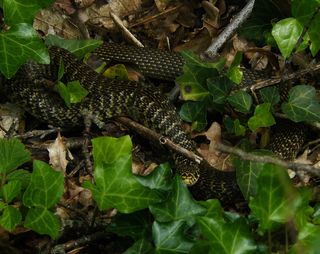
    Hierophis viridiflavus. Pretending to be a stick. Can lead to misunderstanding. Photo: Manfred Heyde. Creative Commons Attribution-Share Alike 3.0 Unported. being used as firewood to be provocation.

    The Snakes of Croatia webpage agrees about the snake's personality. “Extremely [aggressive] if caught, it tends to bite hard and persistently.” (So would I.)

    But not poisonous. No wonder Paul didn't drop dead. This means that if you had been there, and that snake had bitten you, you would not have swelled and died, and they
    Hierophis viridiflavus. Thinking angry thoughts about Paul. Photo: Jeroen Speybroeck, GNU Free Documentation License. would have taken you for a god. (Unless you had been a big whiny baby about it, because that always seems so non-divine.)

    Celebrated as a god! Nice. Of course, then you would have to heal the sick. There's always something.

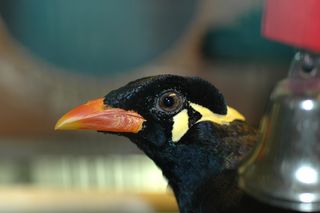
  • A 2008 New Yorker story by Margaret Talbot on Irene Pepperberg's work with parrots and language made brief mention of unsuccessful work with mynahs and language. This was to explain why Pepperberg didn't train her eloquent parrot Alex with classic behaviorist methods of operant conditioning. I recognized the reference.

    While reading about animal communication for Becoming A Tiger I ran across a long article called “Verbal Behavior and the Mynah Bird.” (1967.) Experimental psychologists Joseph Grosslight and Wesley Zaynor had a theory that babies talk earlier if you pick them up when they cry. They speculated that by thus rewarding babies, you create a “noisy organism.” The noisy baby learns to attach meaning to noises later – but sooner than a quiet baby.

    They couldn't experiment with babies. They went with talking birds. Mynahs – great choice! (Gracula species.) Easy to buy (then), easy to feed, can't bite your finger off, cheap. Definitely noisy organisms. They started the Mynah Bird Project. They scheduled a report called “Verbal Behavior and the Mynah Bird and Implications for Man.”

    The paper makes it clear that they understood that babies eventually learn language and mynahs don't. They say it several ways so no one thinks they're stupid or anthropomorphic. My favorite way they say it: “there is a complete absence of zoosemiotic considerations.” We get it, guys. You're not zoosemiotes.

    (Zoosemiotics seems to be the study of signs or symbols in animal communication. You know, meaning. Can't have that.)

    In the 1960s operant conditioning was new. It seemed as if, using this powerful system of rewards and punishments – you could get any animal to do anything. You could teach a rat to push a lever, a pigeon to peck when it saw the word “PECK,” a chicken to dance. (Okay, teach a chicken to “dance.” These are academics. It's a chicken. How well did you expect it to dance?)

    Grosslight and Zaynor would use operant conditioning to create a bird equivalent of noisy babies. They viewed a mynah saying “Hello!” as “motor behavior not wholly unlike the classical operant bar-press of the rat in a Skinner box.” But, they reported in the plaintive 1967, “Verbal Behavior and the Mynah Bird,” that they had taken “and Implications for Man” out of the title due to “adversity.”

    Author not known to me; GNU Free Documentation License.

    What adversity? Uncooperative mynahs. The researchers expected great results by putting each mynah in a sound-proof chamber and playing a recorded phrase which the bird would get food rewards for repeating. Isolation in sound-proof chamber = no chance of hearing other noises. Recording = identical stimulus each time. Rewards for repeating = according to operant conditioning principles, rewarding behavior increases the frequency of the behavior. Voila! Superior talking birds!

    But instead of repeating the phrase, the mynah would stay mute, beak shut. Finally the researchers would give up and put the bird back in the aviary – and then the mynah would say it. Or the bird in the chamber would say the phrase once and never again.

    The researchers were also bewildered by the daily “jungle hour,” when mynahs vocalized without food rewards. They screeched, cackled, hooted, whistled, clicked, and hollered—why?

    Their failure to produce talkers led Grosslight and Zaynor to confess “we do not know the motivational or controlling stimuli for the emission of vocal or verbal behavior in the mynah.” They could not answer the question, “why does the mynah bother to talk at all?” (Some scientists complain researchers don't publish negative results often enough. Maybe they're afraid people like me would mock them. At least I didn't call them zoosemiotes.)

    This doesn't mean operant conditioning doesn't work. It means the researchers didn't understand  mynahs. It didn't occur to them that being trapped in a soundproof chamber hearing repetitive tapes is already punishment for a mynah. They assumed that food is the only reward an animal cares for.

    Nowhere do Grosslight and Zaynor say a harsh word about mynahs. They never blame the birds for the failure of their experimental vision. Which would be easy, because mynahs can be jerks.

    I knew a pet store mynah who spoke dozens of phrases, which were scrawled on a card on the front of his cage. New customers would tryPhoto: Dhabyany. Creative Commons Attribution-Share Alike 3.0 Unported. the top few phrases on the card. “Hi there!” they would read, “I’m a  pretty bird!” The mynah would put its head on one side and stare out of one eye. “Hello! I’m a pretty bird! How are you?” the visitors would try. The mynah would stare out of the other eye. “Hello! Pretty bird! What’s your name?”

    Silence.

    As they turned away, the mynah would sneer, “You're stupid!

    He rolled the r – 'Yerrrrrr stupid!”– in a way that suggested he had once lived around a ten-year-old boy.

    So one of Grosslight and Zaynor's few successes makes sense. With food rewards they could increase the frequency with which the mynah Charlie said “I talk!” They could decrease the frequency with which Charlie said, “Ah shut up!” But they could not decrease it to zero.

    It's enough to make you zoosemiotic.

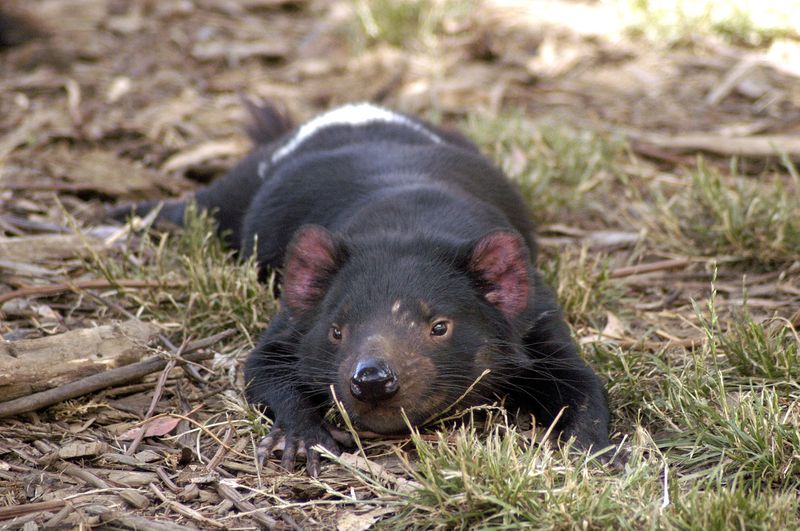
  • According to the newspaper Daffy Duck reads, “The TASMANIAN DEVIL is a powerful, vicious, evil-tempered brute… hungry at all times… it will eat anything but is especially fond of wild duck.

    In creating the character of Taz, Warner Brothers was building on precedent. The person who described the Tasmanian devil (Sarcophilus harrisi) for science, in 1807, surveyor/naturalist George Harris, told the world how ferocious, fiendish, savage — “uncontrollably wild” — devils were.

    He wrote, “They bite frequently and snarl and bark loudly.”

    But here's how he knew. He had two devils. He kept them in a barrel. Chained together. They are nocturnal, and slept all day, while Harris was writing insulting things about them. They woke up when it got dark and discovered they were still chained together in a barrel. They fought and shrieked all night, when Harris probably planned to sleep. Perhaps he felt that if he had been chained to another guy, in a barrel, he would have remained quiet and sweet.

    Tasmanian devils still have a terrible reputation. People call them vicious and impossible to tame. But Grzimek's Animal Life Encyclopedia, where I first learned about Harris and his barrel, also mentions a person who had two pet devils whom he leashed and took for walks. And there was no trail of bloody bodies behind them, even when he took them to Melbourne.

    Others say they are “delightful and affectionate pets.” When not chained in a barrel. It's easy to find video of devils scampering across verandahs, hanging from sleeves like Jack Russell terriers, or in one remarkable clip, nestling in a zookeeper's arms and being persuaded to relax her pouch to reveal two infant devils (imps?) clinging blindly to her nipples.

    It's true that Tasmanian devils yell a lot, specializing in a noise that's partly screaming and partly retching. Carrying on at night is how Photo: Chen Wu. Creative Commons Attribution 2.0 Generic. they got called devils in the first place. They are not as timid as people like wild animals to be.
     
    They hold an ecological niche—that of a small scavenging carnivore—that gets bad press even without the shrieking at night and George Harris slandering them. (Also: chicken-snatchers.) Essentially they are marsupial wolverines. And you know how Photo: Birgit Fostervold, Creative Commons Attribution 2.0 Generic. people talk  about wolverines (Gulo gulo). For some reason people enjoy the idea of a small demonic animal and promote the legend of its savagery.

    I once met two hand-raised wolverines. The minute they saw you they rushed up scrabbling over each other to lick your hands (and see if you had been nice enough to bring snacks). Like puppies, they loved to be rubbed and scratched. I'd love to meet devils raised that way, with affection. And no barrel.
    Photo: Wayne McLean, Creative Commons Attribution 2.0 Generic.

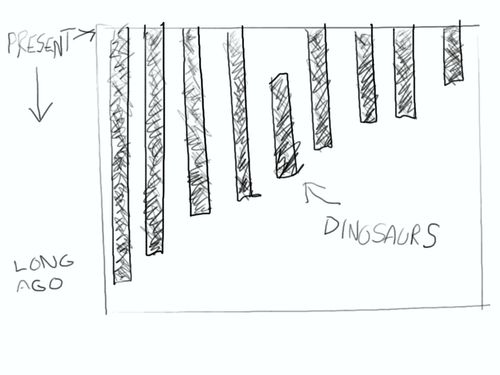
  • It was morning. My spouse was dressing for the day. I was reading in bed, working through Kenneth Miller's Finding Darwin's God: A Scientist's Search for Common Ground Between God and Evolution. “This is an interesting bar graph,” I said. “It shows a bunch of major living groups through time, and the only group that doesn't make it into the present is the dinosaurs.”

    “Oh?” said my spouse, not really seeming fascinated.

    “And I've been reading all these books about religion, and so the idea naturally occurs to me that if the dinosaurs were the only group wiped out, it must be because God punished them. I wonder if anyone has advanced that idea.”

    “Uh huh,” my spouse said.

    “The dinosaurs must have really sinned to be singled out that way,” I said.

    “The dinosaurs were sluts!” my spouse shouted as he rifled through his sock drawer. “Sluts and gonifs!"

    I don't know where that came from. I had no idea that he harbored resentment about the moral character of dinosaurs.

    After Miller, 1999.
     

    I don't want anyone to think I take Miller's graph too seriously. He calls it “elementary.” But I've been thinking off and on, when I have something else to do, about the sins of the dinosaurs. Some Biblical literalists say the dinosaurs drowned because they weren't taken onto Noah's ark. Well, why weren't they? Not because they were too big, for there were many small dinosaurs – they weren't saved.

    It can't be that they were unclean, because Genesis has Noah loading both clean and unclean animals.

    So some dinosaur did something awful? For a second, I thought maybe it was a dinosaur who suggested frugivory to Eve, but then I remembered that Genesis not only fingers the snake, but says the snake is punished by having to crawl on its belly thereafter. All the dinosaurs I know about had legs.

    A dinosaur did something even worse than abetting the Fall? Not necessarily. Peoples in holy writ are often obliterated for things that I, personally, might pass over with a glare and a sniff. Maybe something trivial got the dinosaurs killed, whether you believe it was done by barring them from the Ark, or by something mechanistic like having an asteroid flung at them.

    Maybe a pteranodon laughed at a prophet's bald head, or a stegosaurus danced naked on an altar, or a velociraptor worshipped a golden calf. Could have been anything, really. Being a slut or gonif might be enough.

    Baddinos
    But let's think about the biology. What sins are dinosaurs likely to have committed? Let's look at birds, their closest living relatives. What really annoying things do birds do? Often they make a lot of noise. I've heard many complaints about trees full of grackles or starlings shrieking their heads off. A lot of self-proclaimed tree-huggers become enraged when describing a mockingbird singing at night when said nature lovers are trying to sleep, damn it. One dark secret about penguins is how incredibly noisy their colonies are. (The other is how badly those colonies stink.)

    Maybe dinosaurs were noisy. There were a lot of them, and some were huge. Imagine a bunch of forty-ton tubas having an argument with a colony of ten thousand furious piccolos. (Maybe a few swooping pterosaurs – imagine angry fiddles with 11-meter wingspans.)

    Fans of the Gilgamesh epic will know that the Babylonians also wrote of a Great Flood. It happened because humans, who had become numerous, were noisy and made so much racket that Enlil, greatest of the gods, couldn't sleep. Plagues didn't shut them up. Droughts didn't shut them up. So, flood.

    Thus the possibility that the dinosaurs roared and chirped and screamed so incessantly that they were destroyed by divine wrath has theological precedent as well as biological plausibility.

    Sluts, gonifs, loudmouths, who knows what got the dinosaurs in trouble? Whatever it was, they clearly threw amazing parties.

    You wouldn't find them sitting around reading about reconciling evolution and religion.

    Sometimes I really miss the dinosaurs.

    Noisysaurs

  • Daniel Everett – then a missionary, now a linguist — had just come to live in a Pirahã village in the Brazilian Amazon, by the bank of the Maici River. In his book, Don't Sleep, There Are Snakes, he writes, “I was startled by the sight of two small gray porpoises jumping in sync out of the river. I had no idea that there were freshwater porpoises.”

    Not in the Amazon Basin, there aren't, so let's call them dolphins.

    Things got even better. Two canoes came hurtling around a river bend, furiously paddled by local men who were chasing the dolphins, trying to tag them with the canoe paddles. The dolphins could easily evade the canoes, but kept popping up almost within reach so the men would chase them some more. People in the village gathered to watch, laughing uproariously.

    The men chased the dolphins until it got too dark to continue. “In all my years watching this contest between mammals, no porpoise has ever been 'tagged,'” Everett writes.

    Everett and his family lived among the Pirahã for years. He learned, and wrote a thesis on, their difficult language, and failed to convert a single person. He lost his religious belief and diverged from the teachings of famous linguist Noam Chomsky in making the controversial argument that the Pirahã language doesn't have features of Chomskian “universal grammar,” notably recursion. He also says it doesn't have names for colors or numbers, and that the Pirahã don't have “motherese” (baby talk). They don't have a creation story. My favorite part is the idea that the language has many suffixes indicating the source of information, so that one distinguishes instantly between, say, “Dan caught a fish (I saw him),” “Dan caught a fish (Keren says she saw it)” and “Dan caught a fish (I assume on circumstantial evidence).”

    (A related problem with missionary efforts to the Pirahã seems to be a cultural impatience with extended hearsay. If you were Jesus Christ, they would be happy to talk to you. If you had seen Jesus Christ perform a miracle, they'd be willing to hear that. But if your pastor told you that he read in Bible that Timothy heard that Jesus Christ performed miracles, the Pirahã can't be bothered.)

    Everett's claims have created great ongoing controversy, and more non-theological interest in studying the Pirahã language. He's been called a charlatan, or simply wrong about one point or another.

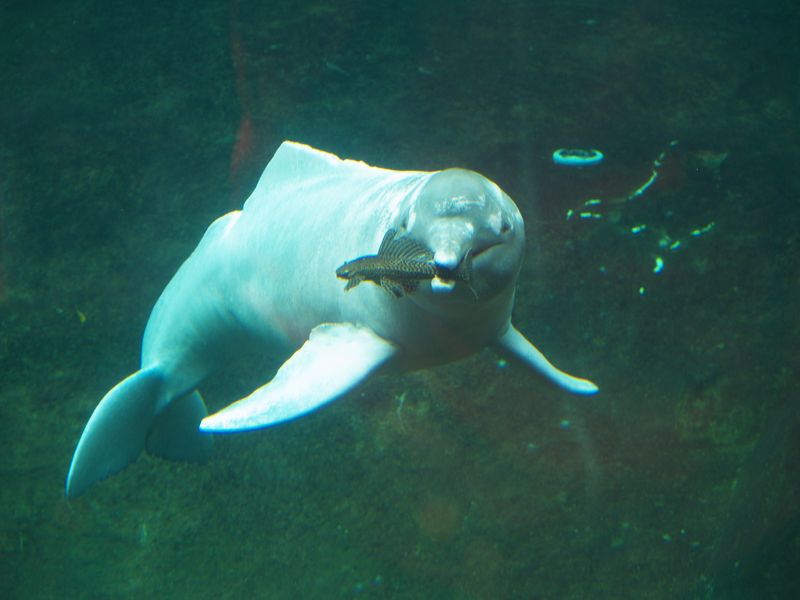
    About the porpoises – the only freshwater porpoises were in the Yangtze (probably now extinct). I can't figure out if Everett was seeing the freshwater dolphin called Inia geoffrensis or boto, or the one called Sotalia fluviatilis or tucuxi. He had missionary training and linguistic training, not natural history training, so I don't think imprecise cetacean nomenclature reflects on Everett-as-observer.

    Here's a picture of a boto in the Duisberg Zoo.
    Dennis Otten, GNU Free Documentation License

    Here's a picture of what I take to be a tucuxi.
    "DELFIN DEL ORINOCO2", Archilider, GNU Free Documentation License

    If only I were blogging in Pirahã! This entry would be much shorter, since with simple prefixes I could indicate things like “Everett said this,” “Everett said this, but I think he meant something else,” “Wikimedia Commons didn't exactly say this, but this is a picture the search term sent me to,” and “the boto caught a fish (unless that's Photoshop work).”

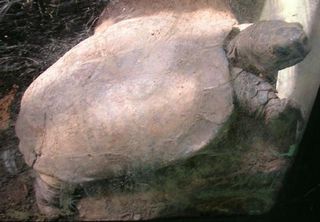
  • It was sad about the Arakan forest turtle (Heosemys depressa). It hadn't been seen since 1908, when a British officer in Myanmar (then Burma) found all of one specimens. Clearly extinct. Farewell, small drab turtle.

    However, in 1994, “conservationists found a few specimens in a food market in China.” Not extinct.

    This is the easiest way of doing research I have yet heard of. No need to pole up mosquito-thronged rivers in stifling heat, stretch heavy nets across waterways, interview suspicious local residents with aid of unreliable translators. Just go shopping. In a food market! Snack your way to conservation.

    ZooAtlanta started trying to breed them and at last report had generated 5 additional Arakan forest turtles. (They mate just once a Photo Eoghanacht. year, and the eggs take 100 days to hatch. Do not rush the Arakan forest turtle.)

    Since the turtles were not actually living and breeding in the food market, dissatisfied conservationists went looking for the turtles' actual stomping grounds, and in 2009 researchers from the Wildlife Conservation Society (WCS) finally found wild turtles. In an elephant sanctuary, excellent evidence for the often-asserted notion that when you set aside land for something big and charismatic, you simultaneously protect smaller dowdier species, including ones you don't even know about.

    Though this sanctuary contains elephants, apparently nobody goes there, because it also contains “thick stands of impenetrable bamboo forests”. Probably hot and full of bugs, too.

    It sounds a little like the area where Sharon Gursky-Doyen sought the pygmy tarsier (Tarsius pumilus). This species hadn't been seen in 70 years when one turned up in a rat trap in Sulawesi. To find more of these mouse-sized primates, Gursky-Doyen set up 276 nets on Mount Rorekatimbo, at above 6,000 feet. Her team caught, radio-collared, and released 3 tarsiers (so one tarsier per 92 nets deployed).  But Rorekatimbo's steep slopes are so dangerous that Gursky-Doyen “actually broke my fibula walking around there.”

    I admire tough, resolute field workers like these deeply, and so I hope to tell them when I run into them at the food market.

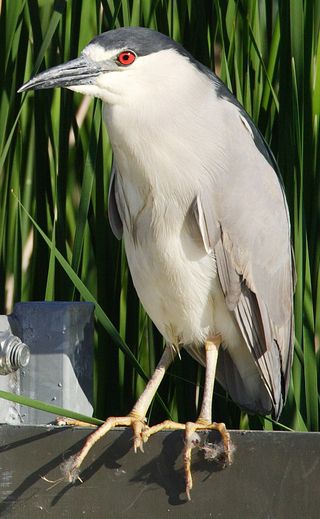
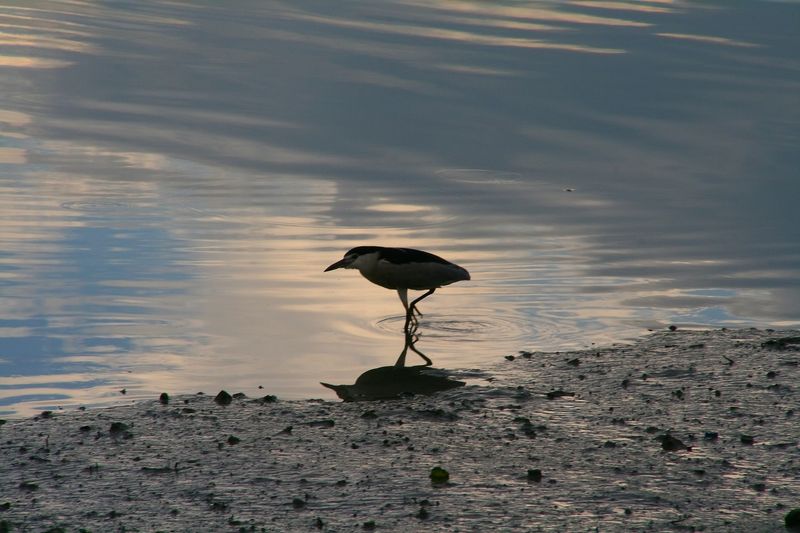
  • Ten thirty at night, driving through Oakland's Chinatown, we glimpsed a large bird perched on a sign. We went around the block and there was a black-crowned night heron (Nycticorax nycticorax) on the LEFT TURN ONLY sign, two more on a jewelry store awning, and another on a pho restaurant awning. We knew that night herons scavenged fish parts in local dumpsters, but no dumpsters were in view.

    We pulled over and watched from the car. A heron might fly from an awning to the top of a NO PARKING sign, or shuffle along an awning. They weren't alarmed when cars drove by, or when waiters from the restaurant on the corner came out for a smoke. They flew toNycticorax-nycticorax-004 more distant spots once when a pedestrian appeared. (Clearly they found him suspicious – what's he doing here at this hour? Our presence in the car didn't bother the herons, though the waiters seemed to find it strange.)

    Mostly they stared intently down toward the sidewalk. Odd. Night herons spend much of their working life staring intently into water looking for swimming prey. I could not see the sidewalk from where we were, because parked cars were in the way, but nothing seemed likely to be swimming there. If the restaurant had kindly put fish offal out, why wouldn't herons just go down and get it?


    I speculated that the night herons were waiting until dumpsters got put out, and staring intently just because staring intently is their habit.

    Sakura1994, GNU Free Documentation License A heron suddenly popped into view, flapping up from the sidewalk, as if fleeing a kerfuffle of some kind. We realized there were more night herons on the sidewalk, either consuming or awaiting some fishy bonanza. The ones we saw peering intently were envious bystanders. Perhaps they were low-status birds – young birds? – wondering when it would be their turn.

    The scene was one of social complexity, awaiting its naturalist, a Goodall of the dumpsters, a Schaller of the streets.

    Frankyboy_Night_Heron
                                                                           Frankyboy5, Creative Commons Attribution 3.0

  • The Monterey county inn offered a special rate. The deal included a “breakfast basket.” Around 8:30 am someone would knock. On the step they would leave a basket with packaged  pastries, juice, fruit, yogurt, and hardboiled eggs, which you could draw inside and consume at leisure.

    They warned that birds might steal from your basket if you left it out too long. True.

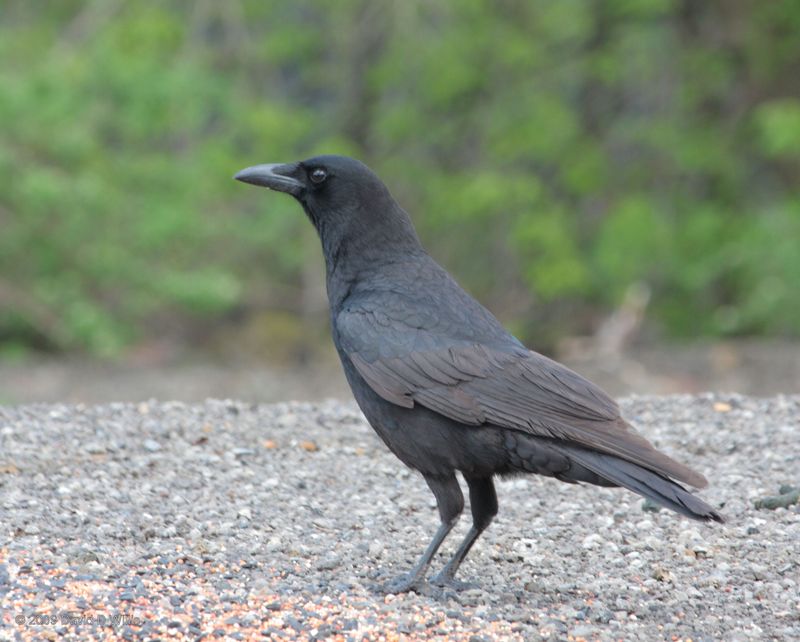
    The first morning I didn't retrieve the basket for several minutes. I came out to find that a crow had seized an egg, and was attacking it  with powerful blows of its large black beak. I rescued the egg. The crow had barely started, cracking the shell, exposing the yolk, but eating only a teaspoon's worth.

    The second morning I lurked. I had angled the shutter slats so I could see without being seen. At the knock, I rushed to peer. Already a crow was striding up the path with long confident steps of its shiny black legs.

    I think not. I opened the door and the crow wheeled and fled. I enjoyed that. I refrained from shouting a lecture after the crow about how it should be foraging on wild foods. Or asking how it would like it if someone ate its egg.

    Once I stayed at a place in Mendocino County, in much wilder country, with fancier breakfasts (frittata! cobbler!), where the competition was so severe that they enclosed the baskets in heavy lidded wooden boxes. That time I didn't have to fight wildlife to eat.

    If I go again, maybe I'll wait and see who tries for the food, and how. I could leave tools around and see if they select any. Perhaps that's entrapment, legally, but since I have no plans to prosecute, evidence doesn't have to be admissible. No plans at present – if they get the cobbler, that could change.
    Corvus_BrachyrhynosI_2234
    DDWESQ
     

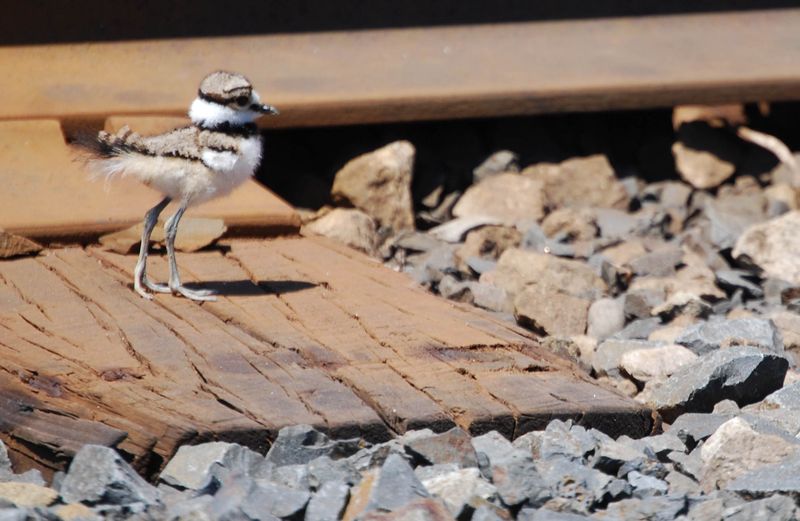
  • Killdeer are marvelous birds. They wear a handsome double necklace for easy identification by eye. They fly around shouting their name – KillDEER! KillDEER! — for easy identification by ear. (It would be impressive if they shouted their Latin name – ChaRAdrius voCIFerus! — but harder to remember.)

    070530_4855_wiki
    ShutterGlow.com

    Famously, when any worrisome creature comes near their nest or chicks, they go into an elaborate act to entice the intruder away. They stumble along the ground dragging a wing, shrieking. “Look over here! I have a broken wing! Look! I can't fly! You'll catch me easily! Oh no! C'mon!” They keep stumbling and wing-dragging, and if you don't rush after them, they will circle to give you another chance. “Dude! I'm crippled here! Fresh meat! C'mon!”

    I fell for this the first time I saw it and ran after the injured bird, planning to rescue it and subject it to life-saving treatment. Somehow, dreadfully hurt as it was, it managed to stay out of my grasp. As soon as I was far from where the killdeer didn't want me to be, it suddenly turned out not to have a broken wing and flew off. I stood astonished. “What? …Oh. Wow, I read about that.”

    It seems as if such splendid birds would be rare, not as easily seen as they are.

    It's a good thing killdeer (it's also okay to say killdeers) have such a clever trick for protecting their nests and chicks, because their nests are on the ground, and their chicks scamper around for a few weeks before they can fly. Lots of killdeer chicks end up in the hands of wildlife rehabilitators.

    Now, one difficult thing wildlife rehabilitators learn is not to form loving relationships with the wildlife. If an animal learns to love and trust people while it's in rehab, it might trust people it meets after it's been released. A bobcat can get killed that way. Or a duck.

    A baby animal may also imprint on human caretakers, and never mate with its own species.

    So wildlife rehabbers go to a lot of trouble to keep their animal charges at an emotional distance, no matter how adorable they find them. This is a hard lesson for animal lovers to learn, and many professionals take pride in having learned it, enforce it rigorously, and are quick to criticize those who don't seem to take it seriously enough.

    That's why I won't tell you who I'm quoting, or what organization they work with. This person understands the need not to cuddle up, and puts that into practice most of the time. But not all species are alike, and killdeer, this person says, killdeer are great! No matter what you do, they'll never love you. “You can kiss them, but they never get tame.”

    Baby_Killdeer
    Salvez Dodd

  • At Point Lobos, wild irises are blooming now. That's about sea level. My migratory habits are such that I'm more used to seeing wild irises flowering at the end of summer, in late July or August, in the Sierra near Tioga Pass. That's about 10,000 feet.

    (The irises at Point Lobos are Iris douglasiana, the Douglas iris, and the  ones in the high Sierra are I. missouriensis, the Western blue flag, so I'm considering irises as a genus.)

     Wouldn't it be dreamy to spend six months climbing California along with iris flowering time?

    Maybe we could raise awareness for something.

    Iris_douglasiana_1
    (Stan Shebs; GNU Free Documentation License.)