• My schedule is so cruel that I was able to go to only a few talks at the Wildlife Society's excellent 2009 conference, and to look at the posters. (This did however protect me from buying a coatimundi skull, a book on gibbons, and a radiocollar big enough for a bear.)

    Even so, it was rewarding because so informative. Let me just say: you will log more fisher visits to your camera traps if you use actual bait. If you are translocating endangered birds from one side of Mauna Kea to the other, they may lose less weight in transit if you provide a wider variety of snacks during travel. Also, if you bought the conventional wisdom about imported red foxes occupying previously foxless lands, you might rethink in light of recent DNA evidence.

    Fisher_(animal)


    Fisher (Martes pennanti)

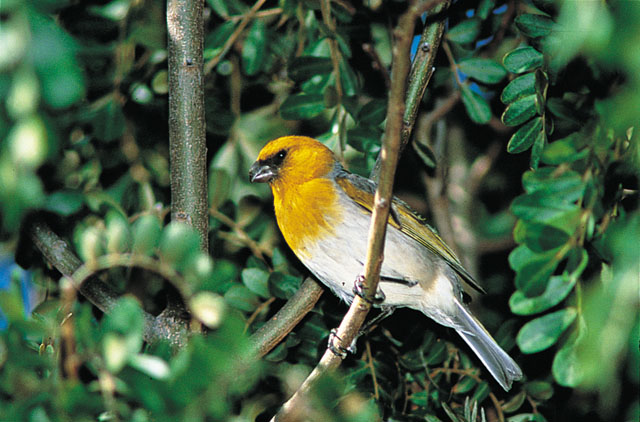
    Palila_on_Mamane_Tree

                            Palila (Loxioides bailleui) J. Jeffrey Photography

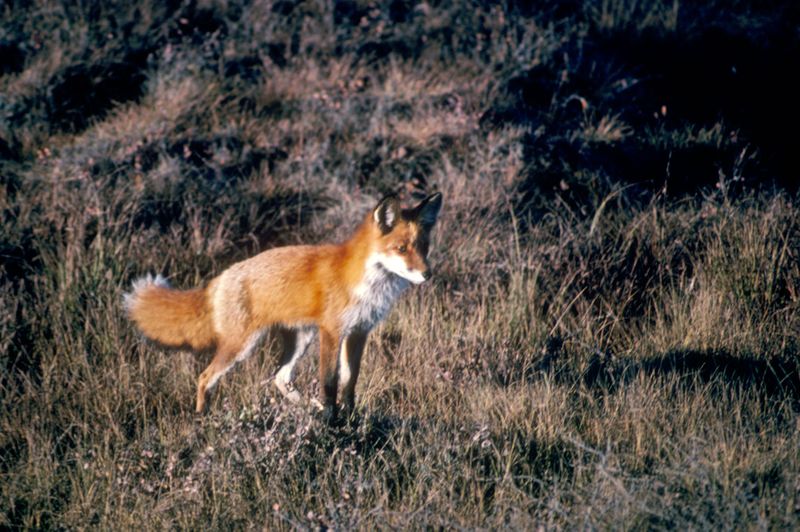
    The traditional view has been that Europeans arrived on the east coast of the US, wailed that there were no red foxes, imported red foxes from Europe (suitable for hunting), and created an exuberant population of alien red foxes who spread out over the land. There were already clades of red foxes in the north and in the Rockies, but the invaders filled in the blanks on the map, occupying previously lightly-foxed lands .

    A newer view hypothesized at the conference (goaded by a plea from an audience member, apparently a random crotchety blogger who had infiltrated the event) suggests that Europeans arrived on the east coast and saw no red foxes, yet foxes were probably there in modest numbers. The European immigrants imported red foxes, which vanished, leaving no traces in the DNA of the modern foxes sampled. But at the same time the Europeans altered the landscape in ways hospitable to the native red foxes (“Say, looks like they cut down that heavy forest and put in… a… can it be? It is, by cracky, it is! A chicken coop!”) Also they killed off fox-hostile species like wolves. It was by these acts, rather than by imports, that they created the exuberant population of red foxes.

    “Tally-ho!” they cried, with completely misplaced self-esteem.

    Vulpes_vulpes_standing

     Jim Thiele

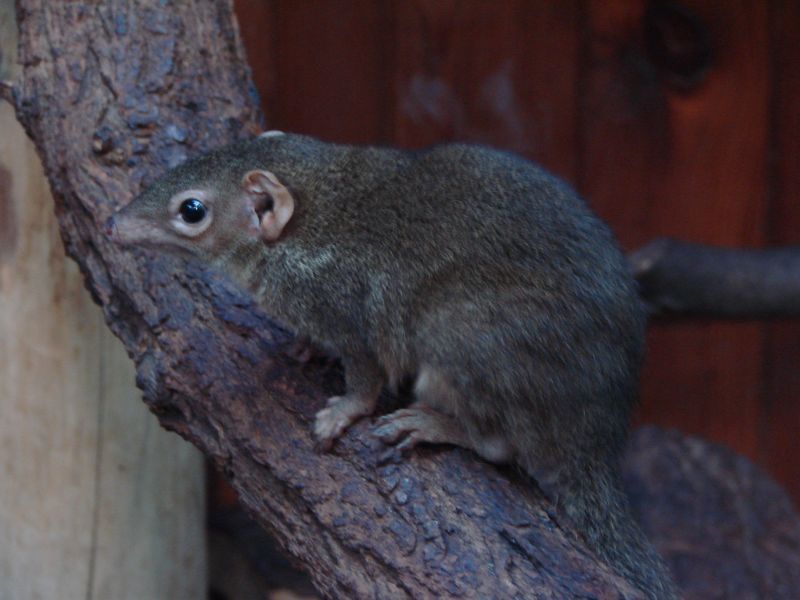
  • There were two northern treeshrews in a glass-fronted cage in the National Museum in Washington, DC. The female scampered along a tangle of branches, up, down, over, under, back, up, over, down, over, down, etc.

    I was busy myself, leaning on a wall and sneering at the sign. It identified the treeshrews and gave the remarkable fact that their milk is 25% fat, whereas human milk is only 4% fat – but it didn't say why. It said nothing of the amazing “absentee maternal system” (see 4/23/08 post). Since the babies only get one fast shot of milk every other day, there has to be enough fat in it to last them. Why didn't the sign mention that?

    The slightly larger male treeshrew suddenly ran to the female. She waited as he sniffed urgently under her tail, and braced herself in place as he initiated a quick, vigorous sex act. Then she raced off to do some more scampering. The male scampered more slowly to another branch, sat, and looked around.

    People passed by, glanced at the two treeshrews in the cage, said “rats” or “squirrels” and passed on. Occasionally someone read the sign and said “northern treeshrews.”

    The male treeshrew focused on the female, scampered to her, sniffed, and initiated another speedy mating. As soon as it was over, the female dashed away again. The male would go sit on a branch until he once again found the female irresistible. In ten minutes, they mated eight times. One passing family glanced at the treeshrews, noticed the activity, and observed with interest until, apparently, it suddenly seemed to the mother that this might be unsuitable for her son (a kid of  8 or 9). “Rafael!* Come!” she said sharply, pushing the stroller to the next cage. (*I have changed this kid's name to protect the family and out of sheer mockery.)

    Another woman with a stroller came by. She spotted the scandal, and sang fondly to her child, “Babies! There's gonna be babies! Baby chipmunks!”

    Finally, the male treeshrew climbed to a high branch and lay down along it in a pose of utter exhaustion. The female, still energetic, did some scampering, glanced at the male, and hurtled up to the branch where he lay. She nestled up behind, put her front paws around him, and lay there holding him. There the two remained, quite still.

    If you walked by and saw them then, it would have been a dull sight.

    Tupaia_belangeri_(Wroclaw_zoo)

    Photo: Guérin Nicolas

  • Afternoon at the zoo. Fake savannah, real giraffes. Fake rocks, real plants. In a real crevice on top of a fake cliff, real weeds growing in real dust.

    Child: “That giraffe is sleeping on the rock!” It did look as if the giraffe had approached the simulated sandstone cliff and laid her head along the top of it for a rest. Actually the giraffe was straining toward the weeds in the crevice, almost out of reach of her outstretched tongue.

    They can't be that delicious. It must be a project.

  • In turbulent times, I may turn to the garden for solace and calm, as on a recent afternoon.

    Fondly I gazed on the gigantic rose bush. (An old Cecile Brunner, with small fragrant flowers: it needs no fertilizer, no insecticides, no watering; it simply goes about growing, blooming, and taking over the block. Occasionally enraged neighbors lop thorny branches that Cece has thrust through or over fences, and toss them back into our yard. Cece shrugs them off and continues struggling for conquest.)

    More glumly, I noted infestation. Here and there were clusters of green aphids at the tips of young branches or on buds. Although the bush thrives, I disapprove of these sapsuckers. I surveyed nearby branches to see how many clusters were there.

    I saw a ladybug and brightened. Ornamental! Widely mentioned in children's verse and literature! Sign of a healthy food web! I dollied in for a better look.

    Shockingly, the ladybug had an aphid in its jaws. Long ago I was instructed that ladybugs eat aphids and that ecologically-minded gardeners encourage—even buy and release—ladybugs to control them, but never had I actually witnessed the predatory act.

    The aphid waved its legs and feelers wildly. The ladybug had it firmly by the abdomen, and the aphid's head and front legs were free. I was glad I could not hear it shriek for help.

    (A larger aphid at the tip of the bud turned. It headed toward where the lesser aphid was being eaten alive. It could not possibly be going to the rescue, though that's what it looked like. Suddenly it halted. Whether there were significant antenna gestures or expressions I'm not nearsighted enough to say, but the large aphid turned on its heels and marched back to the tip of the bud.)

    To see something like this, a thing I have known about for so long, have told others about, have never questioned, but never seen—is startling. There's a little jolt at the moment when life as experienced matches up with as-told-to life. A pleasing jolt.

    It's as if I was walking down Market and the guy at the table pushing Free Personality Tests was Tom Cruise. Superimposed, the image from movies and the face before my eyes would click together. The often-read information that Cruise is a Scientologist would slot into my personally-gleaned knowledge that such personality quizzes are Scientology recruitment bait. That would be cool.

    But since I consider such recruitment a lower activity than sapsucking, or slowly consuming a suffering sapsucker, it's fortunate that I looked in the garden and not downtown for solace and calm.

    Ladybug
    A killer advances…

  • Curiosity killed the cat. I never heard exactly how. But The History of Borough Fen Decoy,  written by Tony Cook & R.E.M. Pilcher, explains how curiosity killed a lot of ducks. With the help of some dogs.

    A decoy, in this sense, is not a fake duck meant to encourage real ducks to fly down and join it. It's a carefully designed pond with curved arms, meant to encourage ducks to hang out there in large numbers – and occasionally get netted at the end of an arm, also in large numbers. In the 1804-5 season they trapped “450 dozen and 8” ducks at Borough Fen Decoy. They sent those 5,408 ducks to be sold in London. You could make a lot of money with a decoy, and there were hundreds in England and Ireland, in suitable areas, such as the Fens.
    Decoyduckseye

                           (After Anne Treadwell-Cook, in Cook & Pilcher.)

    They seem to have been invented in the Netherlands, and brought to the UK by the enterprising Sir W. Wodehouse, who lived in the early 1600s. (Surely a relative of the brilliant P.G. Wodehouse.) “Decoy” is an Anglicisation of “Eend-kooi,” which means “duck-trap.” Knowledgeable types, decoymen, would just call it a coy. Or kooi, if they were knowledgeable Dutch types.

    The arms, or “pipes,” of the decoy are covered with high archways of local reeds, a pleasantly rustic effect. The banks are gently sloped, perfect for resting on while you doze or rearrange your plumage, if you are a duck. At the end it is a giant tunnel-net. There are reed screens along one side of the pipe, so you can sneak along without being seen by the ducks, if you are a decoyman. The screens have gaps between them, and are fanned, so “The final effect is that of a Venetian blind laid half-open on its side”.
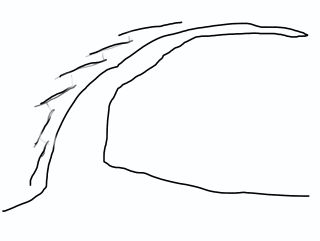
    Decoypipe

                    (Ineptly, after Anne Treadwell-Cook, in Cook & Pilcher.)

    The pond is shallow, so as not to encourage diving ducks, which can get away too easily and which are considered inferior eating. It is kept clear of reeds, to discourage ducks from skulking there, and its banks are steep and uncomfortable.

    The simplest way to catch ducks in a decoy is to notice that there are a bunch of ducks relaxing in one of the pipes, probably because you laid out a nice duck-food buffet there the night before. (You selected the pipe in accordance with the wind direction, since ducks don't like to take off with the wind behind them.) You suddenly pop out from behind a screen near the mouth of the pipe, the horrified ducks flee down the pipe, you bound along and pop out at the next gap, chasing them, and they fly into the net or “bunch huddled together,” at the end. A twist of the net traps them all. Because of the Venetian blind effect, ducks in the pipe could see you, but ducks in the pond could not.

    But often the ducks don't go far enough into the pipes to make this a fruitful endeavor, even though food is there. This is where the dog comes in. Instead of scaring ducks further down the pipe with the sight of your ghastly self, you entice them into the pipe by giving them glimpses of the dog. You send the dog over a low “dog-jump” between screens, and it runs down the bank of the pipe and disappears over the jump behind the next screen.

    Wak? What was that? The ducks swim a little further down the pipe, stretching their necks to see what's going on. Wak?

    Meanwhile you sneak behind the screen and signal the dog to go over the next jump at the right moment. The ducks pursue. Wak! Wak! Did you see that?

    Wak! I saw it again! Hurry! Wak wak wak!

    When the ducks are far enough down the pipe, you show your scary self, the ducks panic and rush down the pipe, and are netted as before.

    Why do the ducks follow the dog? One explanation is that they are curious. They want to know more. Animals generally want to know what is going on in their world. Plains Indians used to lure pronghorns within arrowshot by lying in tall grass and waving a stick with a cloth on it. The antelope just had to find out what that thing was.

    And if there's a predator sneaking around it would be nice to know what kind of predator it is and where and what it's doing. Traditionally decoy dogs are supposed to look like foxes – small, ginger-coated, bushy-tailed dogs. (Tradition has been flouted by the use of yellow labs, white terriers, and “a large Newfoundland-type” dog. Also a cat. Sir Ralph Payne-Gallwey experimented with a rabbit, a ferret, and a monkey he borrowed from an organ-grinder. But you should use a small ginger dog and you should name it Piper.)

    More than curiosity, the ducks may feel the urge to mob the probable predator. When animals mob a predator, they surround it in a crowd, make as much noise as they can, and maybe peck at it. This might seem risky, but it's common. If you hear a tremendous shrieking of birds in the forest, you may find a cloud of small birds mobbing a hawk or an owl. The hawk or owl is made miserable and knows it has no chance of taking any prey creature by surprise, so it flies off, pursued by shrieks. At my sister's farm the guinea fowl have been heard and seen mobbing a bobcat and a coyote, each of which ran away. So the ducks in the decoy may be planning to catch up with that dog or fox or whatever it is (that can't be a monkey? – wak!) and hassle it. They would wave pitchforks if they could.

    Most decoys are long gone. Borough Fen hasn't been used to catch ducks for sale since the early 1950s. The Wildfowl Trust, under famous ornithologist Sir Peter Scott, turned it into a bird-ringing station. Ducks are caught, banded, and released, in the pursuit of knowledge about their migrations. Cook and Pilcher proudly write “There is one recovery of a Teal from Turkey.”

    The decoy doesn't work as well when ornithologists run it. The trouble is that banded ducks remember. They hang about near the mouth of the pipe making worried noises. They won't go in, and other ducks, “sensing the disquiet of their experienced fellows,” also become unenthusiastic. Major criminals have a rule: Leave No Witnesses. This is probably why we don't know what happened to that cat.
    Twoducks

  • Long long ago, people brought dingoes to Fraser Island, a big sand island off eastern Australia. The dingoes went wild and self-supporting. Nowadays, dingoes in most of Australia have had the chance to breed with more recently imported dogs. (Don't get silly. I do not speak of the dingopoo, the cockadingo, the dreaded dingohuahua.) The Fraser dingoes are among the purest old dingo stock, so dogs are forbidden on the island.

    Dingo-Fraser_Island

    Photograph by ogwen, Creative Commons Attribution 2.0.

    Fraser Island is in Queensland. It has miles of shimmering beaches, a hundred lakes of pure fresh water, and lofty, ferny rainforest, so a third of a million people drop by each year.

    Tourists, and some of the few hundred people who live on Fraser, sometimes feed the dingoes. Authorities advise against feeding dingoes. Residents say they can handle themselves around dingoes. But in 2001 dingoes killed a 9-year-old whose family was camping there. To protect both humans and dingoes, the government shot some of the bolder dingoes and built sturdy dingo fences, surrounding areas where people live. Many island residents protested, finding the fences destructive, annoying, or pointless.

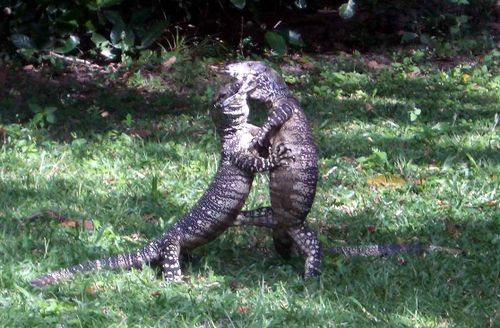
    Several nonfatal dingo attacks have occurred just outside the fences. In April, Mike West, of Birds Queensland, said that goannas – huge, speedy, monitor lizards, (Varanus) – are multiplying dangerously because of the dingo policy.

    “We're up to our armpits in bloody great big goannas at Kingfisher Bay and Eurong because there's no dingoes inside the fences to chase them off,” West told the Courier-Mail. (I found this story on the comprehensive website herper.com.)

    Goannas can get nearly seven feet long. They can harm people, although they are unlikely to try to eat us because they cannot swallow us whole. Their bite may be a little bit venomous. Apparently, many people who are not bothering goannas get injured while watching someone else bother a goanna. The goanna lashes its huge tail, and bystanders suffer. That's not all. “Alarmed goannas can mistake standing humans for trees and attempt to climb off the ground to safety, which is understandably painful, as well as distressing for both man and beast,” according to Wikipedia.

    Lace_Monitors
    John E. Hill, GNU Free Documentation License 1.2

    West told of being personally menaced by goannas. “I got chased by one and had to drop an Esky on it. It's the same problem as dingoes. They are not frightened of people.” (An Esky is a cooler, sometimes even an Eskimo brand cooler.)

    In lots of places goannas have learned that people have food, either food which they will give a hungry lizard, or which a hungry lizard can just help itself to. Authorities advise against feeding goannas.

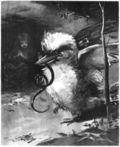
    Kookaburra_ill-02
    Frank P. Mahoney

    West says the dingo fencing has been a failure, and should be scrapped. Inevitably, he says, a tourist will get bitten by a goanna. “Are they going to start shooting goannas next? They've already shot kookaburras for pecking people and they are trying to trap a crocodile off Fraser. Where's it all going to end?”

    Authorities say they are reviewing dingo management strategy. In the meantime, they advise against feeding wildlife. Recently, a litter of dingo puppies was discovered underneath the Queensland Parks and Wildlife Service headquarters. They are insanely cute. Malcontents suggest the rangers are… feeding them.

    I long to travel to Fraser Island to view wildlife. I will join the other tourists balanced on top of the sturdy government fence, with dingoes eyeing us from one side and goannas from the other, and all of us keeping an eye cocked to the sky for flocks of killer kookaburras. Look for me there! I'll be wearing body armor and a NO DINGOHUAHUAS T-shirt, and I'll be carrying a picnic basket.

  • Five representatives were ranting and frothing in Congress the other day about how the economic recovery bill included a $30 million earmark for San Francisco mice. Representative Jackie Speier, who represents San Francisco and San Mateo counties, was surprised. She looked into it and wrote something on her findings for the San Francisco Chronicle, a newspaper to which I subscribe.

    The short version: it's a deliberate lie. Slightly longer version: a staffer said someone said $30 million might go to wetlands recovery, and since the wetlands in San Francisco Bay contain an endangered species of mouse, and “mouse” sounds sillier than the names of other endangered wildlife that live there, not to mention the other reasons to restore wetlands, let's just say the mouse gets $30 million. Let's blow up a picture of a mouse into a poster and wave it around at a press conference. Forget the economy, let's grandstand!

    (Speier points out that while the mouse in question, the salt marsh harvest mouse, does live in wetlands around San Francisco Bay, none are actually found in San Francisco itself. Odd—it's as if we had mislaid all the city's wetlands over the years. Somehow.)

    Do I have to tell you what political party people pretending to be outraged about alleged money for mice belong to?

    I don't feel like it. I bet you know. If you don't, you can read the newspaper story, but I bet you just know. Hint: they're not big on protecting endangered animals and they don't like San Francisco. (Although the fact that these legislators chose to pretend wetlands restoration was just a mouse boondoggle suggests that they're afraid many members of their party might actually like the idea of wetlands restoration. They want to be the party of hunters, for example, yet ducks like wetlands too.)

    Suppose there was actually going to be $30 million just for the salt marsh harvest mouse. Suppose a powerful harvest-mouse identity-politics organization wrested control of the money away from the bureaucrats. What would these sly little featherbedders spend it on? I only hope they wouldn't get flimflammed into spending it all on lobbyists.

    Would they buy a controlling interest in Habitrail? Would they order trucks full of sunflower seeds and instruct them to back up to the Bay and dump their cargoes? I doubt they have the imagination. I fear they'd go the obvious route. For their own selfish, greedy, short-sighted, personal gratification, they'd spend it on wetlands restoration.

  • The Brooks Park community garden sits on a knobby, windy hilltop with near views of San Francisco and Daly City, and a far view of the Pacific. With a plastic watering can left for the use of gardeners, I was dreamily watering lettuce seedlings in our nano-ranch when a high-energy individual sped up and gave me a once-over. It was an hummingbird, in immature plumage, and it seemed intent, hovering a few feet away. What was on its mind?

    Before the current drought, when we still ran a sprinkler in the back yard, I have seen hummingbirds  catching drops, so perhaps this bird was interested in the water. I held the can out at arm's length and tilted it so water ran from the nozzle in arcs of spray. The hummingbird zipped over, buzzing in and out of the spray. Once it opened its beak wide, maybe fifty degrees, but at other moments I guessed it was just getting water with its tongue.

    We were both happy until a slightly larger hummingbird zoomed up and drove the drinking bird away. They raced off at high speed. I turned back to the lettuces until the second hummingbird, returning, also positioned itself in front of me, moving up and down. It had just a beginning fleck of an iridescent gorget at its throat, so it suppose it was a young male. Again the bird seemed to make eye contact.

    Another thirsty customer? I tilted the watering can. A pause as the hummingbird hung in the air. It beelined up to the nozzle and inserted its beak into one of the holes. That seems like drinking from a hose with your mouth right on it, and you get a big drink pretty quickly that way, so I wasn't surprised when the hummingbird left a few moments later.

    I'm still pondering what was on those young hummingbirds' minds. I wasn't wearing anything floral-patterned or brightly colored, so I wasn't attracting them that way. Most likely they were thirsty, saw that water was around, and came to study the situation. Perhaps as they surveyed me they wondered, “Where does the water come out of this thing?” I would bet other gardeners have been approached – maybe there's a custom of watering the hummers that I'm just finding out about.

    It had the casual feel of a routine transaction. Like bumming a cigarette. “Lady. Yeah, you. Human lady. Got a drop to spare?”

  • On Monterey Bay, a tour boat laden with wildlife photographers spotted a sea otter. The boat headed over. When they got close enough to point their cameras at the otter, the otter pointed a camera at them. Enrique Aguirre got the shot that shows the otter with the videocamera.

    As Stephanie Pappas wrote in the Santa Cruz Sentinel, “Judging by the rust and seaweed adorning the camera, the otter probably wasn't getting much good footage.”

    People seem to think that the otter was just curious about this peculiar object, presumably dropped overboard by some unlucky butterfingers. And was imitating the way people hold such objects. Cute! What a crazy picture.

    When we see animals do things that are typically human, we tend to think they're copying us. Trying to be like us. I think it's more reasonable to guess that they're trying to figure out what motivates us – “what do humans get out of this?” Naturally, I like to toy with explanations which give the animals more credit—and which may be more sinister. There's a paranoiac and all too plausible possibility: They're making fun of us.

    When an otter points a videocamera at people pointing videocameras, maybe what's going on is something like, “Okay, I'm the big guy in the blue windbreaker [stupid deep voice]: 'Wow, what do you think they weigh?' Now I'm the woman with the knitted hat [stupid squeaky voice]: 'My sister will be so jealous she didn't come when she sees these pictures!' Now I'm the kid [panicky voice]: 'I'M GONNA BE SICK!'” The otters all laugh so hard they submerge.

    (Maybe that's not paranoid enough. Maybe they're spying on us. Maybe the seaweed on the camera is crafty camouflage. Maybe they're sneering at us right now in the Situation Room. Naah.)

    There could be other instances where we suppose animals are copying us uncritically, but where we might be wrong. I'm thinking of an account I read of a satin bowerbird in a national park north of Brisbane (related by Greg Czechura of the Queensland Museum).

    The males in this artistically gifted species not only build bowers, they sing, dance, and steal beautiful objects to decorate their bowers. (This keeps them too busy for tasks like building or defending nests or feeding fledglings. Freebird!) Their songs include mimicry of other birds' songs.

    This particular bowerbird was putting on a show at his bower, observed by a fascinated crowd of birdwatchers. In the midst of his imitations of various local birds, a cell phone rang. All the birders started grabbing for their pockets and bags, looking for their phones.

    Of course, the ringtone came from the bowerbird. Czechura thought it was pretty funny, and maybe the bird did too.

    They say that imitation is the sincerest form of flattery. Uh huh. But what about ridicule?

  • Paleontologists found the bones of a huge snake in a coal mine in Colombia. A huge, huge snake, more than a ton of boa. It lived back in the Palaeocene.

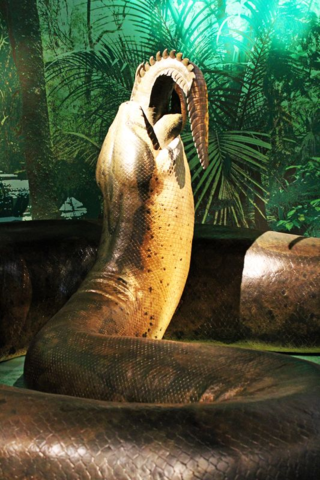
    They found it last year, but it hit the news more recently with the publication of an article in Nature. They're calling the enormous snake Titanoboa cerrejonensis. (Great name. If I had a snake I would definitely name it Titanoboa.)

    The New York Times reported that it was 42 feet long. The Los Angeles Times said 43 feet long. In other words, the scientists estimated it at 13 meters long. The newspapers knew that most of us aren't too good with metric measurements, so they did the conversion for us. Thirteen meters is 42.65 feet, so at the LA Times they rounded up and at the NY Times they rounded down. I choose to pretend that tells us something about the difference between the LA Times and NY Times. Both papers gave the number in feet, probably on the theory that 42 or 43 feet long sounds bigger than 14 yards long.

    The longest snake we have around these days is the occasional python that gets to 33 feet. Explorers in South America who said there were 100-footers out there, well, they may have been misled by skins that had been stretched. Or maybe they were just woofing.

    Titanoboa probably weighed 1,135 kilograms, 2,500 pounds to those of us still in thrall to imperial measurements. (It's as if the French Revolution never happened! It's as if the American Revolution never happened! It's as if NASA never lost a space orbiter due to Lockheed Martin's fondness for the pound-second!)

    Photo: Ryan Quick. Creative Commons Attribution 2.0 Generic license. https://www.flickr.com/photos/order_in_chaos/7684792104/

    Smithsonian Institution exhibit depicting Titanoboa eating a crocodile.

    Sadly, there is much we do not know about Titanoboa. What color was it? What were its habits? We know where it slept – wherever it wanted to – but what were its eggs like? Did it coil around them protectively, keeping a vigilant eye out for time travelers who might try to steal an egg?

    Titanoboa ate crocodiles and giant turtles, they say. (The same fossil beds are full of croc and turtle bones.) But I am sure Titanoboa would also eat us, if it met us.

    Snakes are cold-blooded. This is thought to put metabolic limits on how big they can get at a given temperature. Which suggests that Titanoboa could only have existed if the climate then averaged 30—34° C. The point of the Nature article is not 'Holy tenure committee, that snake was huge!' but 'For a snake to have been that huge, the tropics must have been even hotter.'

    Titanoboa therefore supports those who say that in the Palaeocene the neotropics were hotter and there was more CO₂ in the air.

    So, for those who argue that climate change just means planting different crops in different latitudes, and goodbye to chilly winters, what about creating ideal conditions for giant snakes? Look over your shoulder, you fool – was that the sound of slithering?