In Fort Jackson, Louisiana, the little bird having the oil washed off was struggling passionately. I couldn't figure out what it was. Not a
 gull, not a tern – could it be a rail? No, surely not. I was told it was a black skimmer.
But I've seen skimmers (Rynchops niger). They don't look like that. I was told it was a young one. Skimmers don't hatch with those bizarre long bills with the lower mandible longer than the upper. (How would that fit in an egg?)
Then I remembered other bird species in which little snub bills of
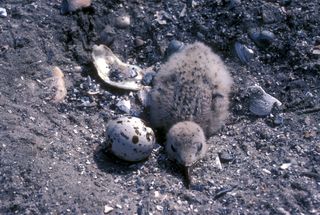 the chicks give hardly any clue to the crazy big bills they'll have as adults.
Chicks' bills have to fit in the egg, and they have to be used to get out of the egg. After they hatch, there's time for bills to elongate or bulk up, to curve down or up, or to acquire interesting attachments if necessary.
The clean little skimmer was moved to the rinse table, where it continued to resist. You rinse my wing, I'll stamp on your hand! Stop or I'll I bite you! There, I bit you! I might do it again! Finally they wrapped the defiant creature in a towel and hustled it off to the drying room. (Many birds never seem to think of stabbing people in the eye with their bills. Instead they bite. You don't want to be bitten by an eagle or a swan, but when an egret bites you, it's okay. They don't have the leverage.)
I went looking for video of birds in which the chicks have to go through some serious bill growth to catch up to their parents. I found these spoonbills (Platalea
ajaja) at Animal Kingdom in Orlando.
Also this shoebill (Balaeniceps
rex) family at the Lowry Park Zoo in Tampa. The
chick doesn't have the big bill yet, but it has the slow serious
demeanor you need to carry off a giant smiley proboscis.
There's an unsettling video from a camera inside a trumpeter hornbill (Bycanistes bucinator) nest. Trumpeter hornbills, like some other hornbills, have a system in which the married female seals herself into a nest cavity with an adobe of her own devising (mud, fruit pulp, and bird dung, if you want the recipe). She leaves just a small opening through which food can be passed.
Once immured, she lays eggs. In fact, as long as she's in there, and not flying around, she molts her feathers. Her devoted spouse may help her build the wall. The advantage is thought to be that this keeps their eggs, and then chicks, safe from predators, and perhaps from other hornbills.
Time passes, the eggs hatch into revolting little hornbills, and the male feeds them all. When it gets simply too crowded in the nest cavity, the mother breaks herself out.
In this video of captive breeding, the hornbill cam shows not-dressed-for-company mother and repulsive not-dressed-at-all child in the nest. At the far end is the opening, and there is much excitement and whining as the devoted father starts passing snacks in to his wife, who feeds them to their horrifying child. Who looks even more disgusting with banana oozing out of the corner of its bill – but notice what a normal-looking bill it is.
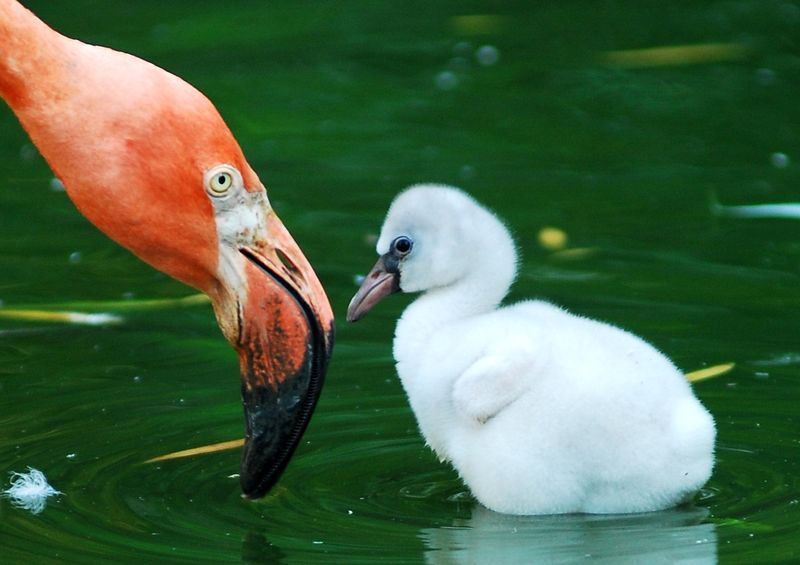
Some birds go with a cuter look.

Even if you think they're adorable, though, it's more polite not to stare and talk about whether chicks have their parent's nose. You might embarrass them. They might get all shy.
Oh, here's what a grown-up skimmer's bill is good for. For this to work out, the water should be clean.


 Site Title
Leave a reply to Susan McCarthy Cancel reply