The story about the smelly babies isn't true. Birds don't reject their nestlings if people have handled them and gotten human scent all over them. Most birds can't smell much, anyway. (But don't say this around a vulture. Or a kiwi. Or a fulmar.)
I don't know how this story got started, but I certainly heard it when I was a kid. Somehow it had an appalling plausibility – our very touch turns innocent babies to pariahs.
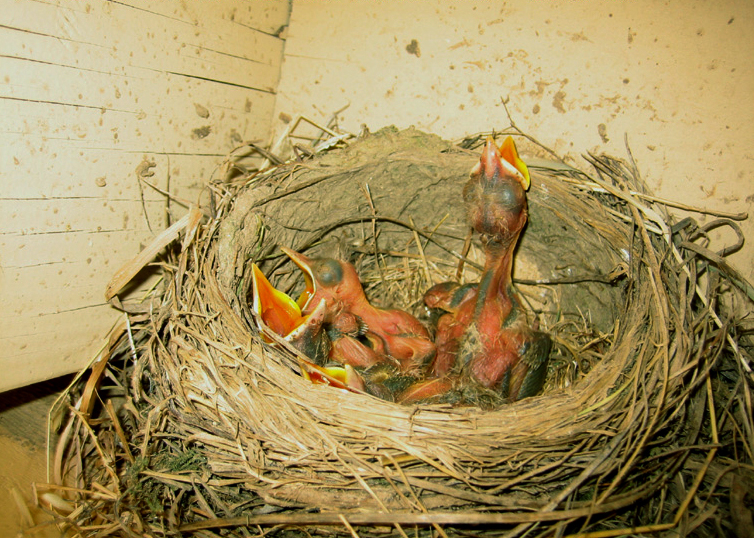
(Not the actual baby robins I'm talking about.)
Fortunately for three small birds I met recently, it's nonsense. These robin nestlings fell out of their nest on a windy morning. They hit the sidewalk uninjured, and a kind passer-by picked them up (intelligently noting the address) and took them to the nearest animal shelter. The shelter had the expertise, and the feeding formula, to take care of the young birds. But they knew the best upbringing for robins comes from robins. They had eight million things to do besides feeding screaming baby robins every 20 minutes. A wildlife rescue organization would try to get the robins back to their parents.
I'd been told that the best thing to do for uninjured baby birds is to get them back up in their nest, or near their nest, or at least up in the branches of their tree out of cat-reach, and let their parents take care of them. I believed it. But I had never done it. (What if it were as false as the human-stink story?)
We inspected the site. With the address, we could identify the home tree, but it was leafy and no nest could be seen. Besides, that nest was clearly a slipshod dealio that baby robins fell out of in a high wind, a flimsy sieve, a deathtrap. We'd have to rig up a substitute. The worrying part was that there didn't seem to be any robins there. The parents were supposed to be hanging 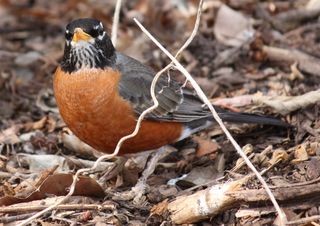 around calling for their children. But no. No one was around but blackbirds. By this time the babies had been away most of the day. Had the parents given up?
We thought we'd try anyway, so we went to get the chicks. They were past the naked blob stage, into the partially-feathered lump stage. They were starting to have robin faces. Maybe a week from fledging, they were correctly-behaved bird children. They alternated between gaping and screeching, twittering softly, and squatting silent and motionless like little lumps of ugly. The shelter gave them a feeding, which would last them in 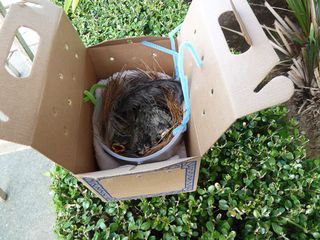 case their parents never returned and we had to bring them back.
Back at the tree, we scanned for robins. Nothing. Using a ladder, we wired a plastic tub into the branches, making sure it wouldn't tip in the wind like certain shoddy constructions. We'd made drainage holes so liquid couldn't collect in it. That was the nest. The shelter staff had made a nice lining with pine needles and bits of 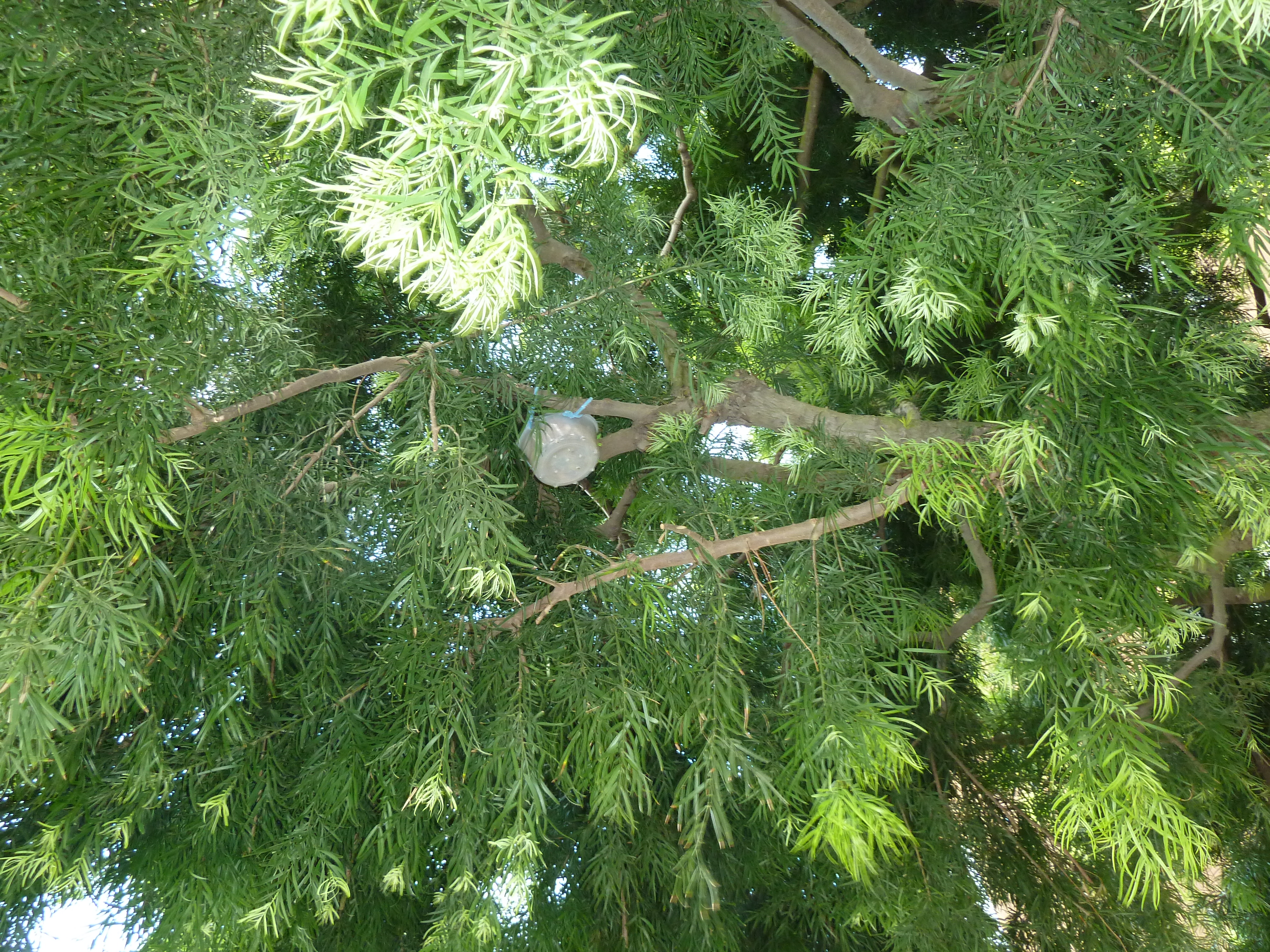 a feather duster. While the wiring took place, the nestlings hunkered low inside, pretending not to exist.
We took the ladder away and looked around. No robins. We peered around with binoculars. Nothing but blackbirds. We crossed the street and sat on a bench and looked. No robins. So we got in the car and drove away, but then came back, and parked across the street, taking advantage of robins' inability to read license plates or tell a Delorean from a Hupmobile. We stayed in the car. Blackbirds flew over the tree, perched on a wire above the tree, and squeaked at other 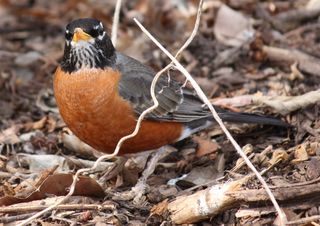 blackbirds, but there were no robins.
Until suddenly there was a silent robin in the tree next to the nest tree. With something in its bill. It silently dived into the nest tree. It had been 16 minutes since we walked away from the tree.
 To be sure it was true, we walked down the other side of the street, crossed, and casually walked under the tree, glancing up for just a second as we did. An adult robin was perched – silently – two feet from the nest tub.
It makes sense that parent birds would approach the nest without making giveaway sounds, but I'm still amazed that they so quickly detected that their kids were back (in a nearby location, with a new pre-fab house) and resumed food deliveries.
Mostly, I'm delighted that they overlooked the fact that the kids must have reeked of rescuer stink.
Follow-up:
I went by the nest tree about two weeks after we put it up. Since the young robins had been about a week from fledging, I wasn't worried about disturbing things. Everything was the same. The nest was still up there, if you looked, and no robins were in sight. I was relieved that the plastic nest hadn't been distubed.
Going back later to remove the nest, I saw that the tree had been heavily pruned since the last visit. It was no longer a thickly-leaved place where you could hide a nest. Whoever had pruned the tree had carefully left the plastic nest. It was a touching gesture, although the nest was now too exposed to be safe. I was very glad that the pruning had happened after the babies had fledged. I took the nest down and examined the lining. It appeared well used.
Babies are often brought into rescue centers when trees being pruned or felled turn out to have nests — baby birds, squirrel pups, dragonets.* It's better to prune out of nesting season.
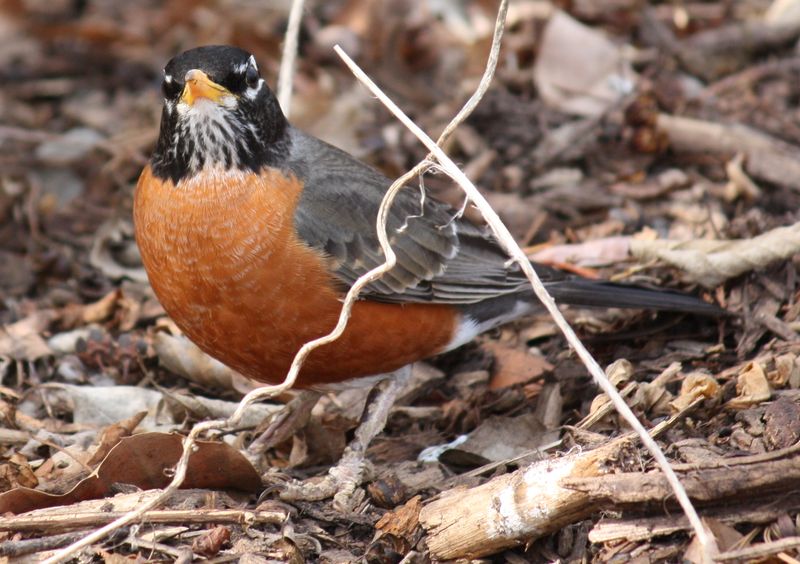
Early this morning, I went back to look for young robins, and saw this squirt in the little park across the street. The spots on  the feathers show that this bird fledged this year and hasn't gone through the preformative molt yet — that it's just a child.
It could be some other robins' child, but it's the right age and the right place to be one of the three rescued fledglings.
(*Okay, probably not dragonets.)


 Site Title
Leave a reply to Susan McCarthy Cancel reply