If Doctor Doolittle offered online courses in animal languages, I would take them all. He'd have many customers. Actually, all of us already know a few phrases  in animal languages. We don't need Intro Dog to know that this dog is saying “I might bite! Check out these teeth!”
We don't need Conversational Cat to guess that this cat is saying “I'm prepared to fight, and while you're thinking about that, notice that I AM HUGE.” 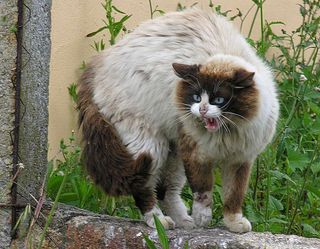
We understand these bits of body language and so do they. Neither dog nor cat would think the other wanted to be friends. But these are generic phrases meant to be understood by many species. Normally canids and felids don't hang out together, and they don't  understand most of each others' body language. What about households where dogs and cats live together?
You've probably seen households where cat and dogs get along. Sometimes they agree to ignore each other, sometimes they're civil, and sometimes they're friends.
So we knew this, but now there's a study that backs us up. (Look it up in Applied Animal Behaviour Science if you don't believe me.) Zoologists at Tel Aviv University observed households 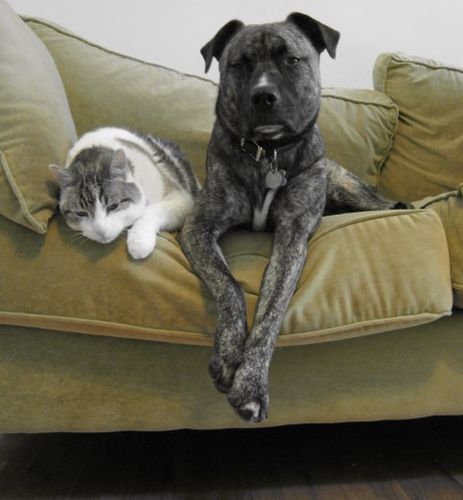 with both dogs and cats. They scored the relationships between the pets as amicable (friendly), indifferent, or aggressive. Many pets had friendly relationships, in which they played together, licked each other, or slept snuggled up. Neta-li Feuerstein and Joseph Terkel found that pets are most likely to become friends if they are under six months old when they start hanging out with the other species. It also helps if the cat was there first.
These dogs and cats learn to understand each other's body language better. Dogs and cats have some signals in common – like growling – but some signals have the opposite meaning in the two species. For example, bilingual pets know that rapidly moving your tail from side to side means different things coming from a dog or from a cat. When a dog wags its tail, that's a happy friendly signal. When a cat lashes its tail, the mood is very different, and the bilingual dog steps back.
The study found that cats were about as good at understanding Dog as dogs were at understanding Cat. When a dog rolls on its back, that's a submissive or deferential gesture, often a prelude to a friendly encounter. Cats living with dogs can learn to comprehend this, even though they use the same movement aggressively. When a cat rolls on its back, that's often preparation for grabbing you with their front legs and clawing the living daylights out of you with their hind feet. Which can also be a game.
The dogs and cats learn to understand each other's body language, not to use it. A dog may understand that the cat lashing its tail is saying "I'm outraged! I may pounce!" but the dog won't begin wagging its tail to show outrage.
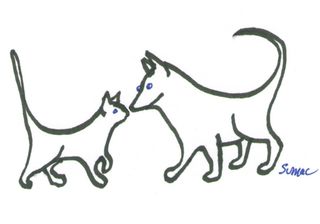
The closest thing to an exception to this rule that Feuerstein and Terkel found is nose-to-nose sniffing. This is a friendly greeting gesture among cats. Dogs usually prefer a mutual start-at-the-tail sniffing procedure. But dogs who are friends with cats learn to do the nose-to-nose with them.
However, I would draw Feuerstein and Terkel's attention to the cat in this video, who appears to switch between languages, using Dog to threaten what I assume is a trespassing dog outside, then switching to Cat to greet a household member.
Feuerstein and Terkel are the kind of researchers who worry about animals in shelters not finding homes. They conclude their scientific report by assuring us that it's possible to adopt both a dog and a cat. They think dog-cat friendships are particularly rewarding for the cats. Dogs are better able to relate to humans in their household as their pack, whereas a cat “seems to gain something from the presence of an additional animal,” showing more friendly behaviors. They particularly urge people with one cat to get it a dog friend to improve the cat's quality of life. If you do, I urge you to send me pictures.


 Site Title
Leave a reply to Susan McCarthy Cancel reply