Long ago, starter birdwatchers in an Arizona desert spotted a huge black bird. Perched commandingly, unimpressed by puny humans.
Could it be – a raven? In the desert? Weren't they forest wilderness birds? A handy bird guide said the raven was “Common only in the Far North and in the West, especially near heavy timber.” No timber in the Chihuahuan Desert.
A more authoritative bird book said, “Resident of wild regions.” This desert was fairly wild…. A western bird guide  said, “Habitat: Mts., deserts, canyons, coastal cliffs, boreal forests.” Okay! Deserts! Common Raven, Corvus corax! World's largest songbird! Yay!
The resident of wild regions has become increasingly common in urban regions. In the last 25 years, there's been a population explosion of ravens and crows in cities. If you can find a wild region, you can still find ravens residing there. But other ravens have decided to join us for dinner.
My San Francisco neighborhood is full of them. They swoop 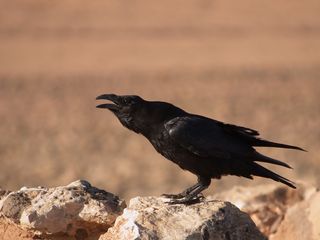 over City College, bursting out of the pines. They holler from roofs. They strut in the gutter, disemboweling that helpless urban victim, the fast-food bag. Ravens evolved as carrion eaters. In a forest, ravens track wolves. If wolves kill a moose, ravens wade in, grabbing bites. In my neighborhood, ravens keep an eye on people, especially the ones walking away from Beep's Burgers.
What changed to make residents of wild regions feel so comfortable in the city? Lots of garbage around, but that's not new. Probably what changed is raven culture. Young ravens stay with their parents for months learning what's safe, what's dangerous, and where food is.
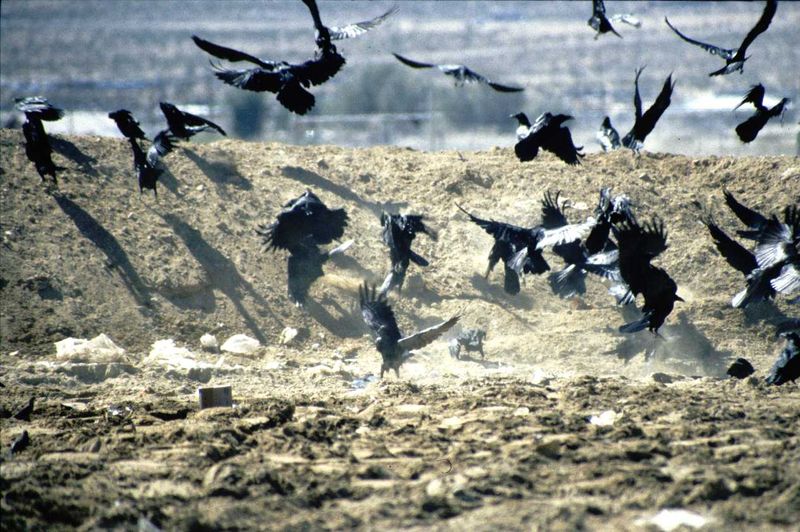
There are several hundred ravens in San Francisco, and not nearly enough places for all those giant birds to nest. So most birds around town are non-breeders, hip young consumers with spare time and a burning curiosity about the world and which parts of it can be eaten. They know the best dumpsters, the most spacious dumps, and the most generous handouts. 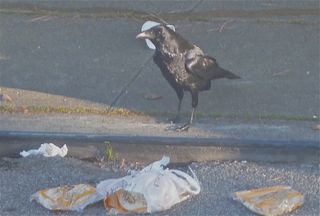
Many people feed ravens. People love the contact with wild animals, and ravens are cool. They are huge and hilarious as they high-step toward your offerings. Sometimes feeding them lets you observe their intelligence. I met a woman who feeds ravens at Fort Funston. When she arrives, ravens gather even before she parks – they recognize her car. She scatters peanuts across the iceplant, and dozens of ravens search for them.
Another time I met a man sitting on a bench overlooking the sea. A raven stood on the seat next to him. Another perched on the back of the bench. He doled out snacks. He said these ravens knew him well, and described their family structure. (He said they were father and child.)
 I love ravens. Feeding animals is fun, and it feels like a win-win. Certainly the ravens would vote for it. But I don't feed them, and I think no one should.
The problem is that ravens are clever wild animals who find their food in many ways. One way is robbing nests of other birds and eating eggs and nestlings. The ravens of wild regions have always done this, and city ravens have kept up the skill. Stuffed with garbage and treats, urban ravens have plenty of leisure time to look for nests of little birds. It would be nice if well-fed ravens didn't feel like robbing nests, but no. They still enjoy the hunt.
Nature's way, even if it's kind of depressing, right? Are we supposed to try to convert wild animals into kind vegetarians?
No. It's nature's way for ravens to rob nests, but it's not nature's way for there to be so many ravens. We've created surplus predators, whose numbers aren't controlled by prey supply. Nature's way includes predators starving if they destroy prey populations. City ravens don't starve, because they have garbage and handouts. Many ravens means many sharp black eyes looking for nests. A project to bring California Quail back to Fort Funston failed, apparently because ravens got all the quail chicks. But they didn't starve, because there are still plenty of french fries scampering around the parking lots.
 Rangers in state and national parks are trying to discourage visitors from feeding ravens. (I know, they discourage you from feeding everything, and why can't a chickadee have a damn crumb, but they're particularly worried about ravens.) In 1989, in Big Basin State Park, near Santa Cruz, biologists discovered only the second known Marbled Murrelet nest. Thrilled, they began observing the nest, which produced one silent thoughtful chick. Just as the chick was almost old enough to fly, ravens killed and ate it. They'd been observing too. The Big Basin ranger campaign to make sure no garbage gets left around for ravens to eat is called “crumb management.”
To speak of surplus predators is also to speak of outdoor cats. Same deal – we support them in high numbers, which have nothing to do with prey supply. They behave naturally, but not in a natural context. Both cats and ravens are clever, fascinating creatures. Interacting with them puts us in touch with a fragment of wildness. We shouldn't do that in a way that lays waste other fragments of wildness.
I dislike telling people they shouldn't do fun things (feeding animals) and I dislike depriving animals of fun things (free food). So here's a loophole for city dwellers. Next time you have a moose carcass, I think it's okay to leave it out for the ravens.


 Site Title
Leave a reply to SA Jacobs Cancel reply